The way things were
Would for past habits
Dev tells the street's history while they strip forty years of wallpaper off the café wall.
- Level
- B2
- Length
- 60 min
- Exercises
- 5
One-off payment · print for your own groups · 14 days to change your mind · faktura VAT
About this lesson
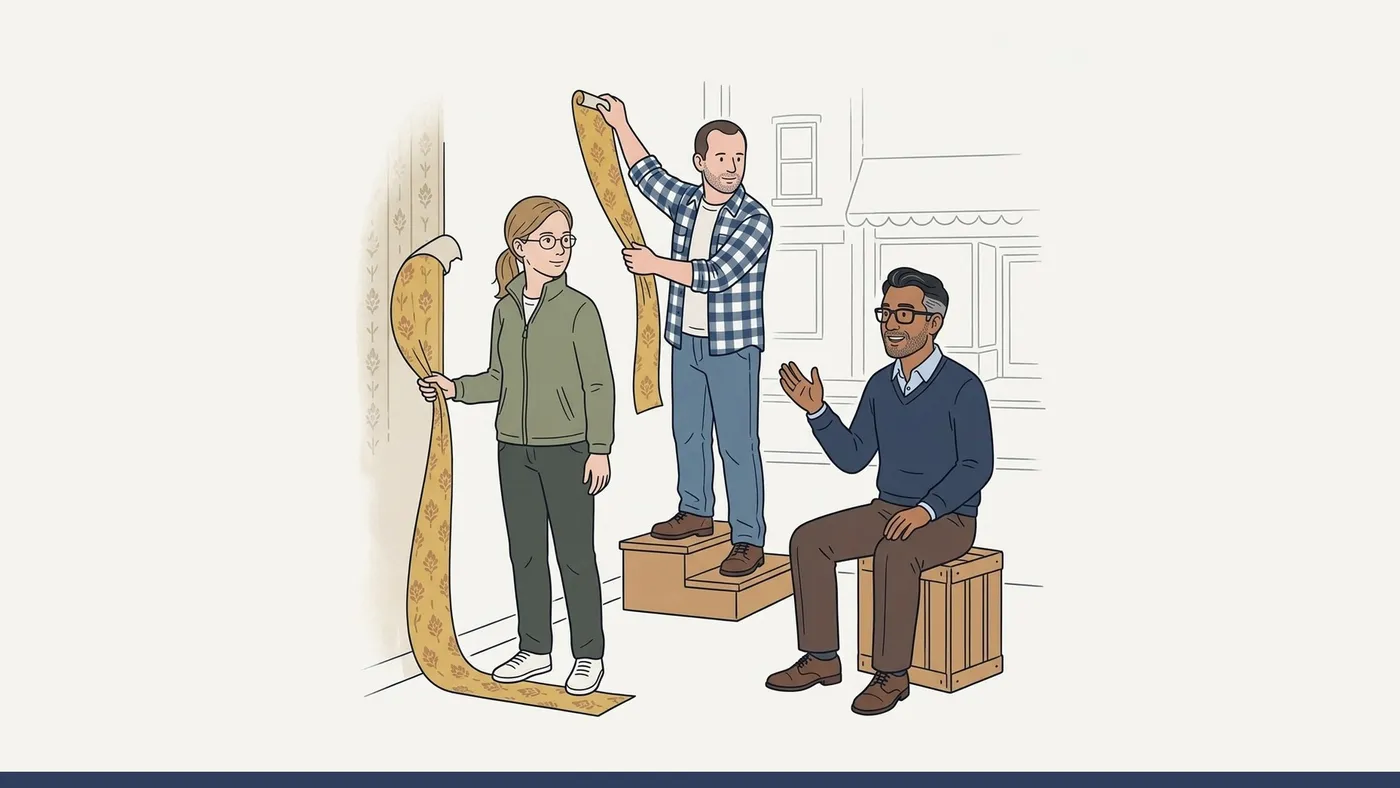
A 60-minute B2 lesson for groups of Polish adults who can tell a story in the past but squeeze every old habit into the past simple. The café on Mill Street is being done up. Tomek is stripping forty years of wallpaper off the back wall, three old shop signs appear underneath, and Dev, the one who remembers the street, starts talking.
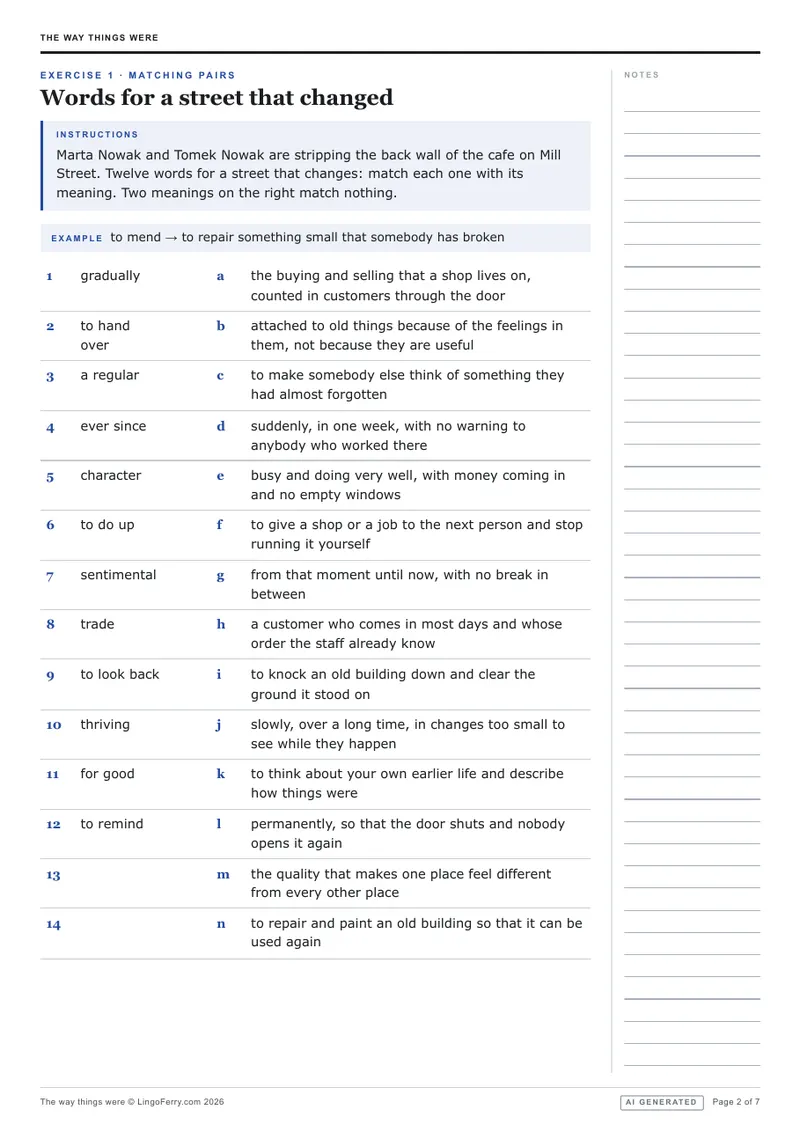
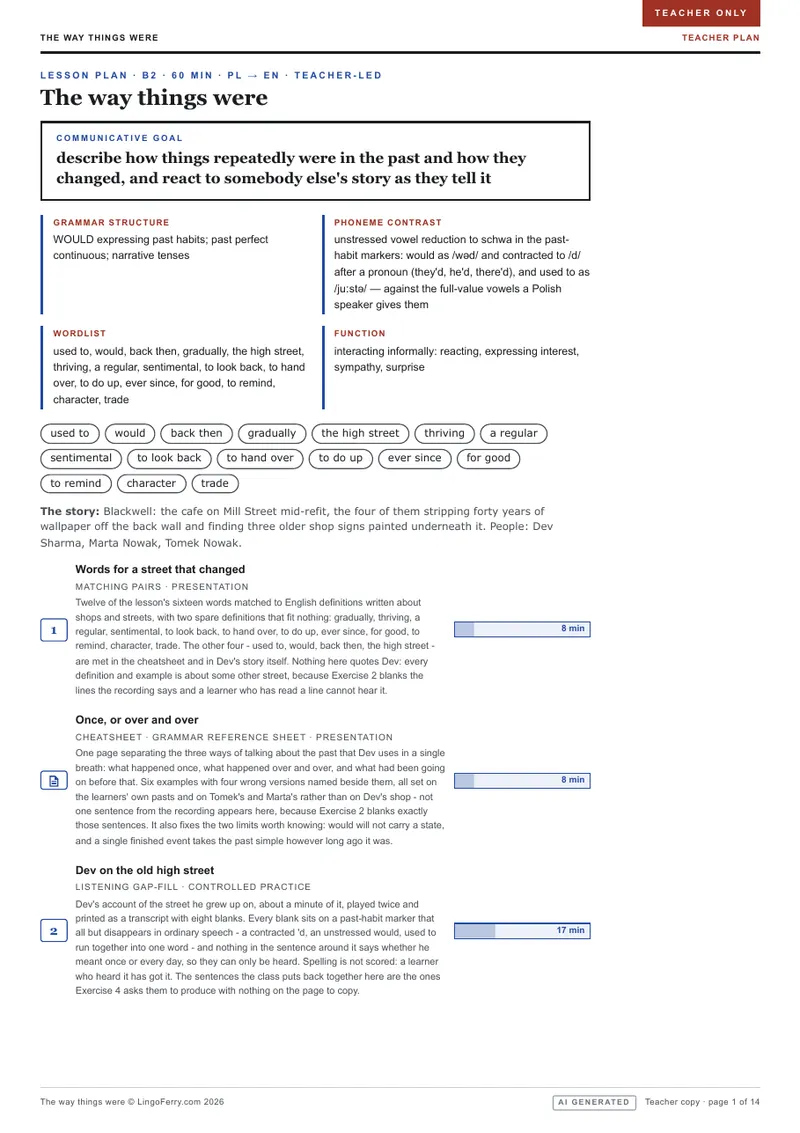
Students match twelve words for a street that changed, then get a reference sheet on used to, would, the past simple and had been + -ing. They hear Dev's story, just over a minute long, twice, and fill eight gaps. In threes they talk about the street they grew up on, reacting with phrases from a box. A sixteen-square team game closes the lesson. Afterwards they can describe how a place used to be, and react properly to somebody else's story.
Describe how things repeatedly were in the past, and react to someone else's story.
- Grammar
- WOULD expressing past habits; past perfect continuous; narrative tenses.
- Function
- Interacting informally — reacting, expressing interest, sympathy, surprise.
- Words (16)
- used towouldback thengraduallyhigh streetthrivingregularsentimentallook backhand overdo upever sincefor goodremindcharactertrade
Why Polish speakers get this wrong
Polish gives every vowel its full value and has no schwa, so a Polish speaker says would as /wʊd/, to as /tuː/ and and as /and/. In English these small words shrink: would becomes /wəd/, or just /d/ after a pronoun (they'd, there'd), and used to runs together as /juːstə/. A learner who does not expect the reduction hears a plain past simple instead.
The listening is built on this. Dev speaks at normal pace, and all eight gaps sit on reduced forms such as You'd, They'd and He'd been. The teacher notes say to play it twice at full speed and never read the lines aloud, since slowing down removes what is being tested. In the discussion and the game, the weak forms are drilled after each turn, not during it.
Free guide: Schwa and weak forms: why “for”, “to” and “and” shouldn't sound the way they're spelt →
60 min · 5 exercises
- 1Words for a street that changedMatching · Presentation8 min
- 2Once, or over and overGrammar cheatsheet · Presentation8 min
- 3Dev on the old high streetListening gap fill · Controlled practice17 min
- 4The street you grew up onDiscussion questions · Freer practice12 min
- 5Sixteen squaresGame · Review11 min
The street you grew up on
One minute in silence first: pick two questions and decide what you will say. Then talk in threes. While somebody else is talking you may not simply nod: react with a phrase from the box, then ask them one question back.
- Think of the street you grew up on. What was on it back then, and which shop or cafe were you a regular in?
- What would happen on an ordinary Saturday where you grew up? Give the others three things that happened every week, not once.
- Which place in your town has closed for good since you were at school, and which one has stood in the same street ever since you were small?
- When older people you know look back on your town, what do they say was better back then? Are they right, or only sentimental?
As printed on the student sheet. Answers are in the teacher pack.
- 1Student pack7 pages · A4 PDF
- 2Teacher pack: plan, notes, answer key14 pages · A4 PDF
- 3Recording (MP3), 1:08Also plays from the QR code on the sheet
Questions about this lesson
Is there a recording, and how is it played?
Yes. Dev's story is one MP3 of just over a minute, used in the listening gap-fill. It comes in your download, and a QR code on the student sheet plays it in class. The teacher notes say to play it twice, at full speed, with thirty seconds between the plays.
How are the 60 minutes split?
Eight minutes for the vocabulary match, eight for the reference sheet, seventeen for the listening, twelve for the discussion and eleven for the game. The listening gets the most time because the whole lesson is built around that one minute of Dev talking.
What group size does it suit?
The discussion runs in threes and the game is played by two teams of four. The game also has a version for one player: students write a sentence for each square and check them against the teacher's list of model sentences, so it can go home as well.