By next spring
Future perfect
The flat above the café: one lease, four names, split four ways. Where will everyone be by spring?
- Level
- B2
- Length
- 50 min
- Exercises
- 4
One-off payment · print for your own groups · 14 days to change your mind · faktura VAT
About this lesson
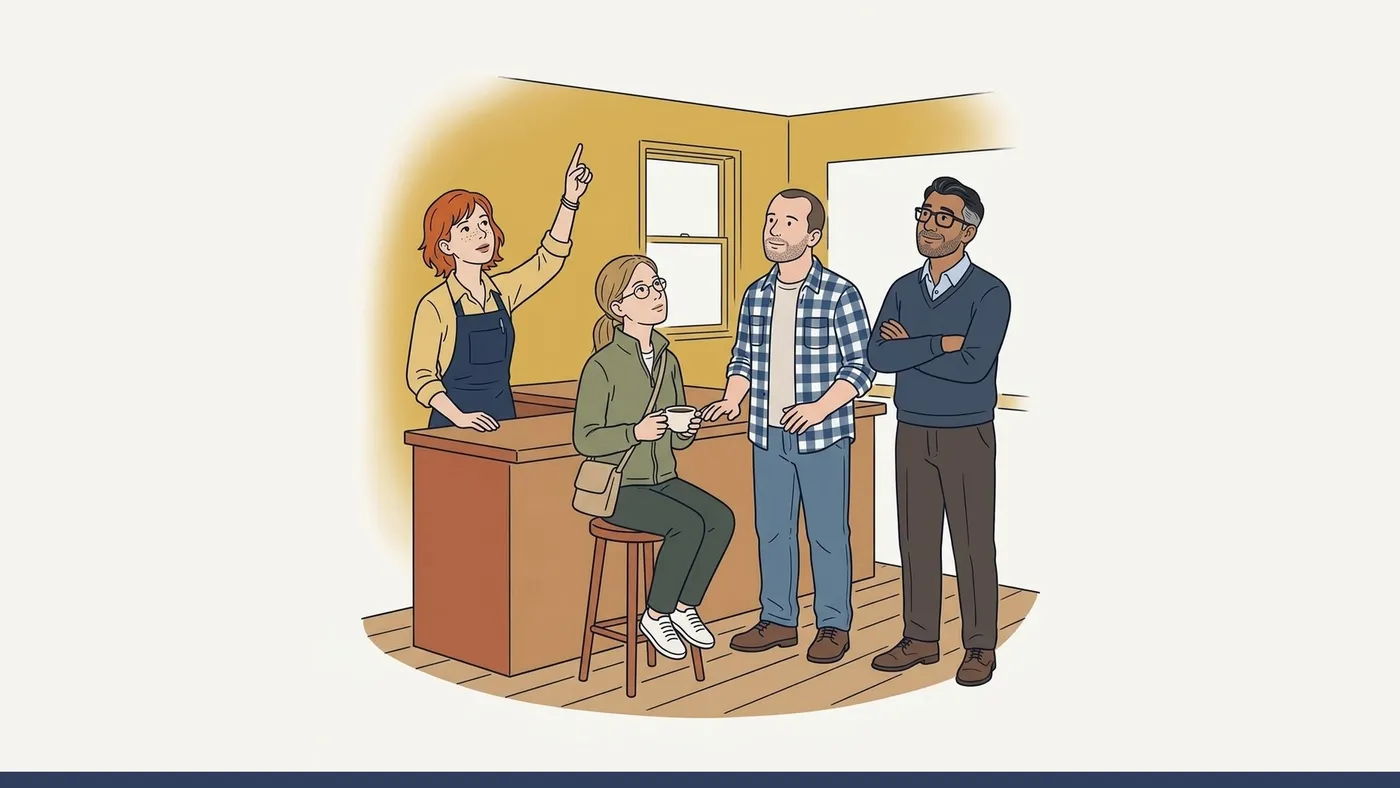
A 50-minute B2 lesson on the future perfect simple and continuous, for Polish adults who can talk about plans but not about what will be done by a set date. At the café counter Isla floats an idea: the empty flat upstairs, one lease, four names, the rent split four ways. Nobody has answered yet.
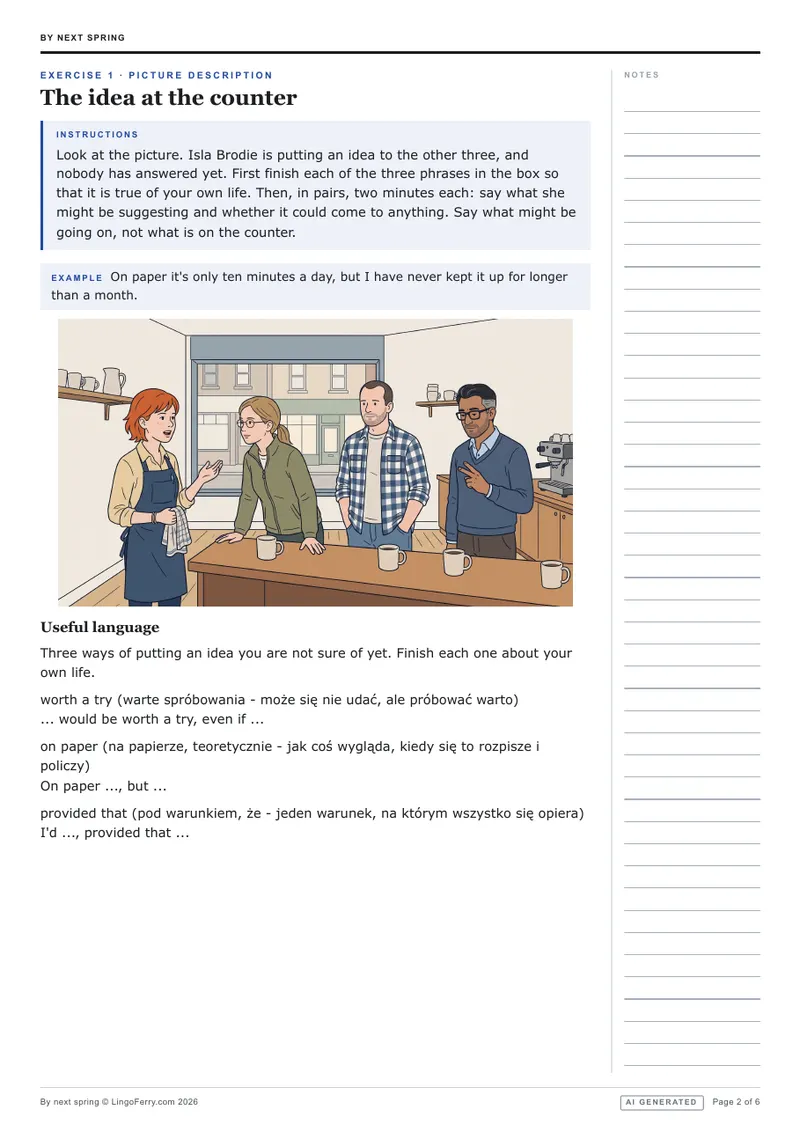
Students guess from the picture what she is proposing and whether it could work, using worth a try, on paper and provided that. The reference sheet sets out the one choice: a total or a finished job takes will have done, a stretch of time still running takes will have been doing. The gap-fill, the rest of that afternoon's conversation, asks for that choice eleven times. Then the class stands up for a find-someone-who about next spring. Afterwards students can say where they will be by a given point.
Describe what will have happened by a point in the future, and set out hopes and plans.
- Grammar
- Future perfect; future perfect continuous.
- Function
- Describing hopes and plans; expressing abstract ideas.
- Words (16)
- by thenthis time next yearsave updepositviewingjointsplitwork out atcommitlong-termin the meantimeget round tofall throughworth a tryon paperprovided that
Why Polish speakers get this wrong
Some nouns count differently in Polish. Pieniądze and meble are plural, rady has a plural, and learners carry that across: a furniture, many advices, how many money. In English money, furniture, advice and information are uncountable and take a singular verb: some furniture, a lot of advice, the money is. A lesson about splitting costs is full of exactly these nouns.
The reference sheet lists How many money will we need? among its mistakes, with much, not much and the advice is beside it. The teacher notes say to expect how many money and a few furniture once anybody adds up costs aloud, to correct the quantifier rather than the noun, and to board the phrase instead of stopping the speaker.
Free guide: How much money, not how many: countability traps that outlast A2 →
50 min · 4 exercises
- 1The idea at the counterPicture description · Lead-in8 min
- 2By then, and how long by thenGrammar cheatsheet · Presentation8 min
- 3Four waysGap fill · Controlled practice14 min
- 4Where will you be by next spring?Find someone who · Review15 min
Where will you be by next spring?
Stand up and turn each line into a question about next spring, or about this time next year where the line says so. One name a line, each name once. After a yes, ask the bracketed question and write the answer in.
- will have been living at the same address for over five years by then (How long?)
- will have got round to some decorating (How much?)
- will have been learning English for over ten years by this time next year (How long?)
- will have finished a long-term project by then (How long will you have been working on it?)
- will have committed to something that lasts over a year by then (How long is it for?)
As printed on the student sheet. Answers are in the teacher pack.
- 1Student pack6 pages · A4 PDF
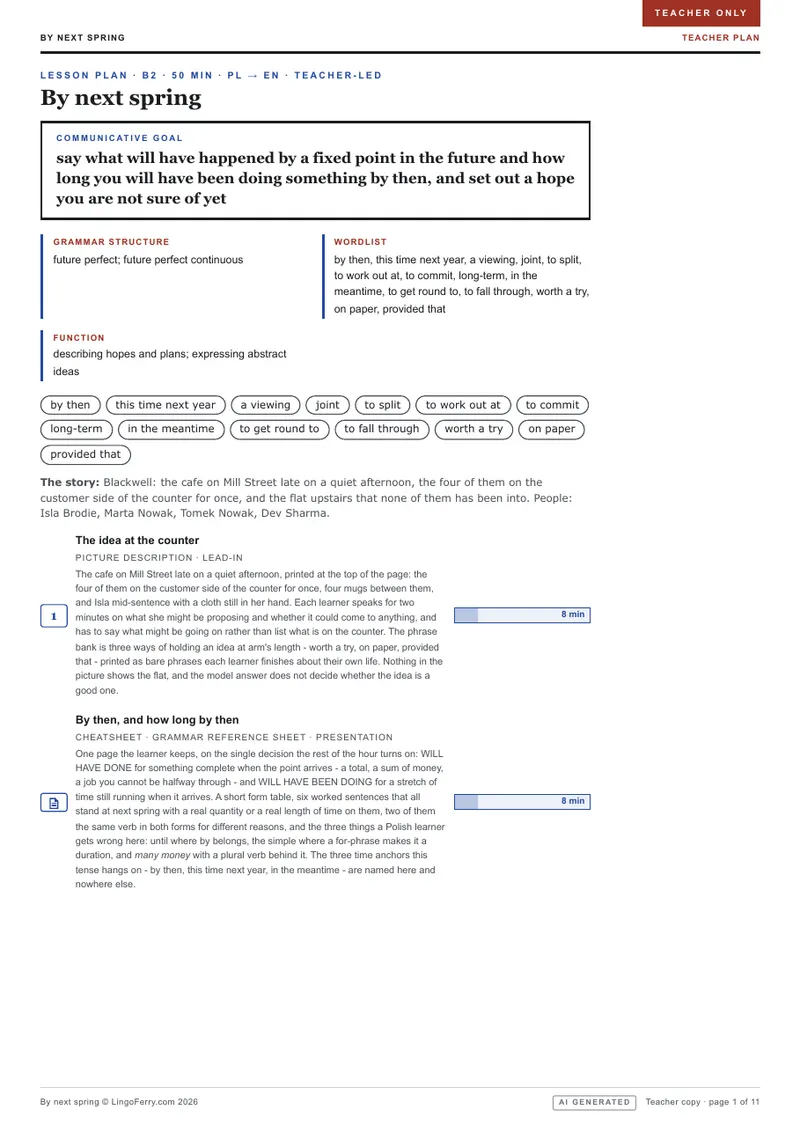
- 2Teacher pack: plan, notes, answer key11 pages · A4 PDF
Questions about this lesson
The last exercise has students moving around. What if the room is small?
The teacher notes cover it: keep half the class seated as the ones being asked, move the other half, and swap after four minutes. Plan two minutes for the example, nine for moving and four for reporting back, and cut the moving rather than the report if time runs short.
Is the vocabulary pre-taught?
Partly. Worth a try, on paper and provided that come with the picture task, glossed in Polish on the sheet. For the gap-fill, the teacher notes list six words to put on the board as they come up: split, work out at, commit, fall through, get round to and viewing.
How long is it, and is there audio?
50 minutes over four exercises: 8 for the picture, 8 for the reference sheet, 14 for the gap-fill and 15 for the find-someone-who. There is no recording. You need one student pack (6 pages) per learner and the teacher pack (11 pages).