All mistakes / B2
How much money, not how many: countability traps that outlast A2
At B2 the mistake is rarely “two informations” any more. It hides in the word in front, “how many money”, “a few furniture”, “many advices”, and in the verb after, “the news are”. The fix is to choose the quantifier and the verb from the English noun, not the Polish one.
What it sounds like
What the mistake looks like
By B2 most learners know that information and advice are uncountable. They would never write “informations” in a test. And yet “How many money will it cost?”, “We need a few furniture”, “Thanks for all the advices” and “The news are bad” keep turning up in speech, especially when you are thinking about something else: numbers, plans, an argument.
The noun itself is often right. What goes wrong is the words around it: the quantifier in front (many, few, a couple of) and the verb after it (are, were, have). The Polish plural still shapes the sentence even when the English noun has been learned properly.
At this level there is a second layer: nouns that are countable in one meaning and uncountable in another, and nouns that exist only in the plural. The rules here are less tidy, and the basic A2 list doesn't cover them. For the basics, a, an, the and the core uncountables, see the A2.1 guide.
Why Polish causes it
Polish counts differently. „Pieniądze”, „meble”, „wiadomości” and „włosy” are plural nouns, and „rady” and „informacje” are ordinary plurals of countable nouns. The verb is plural too: „Pieniądze są na stole”, „Wiadomości są dobre”. In English: “The money is on the table”, “The news is good”.
The deeper cause is in the quantifiers. Polish uses the same words with both kinds of noun: „dużo pieniędzy” and „dużo mebli”, „mało czasu” and „mało ludzi”, „ile pieniędzy?” and „ile osób?”. English splits them: much and little with uncountables, many and few with plurals, and „ile” is either how much or how many. Polish rarely forces that choice, so in English it feels arbitrary, and in fast speech the wrong word slips out.
The rule: start from the English noun
Start from the English noun and let it choose the rest.
Uncountables at B2 include money, furniture, advice, information, news, luggage, equipment, research, evidence, progress, accommodation (in British English), traffic, weather, work (as effort or employment) and travel. They take a singular verb (“The news is good”, “Your advice was right”), much, little, a lot of, some and any (“How much money?”, “not much furniture”), and no a or an: “What awful weather”, not “an awful weather”; “a job”, not “a work”; “a trip” or “a journey”, not “a travel”. To count them, use a countable word: a piece of advice, an item of news, two pieces of furniture, or simply a sofa and two chairs.
Some nouns are both, with a change of meaning: a paper (a newspaper or an article) and paper; a glass and glass; an experience (an event) and experience (what you know from doing); a room and room (space: “Is there room for me?”); a coffee (a cup) and coffee; a hair (one) and hair (all of it); a business (a company) and business (trade).
Rent belongs here too. For one flat you pay the rent, singular: “We split the rent four ways”, “We pay £560 a month in rent”. But when there are several flats, or you mean rents in general, rent is an ordinary countable noun: “Rents in Blackwell have gone up”, “the rents on these three flats”. So “the rents” is correct English; it just means more than one rent.
Plural-only nouns take a plural verb and can't be counted with a number: clothes, trousers, jeans, scissors, glasses (spectacles), belongings, savings, earnings, outskirts, premises. “My savings are in a joint account.” To count them, use pair or item: two pairs of jeans, three items of clothing.
How to practise and fix it
Learn uncountables with their quantifier attached: much money, a lot of advice, not much furniture, a piece of news. Say them as blocks until “how many money” starts to sound wrong.
When you add up costs or make plans aloud, pause on „ile”: is the English noun countable? Money: how much. Pounds: how many. “How much money?” and “How many pounds?” ask the same thing with different words.
Check the verb after news, advice, information, money and furniture. It is always singular: is, was, has.
For teachers: at B2, correct the quantifier rather than the noun. A learner who says “how many money” knows money is uncountable; what's missing is much in front of it. Board the correct phrase rather than stopping the speaker, and expect the same slip more than once: it is Polish grammar, not carelessness.
How lesson B2.5 works on it
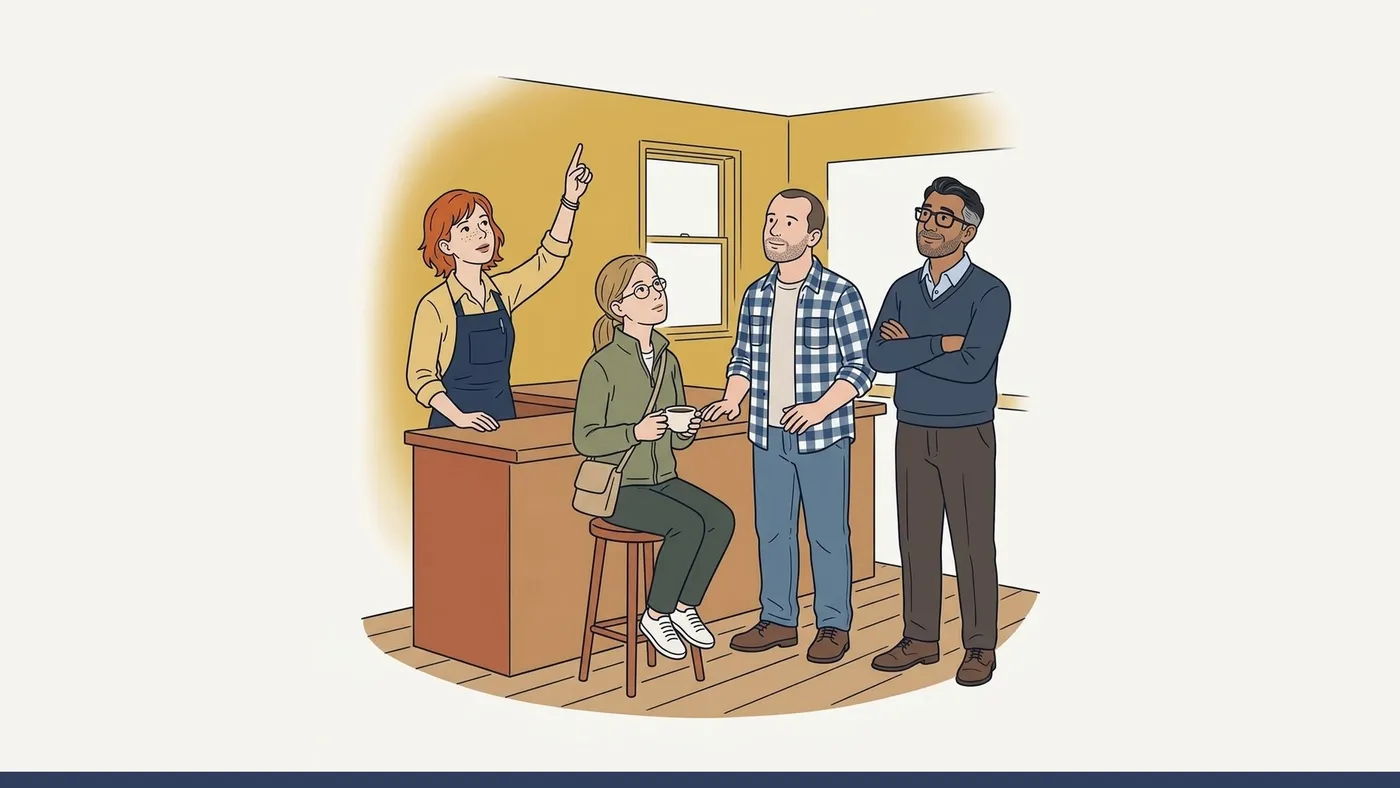
Lesson B2.5, “By next spring”, takes 50 minutes. At the café counter Isla floats an idea: the empty flat upstairs, one lease, four names, the rent split four ways. The grammar is the future perfect, simple and continuous, and the talk is full of money, rent and savings, so countability comes up whether you plan for it or not.
The lesson deals with it only lightly. The reference sheet's list of mistakes includes “How many money will we need?”, with the rule beside it: money, rent, furniture, advice and information are singular in English, so how much money, not much furniture, and the advice is, never are. For one shared flat that holds for rent: it is the rent. The teacher notes expect how many money and a few furniture as soon as anybody adds up costs aloud, and say to correct the quantifier rather than the noun, write the phrase on the board and not stop the speaker. In the closing find-someone-who they also flag how many work and how much work are.
There is no exercise devoted to countability. The gap-fill and the find-someone-who practise the future perfect, though the amounts in the gap-fill (five hundred and sixty a month, fifteen thousand pounds in rent) and the “How much?” column in the find-someone-who give the right forms a natural place.
Check yourself
Choose the correct word in brackets.
- How ___ money do we need for the deposit? (much / many)
Answer
much
- The news ___ better than we expected. (is / are)
Answer
is
- She gave me a really useful piece of ___. (advice / advices)
Answer
advice
- My jeans ___ still in the wash. (is / are)
Answer
are
- There isn't enough ___ for a sofa in the smallest bedroom. (room / rooms)
Answer
room
- We've made a lot of ___ with the flat this week. (progress / progresses)
Answer
progress
- Rents in the town centre ___ gone up again. (has / have)
Answer
have
- I've bought ___ furniture for my room. (a few / some)
Answer
some
By next spring
Future perfect