The first weekend
Past simple · going to
The market, the wrong bus, and, because it was the wrong bus, the best view in Blackwell.
- Level
- A1
- Length
- 60 min
- Exercises
- 5
One-off payment · print for your own groups · 14 days to change your mind · faktura VAT
About this lesson
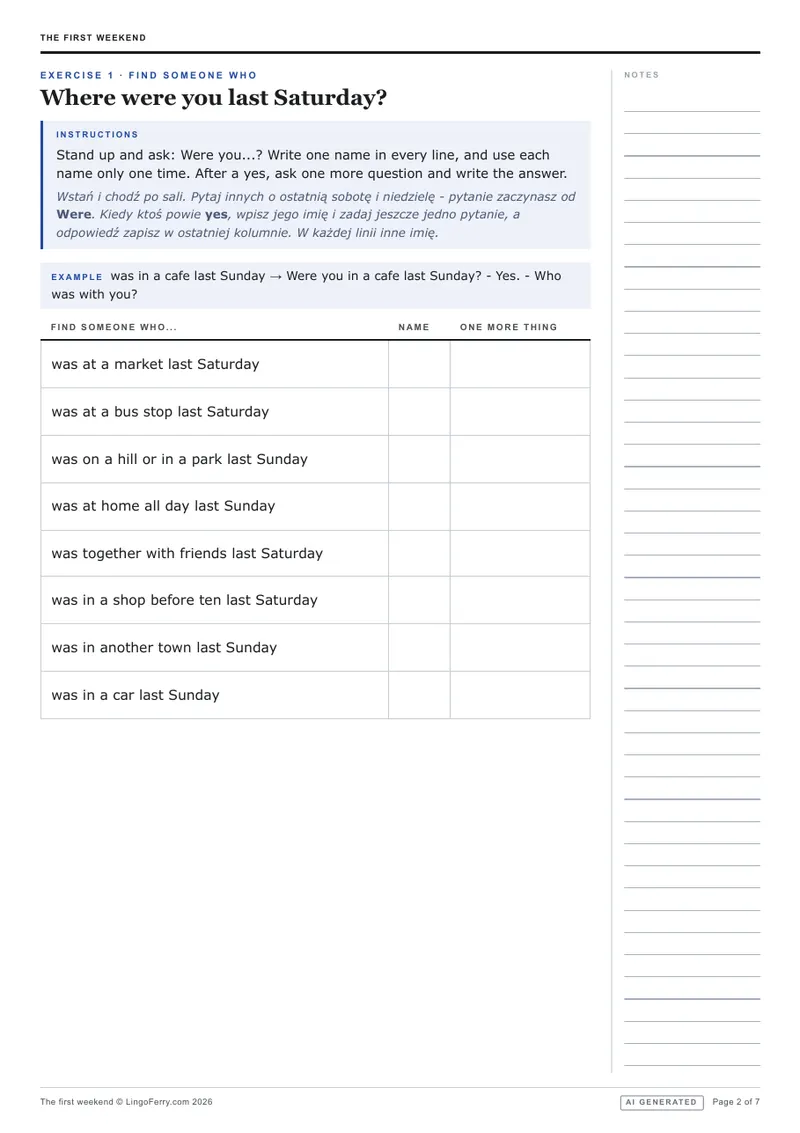
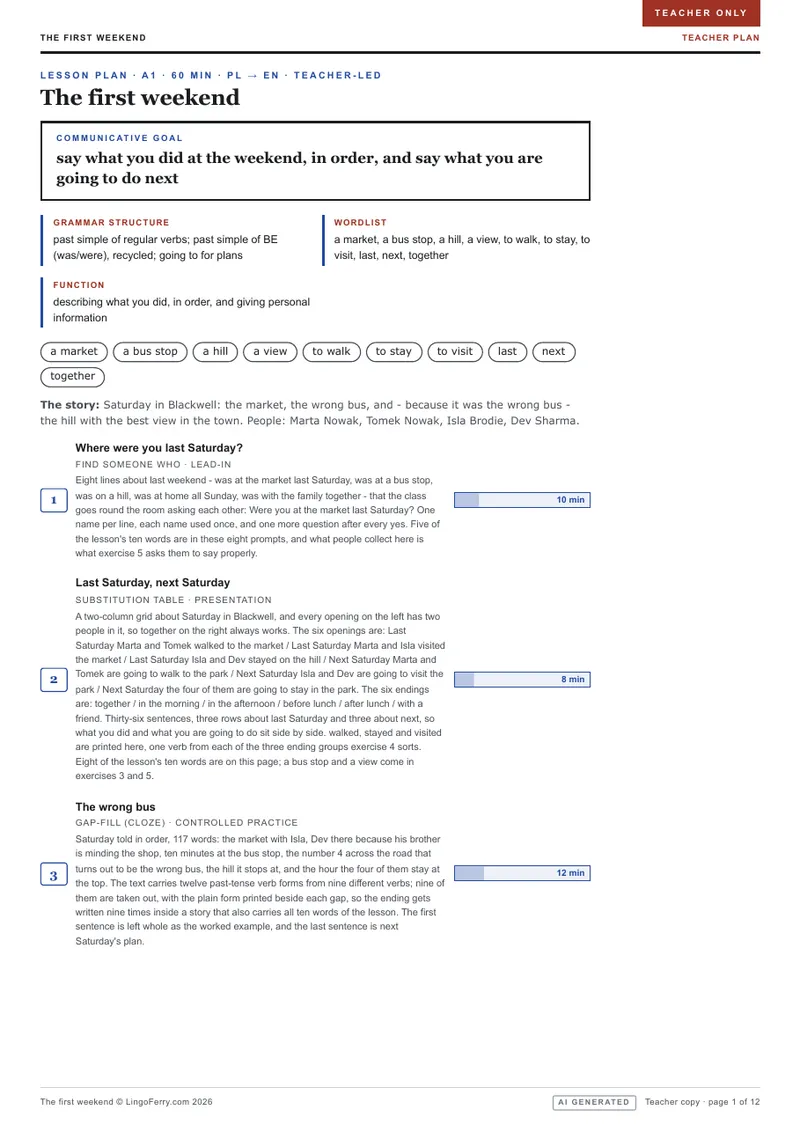
The last A1 lesson, and the longest. Last Saturday Marta, Tomek and Isla walked to the market, met Dev, and caught the wrong bus, which stopped at a hill with the best view in Blackwell. The class starts on its feet with Find someone who, asking Were you at a market last Saturday? Then a substitution table puts walked, stayed and visited next to are going to walk.
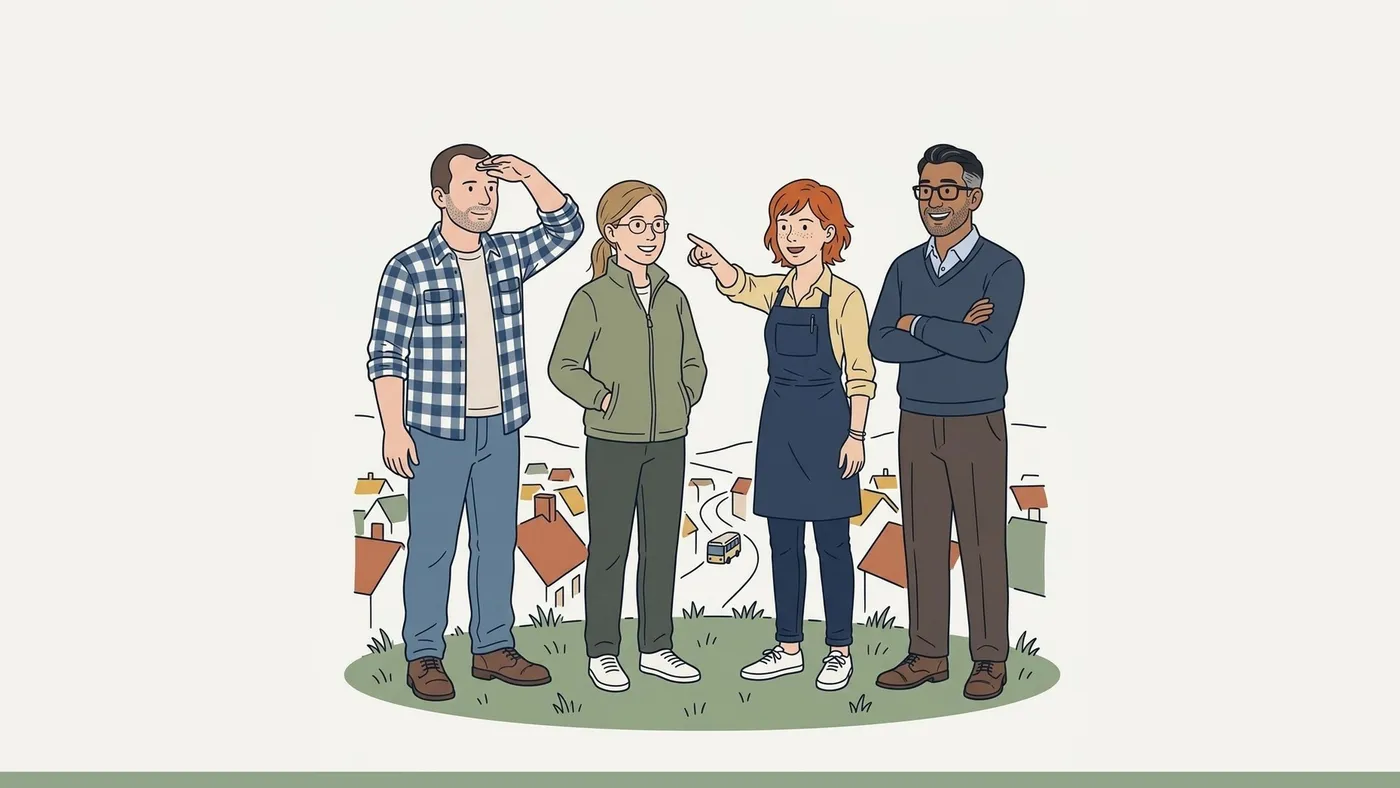
The gap-fill tells the story of the wrong bus. Next, an odd-one-out: the teacher reads each line of four verbs twice, and students pick the one whose -ed ending sounds different. The closing picture shows the four friends on the hill: students retell the Saturday in order, then say what they did last weekend and what they are going to do next Saturday. Afterwards they can tell a weekend in order and state a plan.
Say what you did at the weekend, in order, and what you are going to do next.
- Grammar
- Past simple, regular; past simple of BE (recycled); going to.
- Function
- Describing habits and routines; giving personal information.
- Words (10)
- marketbus stophillviewwalkstayvisitlastnexttogether
Why Polish speakers get this wrong
Polish pronounces almost every written letter and devoices voiced consonants at the end of a word: chleb is said like chlep. Both habits hit the -ed ending. Learners say walk-ed, and lived comes out with a t. English has three endings: /t/ in walked, /d/ in stayed and /ɪd/ in visited, and only the last adds a syllable.
The lesson names the three groups after its own verbs instead of putting t, d and id on the board. The teacher models the verbs during the substitution table, reads the gap-fill story aloud when it is done, and reads each odd-one-out line twice. Two of those lines are deliberately hard: in one only voicing separates the verbs, in the other only the extra syllable. There is no recording, so the teacher's voice is the model, and the notes say where to slow down.
Free guide: Walked has one syllable: how to pronounce the -ed ending →
60 min · 5 exercises
- 1Where were you last Saturday?Find someone who · Lead-in10 min
- 2Last Saturday, next SaturdaySubstitution table · Presentation8 min
- 3The wrong busGap fill · Controlled practice12 min
- 4Walked, stayed, visitedOdd one out · Review8 min
- 5The best view in BlackwellPicture description · Assessment16 min
Walked, stayed, visited
Your teacher reads each line twice. Circle the verb that is not in the same group as the other three. Then write the group: walked, stayed or visited.
- walked / asked / looked / stayed
- stopped / visited / laughed / walked
- lived / played / asked / called
- waited / stayed / showed / followed
- wanted / waited / looked / started
- started / followed / needed / wanted
As printed on the student sheet. Answers are in the teacher pack.
- 1Student pack7 pages · A4 PDF
- 2Teacher pack: plan, notes, answer key12 pages · A4 PDF
Questions about this lesson
Is there a recording for the pronunciation work?
No, this lesson has no audio. The odd-one-out is read aloud by the teacher, twice per line. The teacher notes say which verbs to keep to one syllable and which two lines to read a third time, slowly, if the class is split.
Does Find someone who work with a small group?
Yes. The sheet asks for a different name on each of its eight lines, and the teacher notes say that in a class of fewer than nine a name can come twice. If the room is tight, half the class circulates while the other half stays seated, then they swap after four minutes.
How long is it, and how big is the pack?
Sixty minutes across five exercises: Find someone who (10 minutes), a substitution table (8), a gap-fill (12), an odd-one-out (8) and a picture description (16). The student pack is 7 A4 pages, the teacher pack 12.