Right now
Present continuous
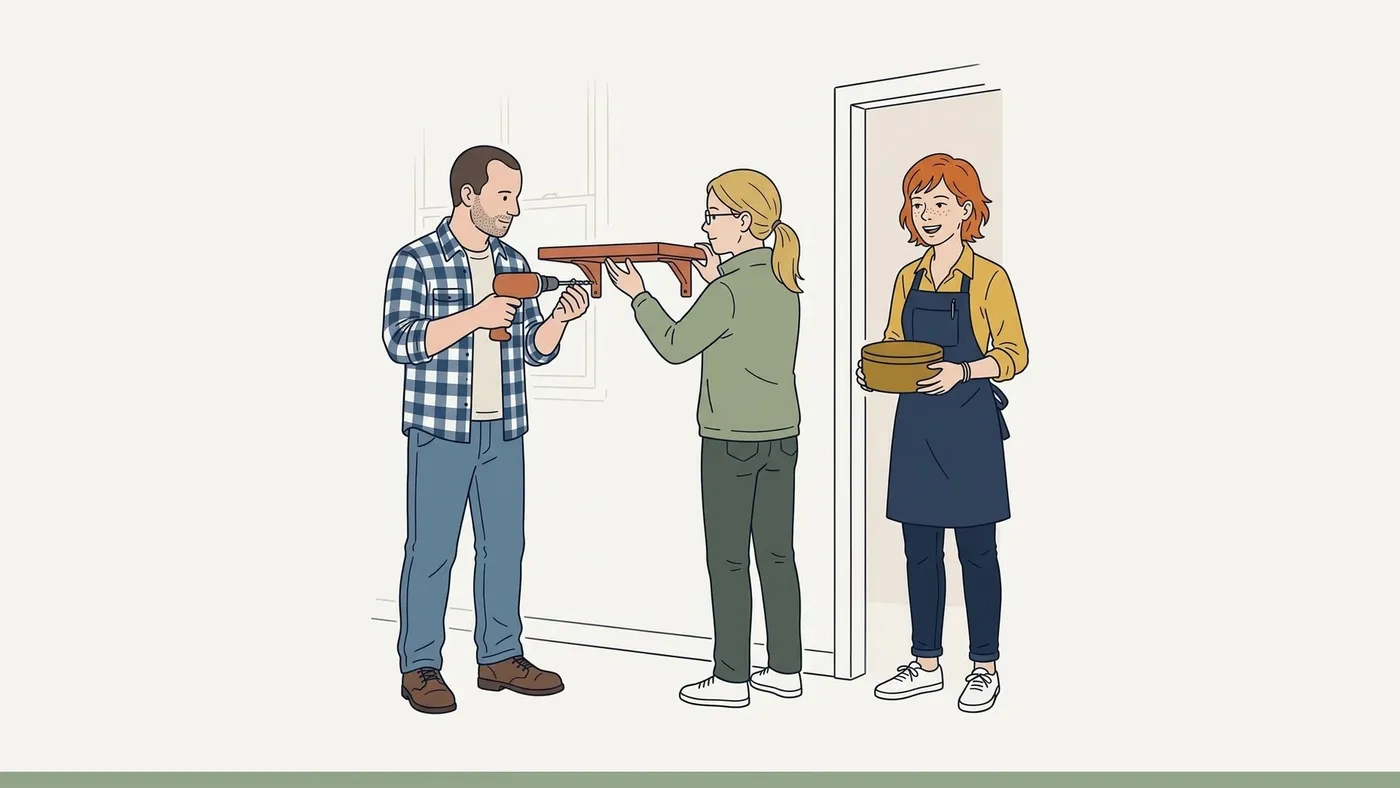
Isla knocks at ten at night with biscuits, finds Tomek putting up shelves, and stays to hold the spirit level.
- Level
- A1
- Length
- 50 min
- Exercises
- 4
One-off payment · print for your own groups · 14 days to change your mind · faktura VAT
About this lesson
At ten at night Isla knocks at flat 4B with a tin of biscuits and finds Tomek putting up a shelf with a drill, Marta holding it and the tea going cold. The lesson starts with a one-page cheatsheet, Now, and every day, that sets the two forms side by side, lists the words that decide between them and shows -ing after like, hate and love.
In the gap-fill students choose between forms such as puts and is putting, and the words around each gap decide. Then a picture of the kitchen: three things happening right now, three that happen every evening. The review is a board game for two teams where the time word in each square sets the form, with a solo version scored out of twelve. Afterwards students can say what is happening now and contrast it with what usually happens.
Say what is happening now, and contrast it with what usually happens.
- Grammar
- Present continuous; present simple contrasted with it; verb + -ing after like / hate / love.
- Function
- Describing habits and routines (recycled from A1.4, now contrasted).
- Words (9)
- shelfdrillbiscuitupstairsdownstairshelpknockholdquiet
Why Polish speakers get this wrong
Polish has one present tense. Pracuję covers both I work and I'm working, and the difference is carried by teraz or codziennie, not by the verb. So learners say I work now, or drop the auxiliary: Marta holding the shelf. Once the form has been taught, the error reverses: Every day Isla is working in the cafe.
That is why the lesson makes the time word the signal, not the verb. The cheatsheet lists the cue words with their Polish equivalents. In the gap-fill the verb is given in brackets, and the class underlines the words that decide each gap before writing. The game prints the time word at the end of every square, and a sentence without is doesn't win it. The notes add one question for the plain verb with now: now, or every day?
Free guide: I'm working now, not I work now: present simple vs present continuous →
50 min · 4 exercises
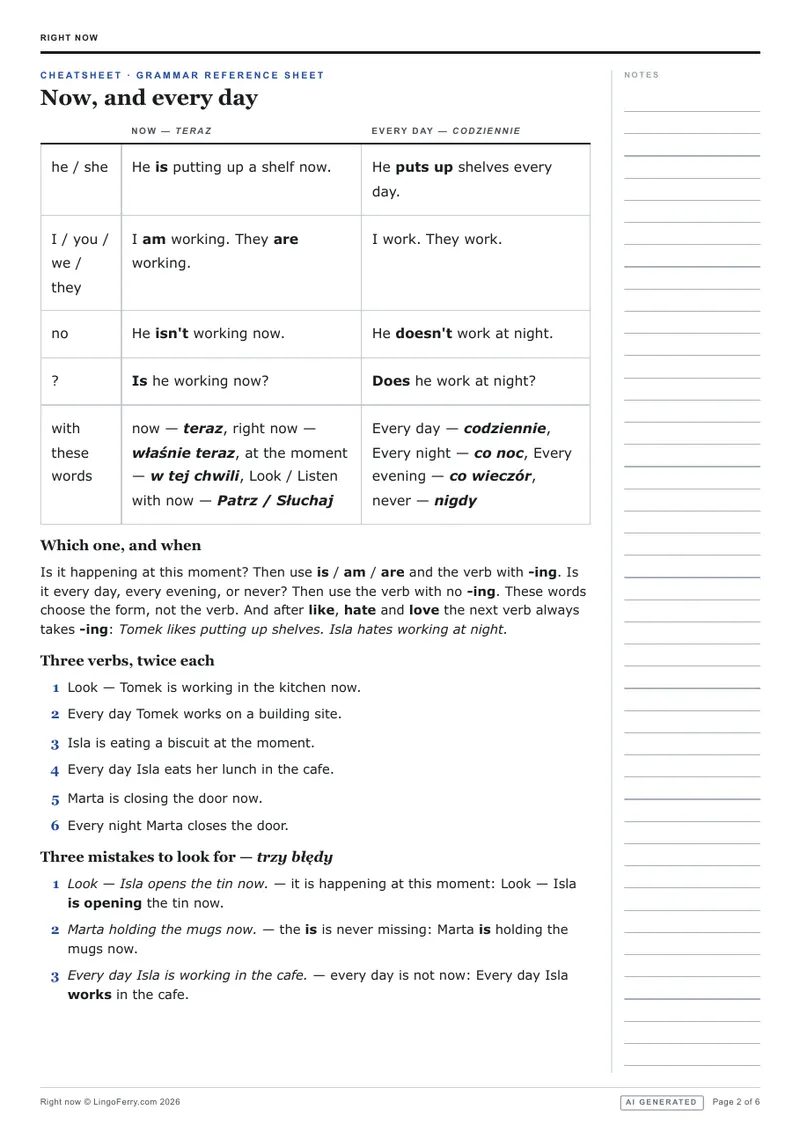
- 1Now, and every dayGrammar cheatsheet · Presentation7 min
- 2Ten o'clock, and nobody is drinking teaGap fill · Controlled practice12 min
- 3The kitchen at ten o'clockPicture description · Semi-controlled practice12 min
- 4Now, or every day?Game · Review14 min
Now, or every day?
Two teams of three, A and B. Take turns: choose a square and say the whole sentence out loud. The time word at the end tells you the verb form.
- Isla / hold / the spirit level / now
- Tomek / put up / shelves / Every day
- Tomek / work / at night / never
- Marta / hold / the shelf / at the moment
- Isla / walk / downstairs / Every night
- Tomek / finish / at four o'clock / Every day
As printed on the student sheet. Answers are in the teacher pack.
- 1Student pack6 pages · A4 PDF
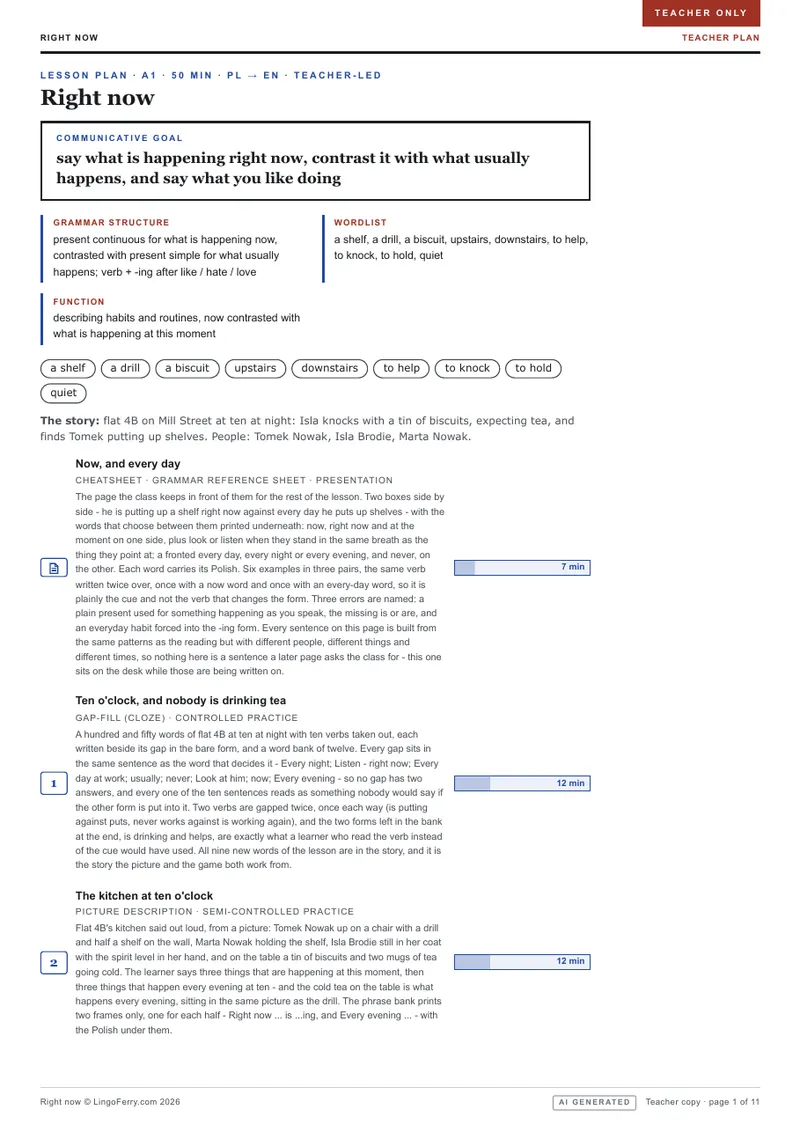
- 2Teacher pack: plan, notes, answer key11 pages · A4 PDF
Questions about this lesson
Should students know the present simple first?
It helps. The lesson takes the routines from A1.4 and contrasts them with what is happening now, so he works, she reads and words like usually and never should be familiar. Like every lesson in the course, it can still be taught on its own.
How long does it take, and what do I print?
Fifty minutes: the cheatsheet (7 minutes), a gap-fill (12), a picture description (12) and a game (14). The student pack is 6 A4 pages and stays on the desk all lesson, cheatsheet included. The teacher pack is 11 pages.
What does the teacher pack add?
Setup, likely problems, what to listen for and timing for each exercise, plus keys for the gap-fill and the game. The picture task comes with a rubric in three parts, right now, every evening and fluency, with a top score of nine.