Two suitcases
Verb be · introductions
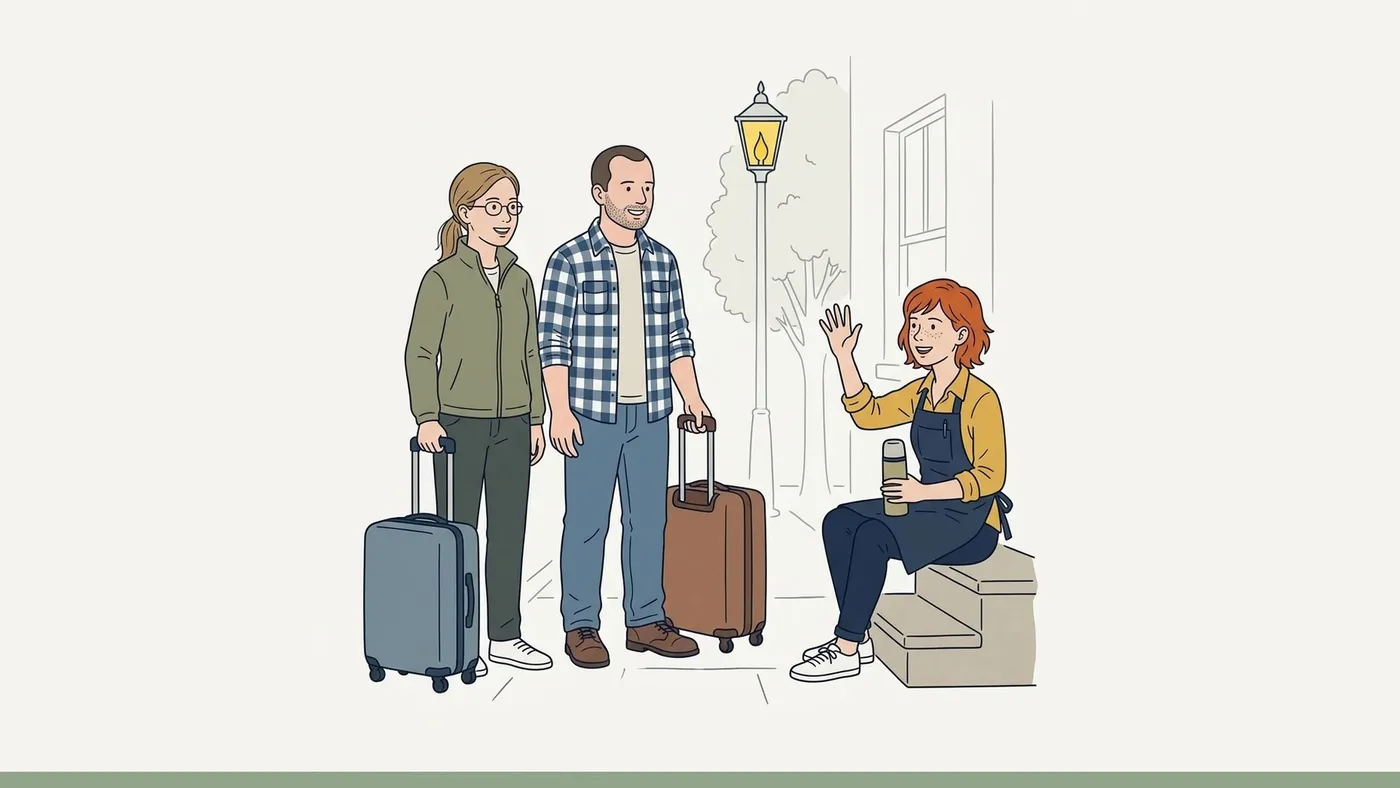
Marta and Tomek get off the coach at eleven at night. The neighbour is waiting on the step with the keys and a flask.
- Level
- A1
- Length
- 40 min
- Exercises
- 3
One-off payment · print for your own groups · 14 days to change your mind · faktura VAT
About this lesson
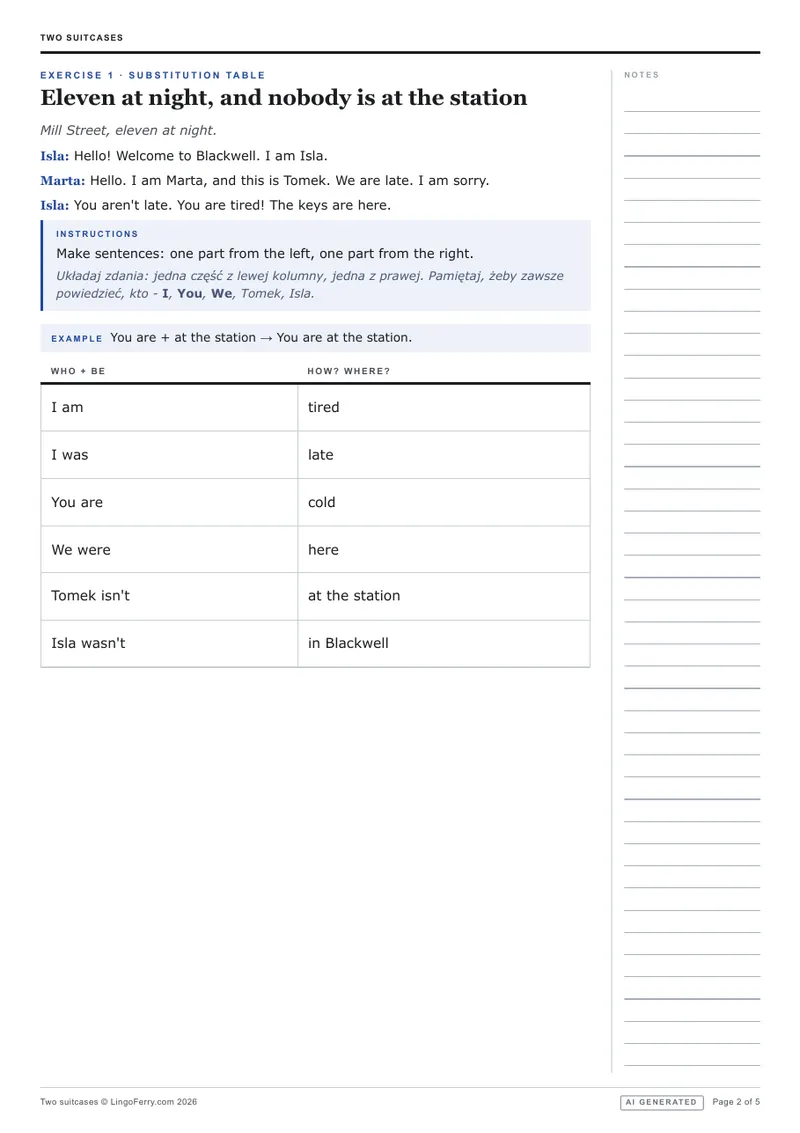
A first lesson for adult beginners. It is eleven at night on Mill Street: Marta and Tomek have just got off the coach, and Isla is waiting on the step with the keys. The class reads their short exchange, then builds sentences from a substitution table with I am, We were, Tomek isn't and Isla wasn't. All 36 combinations are correct.
Next comes a sentence unscramble: eight lines from the conversation on the step, four of them questions such as where are you from. The lesson closes with a picture description marked on a short rubric: one minute on who is in the picture, where they are and how they are, then a greeting to a partner. Afterwards students can say who they are, where they are from and why they are here, and answer the same questions about themselves.
Introduce yourself, say where you are from and why you are here, and answer simple personal questions.
- Grammar
- BE, including questions and negatives; past simple of BE; personal pronouns, simple.
- Function
- Greetings; giving personal information.
- Words (8)
- suitcasestationaddresskeytiredlatesorrywelcome
Why Polish speakers get this wrong
In Polish the verb already says who: jestem, jesteś, jesteśmy. The pronoun is optional, so in English it goes missing and learners say Am tired or Is late. Questions bring a second habit. Polish asks with czy or with intonation alone, so the natural output is You are tired? or Where you are from?
The lesson builds the answer into the layout. In the substitution table the left column is always a subject plus BE, so there is no cell a learner can leave out. In the unscramble the pronoun is a separate word that has to be placed, and in the questions BE has to be moved in front of it by hand. When a subject disappears in speech, the teacher notes say to point at the left column rather than correct.
Free guide: I am tired, not Am tired: why Polish speakers drop the subject →
40 min · 3 exercises
- 1Eleven at night, and nobody is at the stationSubstitution table · Presentation8 min
- 2Isla asks - are you tired?Sentence unscramble · Controlled practice12 min
- 3The step on Mill StreetPicture description · Assessment14 min
Isla asks - are you tired?
Isla, Marta and Tomek are on the step. Put the words in order to make one correct sentence.
- from / you / where / are
- tired / not / i'm / very
- address / where / the / is
- my / suitcase / it's / not
- in / you / Blackwell / why / are
As printed on the student sheet. Answers are in the teacher pack.
- 1Student pack5 pages · A4 PDF
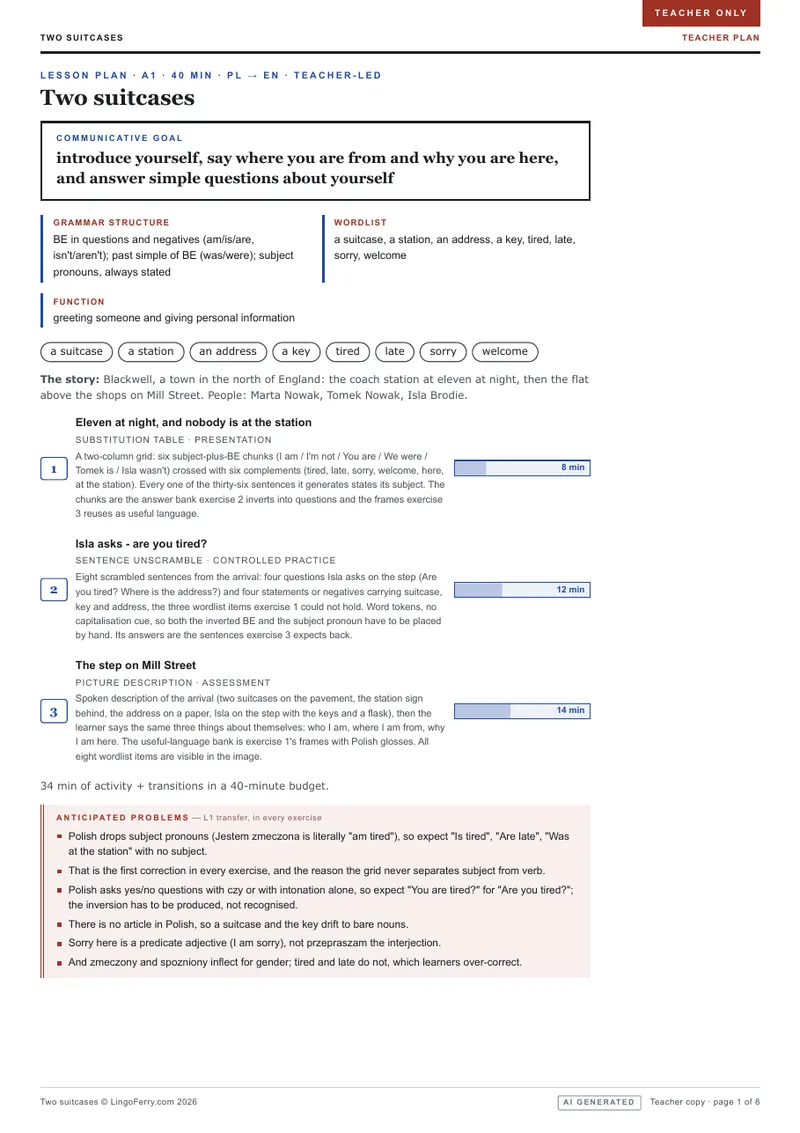
- 2Teacher pack: plan, notes, answer key8 pages · A4 PDF
Questions about this lesson
How long does the lesson take, and what is in it?
Forty minutes, three exercises: a substitution table (8 minutes), a sentence unscramble (12) and a picture description (14). The student pack is 5 pages of A4, the teacher pack 8. Instructions on the student sheet are in English and Polish.
Which words does the lesson teach?
Eight: suitcase, station, address, key, tired, late, sorry and welcome. Sorry and welcome are modelled in the opening exchange, the others appear in the table and the unscramble, and all eight come back together in the final picture task.
What is in the teacher notes?
For each exercise: how to set it up, what to listen for, and what to do if there is time. The unscramble key explains why each answer is the only possible order, and the picture task has a rubric with three criteria and a top score of nine.