All mistakes / A1
I am tired, not Am tired: why Polish speakers drop the subject
In English every sentence except a command needs a subject, even when the verb already makes it obvious: “I am tired”, not “Am tired”. Polish carries the person on the verb ending, so the pronoun feels redundant and quietly disappears.
What it sounds like
What the mistake looks like
It sounds like this: “Am tired.” “Is late.” “Are from Poland.” Every word is English, the verb form is right, and the sentence still has a hole at the front. The listener can usually guess what you mean, but it sounds like a text message typed at a bus stop.
The same habit shows up in questions. A Polish speaker keeps the order of a statement and lets the voice rise at the end: “You are tired?” “Where you are from?” English moves the verb in front of the subject instead: “Are you tired?” “Where are you from?”
Both mistakes can survive for years, because they rarely stop a conversation. Nobody interrupts to tell you a word is missing. That is exactly why they are worth fixing in the first week, not the fifth year.
Why Polish causes it
In Polish the verb ending tells you who is doing the action. „Jestem zmęczony” can only mean I am tired: the -m on „jestem” does the job of the pronoun. Jestem, jesteś, jest, jesteśmy, jesteście, są: six forms, six different people, and no pronoun needed. „Ja jestem zmęczony” is correct too, but it adds emphasis or contrast, as in „Ja jestem zmęczony, a ty nie”.
English verbs have almost no endings left. “Am” does point to I, but “are” can be you, we or they, and most verbs look the same for nearly everyone: I work, you work, we work, they work. The pronoun carries the person, so it has to stay.
Polish also has sentences with no subject at all: „Jest późno”, „Pada”, „Jest zimno”. English fills that slot with an empty “it”: “It is late”, “It's raining”, “It's cold”. The “it” means nothing, but the sentence is not complete without it.
Questions follow the same pattern. Polish makes a yes/no question with intonation or with „czy”: „Jesteś zmęczony?”, „Czy jesteś zmęczony?”. The word order does not change. So “You are tired?” is simply Polish grammar wearing English words.
The rule in English
Every English statement has a subject before the verb: I am, you are, she is, it is, we are, they are. When there is no real subject, use “it” for time, weather and distance (“It's eleven o'clock”, “It's far”) or “there” for things that exist somewhere (“There is a key on the table”).
In questions with “be”, the verb goes in front of the subject: “Are you tired?”, “Is Tomek at the station?”, “Where are you from?” With other verbs, English adds “do” or “does”: “Do you live here?”, “Where does she work?” Polish has no auxiliary like this, which is why this part takes the longest.
One case keeps the statement order: when the question word is itself the subject. “Who was at the station?” asks about the subject, so nothing moves.
And two caveats, so nobody feels cheated later. In casual speech, native speakers do drop the subject in fixed phrases: “Sounds good”, “Can't complain”, “See you later”. “You're tired?” with a rising voice exists too, when someone is surprised or checking what they just heard. Both come with time. The full sentence comes first.
How to fix it
Say the pronoun and the verb as one unit: “I'm”, “you're”, “it's”, “we're”. Contractions help here, because the subject is glued to the verb and cannot fall off.
When you write, check the first word of each sentence. If it is a verb, something is missing.
Practise questions in pairs, out loud: “You are tired.” / “Are you tired?” The point is to hear the verb change places, not just see it.
For teachers: correcting every dropped subject in free speech is a reliable way to end the conversation. A visual cue works better, such as a column of subjects on the board that you point at when a pronoun goes missing. The learner repairs the sentence and you say nothing. For questions, word-order tasks work well, because the learner has to put the verb in front of the subject with their own hand.
How lesson A1.1 works on it
Lesson A1.1 of English for Polish Adults, “Two suitcases”, opens the story: Marta and Tomek arrive in Blackwell at eleven at night, and Isla is waiting for them on the step on Mill Street with the keys. The lesson takes 40 minutes and has three exercises.
The first is a substitution table. The left column always holds a subject together with a form of “be” (I am, We were, Tomek isn't), the right column how or where someone is (tired, late, at the station). There is no cell a learner can skip, so every sentence gets its subject. The teacher notes suggest pointing at that column when a subject goes missing, instead of correcting.
The second is a sentence unscramble built on Isla's questions (“Where are you from?”, “Why are you in Blackwell?”), so the learner places “are” in front of “you” by hand. The last is a picture of the arrival: the learner describes the scene, then greets a partner and says who they are, where they are from and why they are here. The teacher's rubric has a separate line for stating the subject and using the right form of “be”.
Check yourself
Write each sentence in full. In 1–4, add the subject in brackets and the right form of be, using full forms (I am, not I'm). In 5–8, put the words in order to make a question.
- ___ tired. (I)
Answer
I am tired.
- ___ late. (it)
Answer
It is late.
- ___ not my suitcase. (it)
Answer
It is not my suitcase.
- ___ at the station yesterday. (Tomek)
Answer
Tomek was at the station yesterday.
- late / we / are
Answer
Are we late?
- from / you / where / are
Answer
Where are you from?
- Scotland / is / from / Isla
Answer
Is Isla from Scotland?
- in / why / you / Blackwell / are
Answer
Why are you in Blackwell?
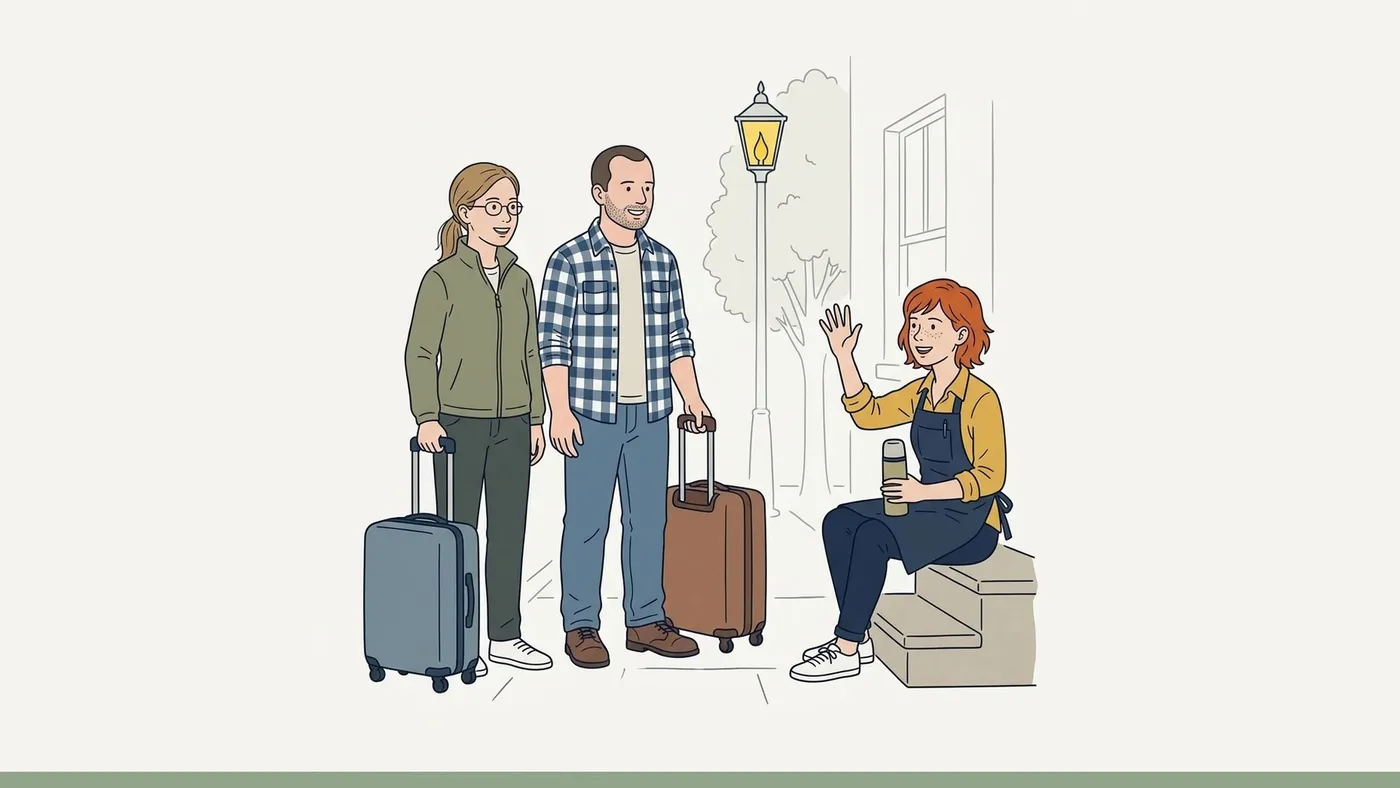
Two suitcases
Verb be · introductions