Every day at eight
Present simple · routines
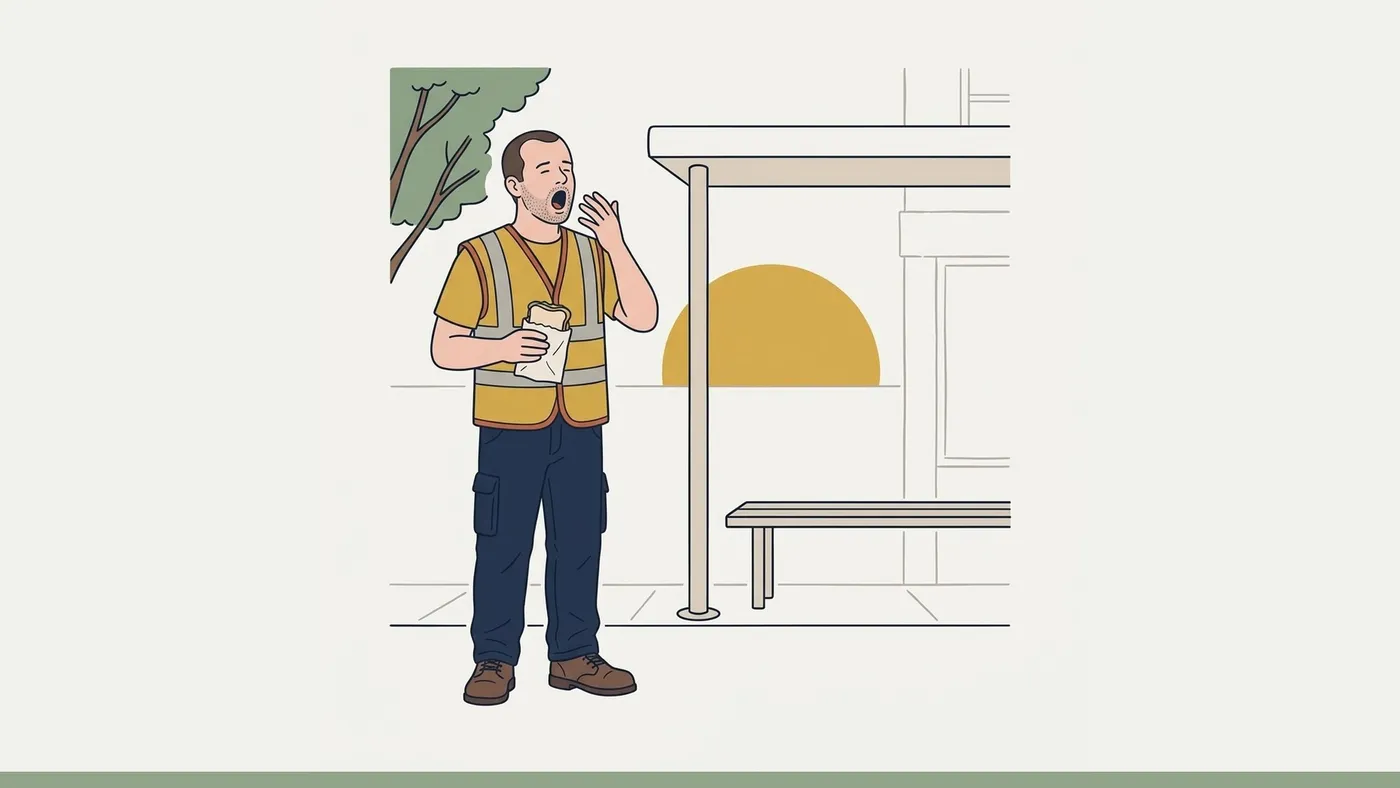
Tomek's first week on a building site. Within two days the crew decide his name is Tom.
- Level
- A1
- Length
- 50 min
- Exercises
- 4
One-off payment · print for your own groups · 14 days to change your mind · faktura VAT
About this lesson
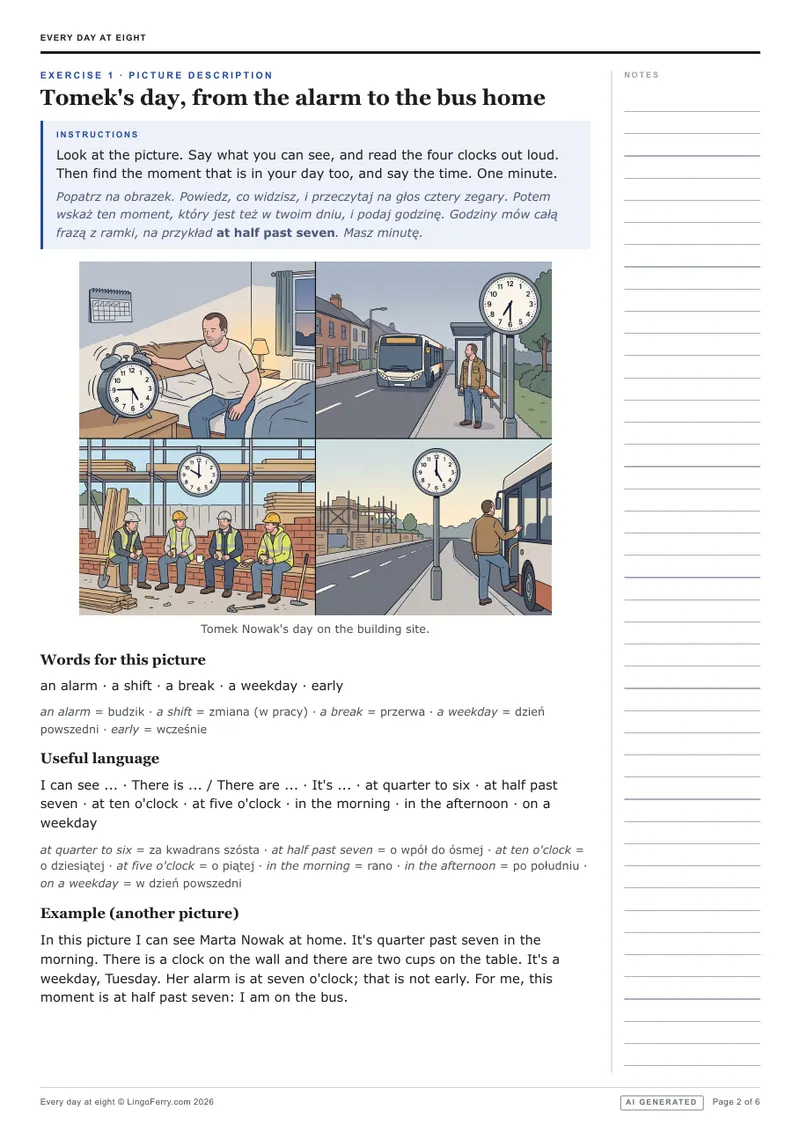
It is Tomek's first week on a building site outside Blackwell, and by Wednesday the crew call him Tom. The lesson opens with a picture of four moments in his day, each with a clock. Students read the times as whole phrases (at quarter to six, in the morning, on a weekday) and find the moment that is in their own day too.
A substitution table then sets always, usually and never in front of the verb, next to ready-made time phrases. In the sentence unscramble the time parts arrive in one piece, so the choice left is where the frequency word goes. The review is a team game of twelve squares, lost for a missing -s, a misplaced adverb or a wrong preposition, with a solo version. Afterwards students can describe their day, say how often and tell the time.
Describe your daily routine and say how often you do things.
- Grammar
- Present simple; adverbs of frequency; prepositions of time — in / on / at.
- Function
- Describing habits and routines; telling the time.
- Words (10)
- alarmshiftbreakalwaysneverusuallyearlyhalf pastquarter toweekday
Why Polish speakers get this wrong
Polish carves up time differently, and each preposition governs a case: w poniedziałek, o siódmej, and rano with no preposition at all. Build English time phrases from those parts and you get in Monday, on the morning, or a bare number where at is needed.
The lesson never gives a rule for in, on and at. Every time expression is taught as a fixed phrase. The substitution table keeps them in one piece in the right-hand column, and the unscramble prints them as single parts that may not be split. In the closing game a wrong preposition loses the square, and so does at nine instead of at nine o'clock. If someone asks why it is on Sunday but in the morning, the notes' answer is that the phrase goes that way.
Free guide: On Monday, in the morning, at seven: prepositions of time in, on and at →
50 min · 4 exercises
- 1Tomek's day, from the alarm to the bus homePicture description · Lead-in10 min
- 2Always at half past sevenSubstitution table · Presentation8 min
- 3What Tomek and Marta do every daySentence unscramble · Controlled practice12 min
- 4Tomek's week, square by squareGame · Review15 min
What Tomek and Marta do every day
Put the parts in order and write one sentence. The part with a capital letter comes first.
- at half past seven / starts work / He / always
- rings / at quarter to six / always / His alarm
- early / gets up / never / She
- on Saturday or Sunday / He / works / never
- always / in the afternoon / She / have a break / doesn't
As printed on the student sheet. Answers are in the teacher pack.
- 1Student pack6 pages · A4 PDF
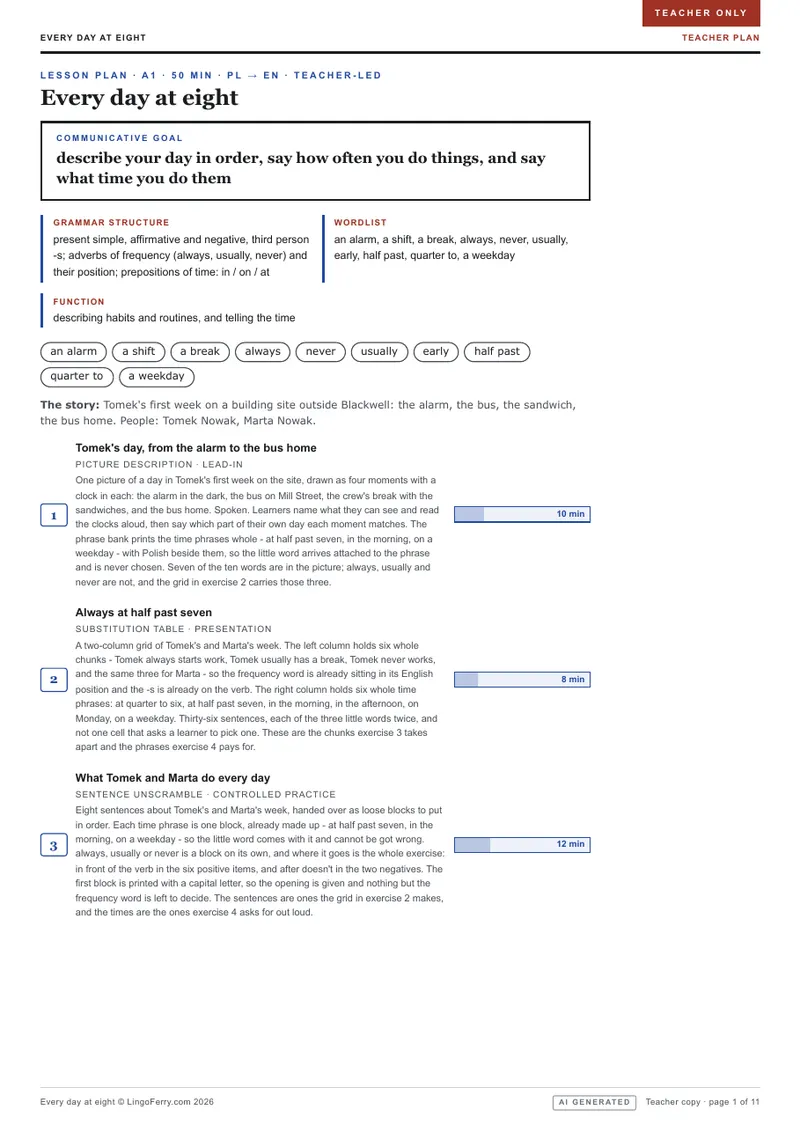
- 2Teacher pack: plan, notes, answer key11 pages · A4 PDF
Questions about this lesson
How is the 50 minutes split?
A picture description as the lead-in (10 minutes), a substitution table (8), a sentence unscramble (12) and a team game (15). The student pack runs to 6 A4 pages, the teacher pack to 11, including the game key and a rubric for the opening picture task.
Does the game work without six students?
The team game is written for two teams of three. The sheet also has a solo game: the learner writes sentences for four squares and checks them against the teacher's key, two points for a sentence with nothing wrong and one when only the time phrase is right.
Does it cover the third-person -s?
Yes. The table and the unscramble print starts, has and rings, and two unscramble items add negatives with doesn't. The notes say to let a missing -s go in the unscramble. Producing it is what the game checks: Tomek start work does not win the square.