Dev's shop
I'd like · how much / how many
Dev knows where they live before they finish the sentence, and puts a loaf they didn't pay for in the bag.
- Level
- A1
- Length
- 40 min
- Exercises
- 3
One-off payment · print for your own groups · 14 days to change your mind · faktura VAT
About this lesson
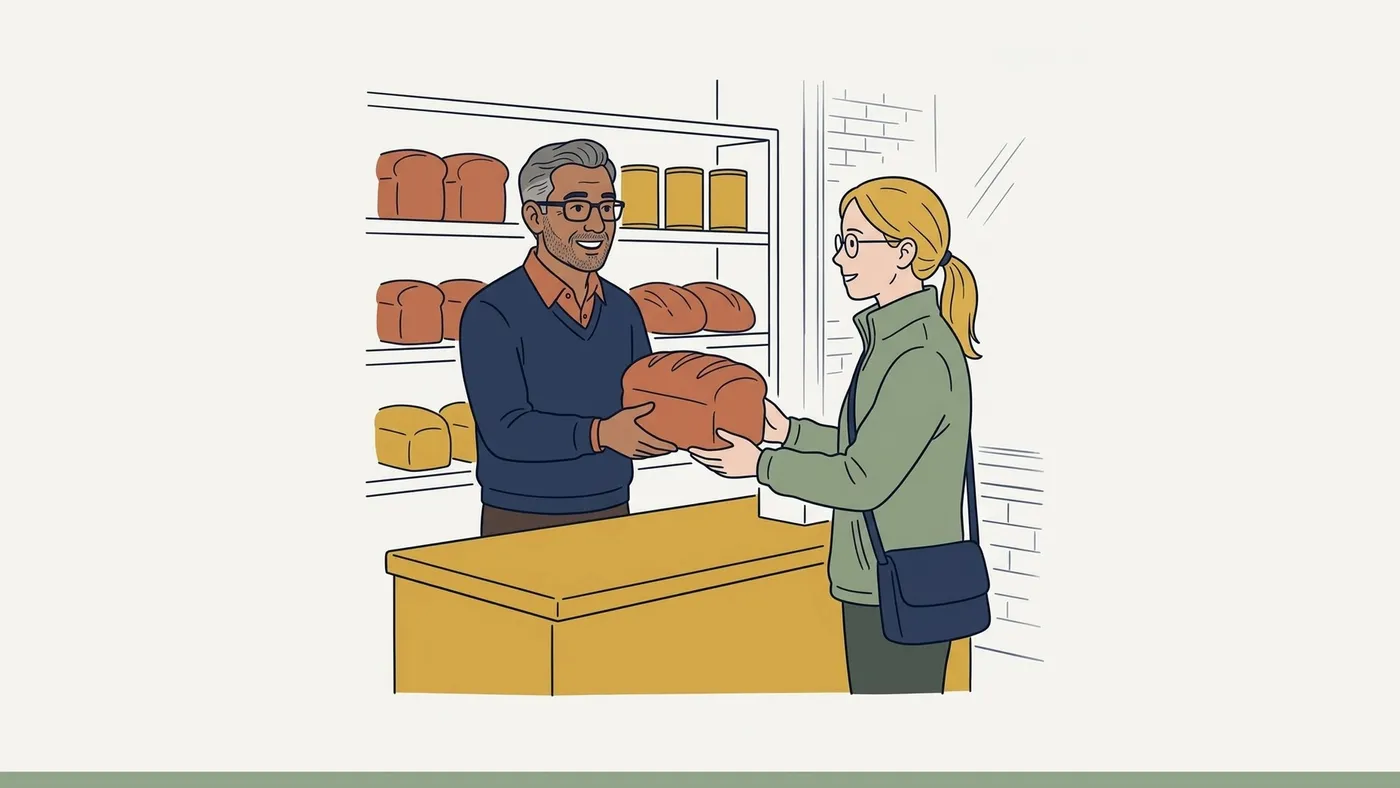
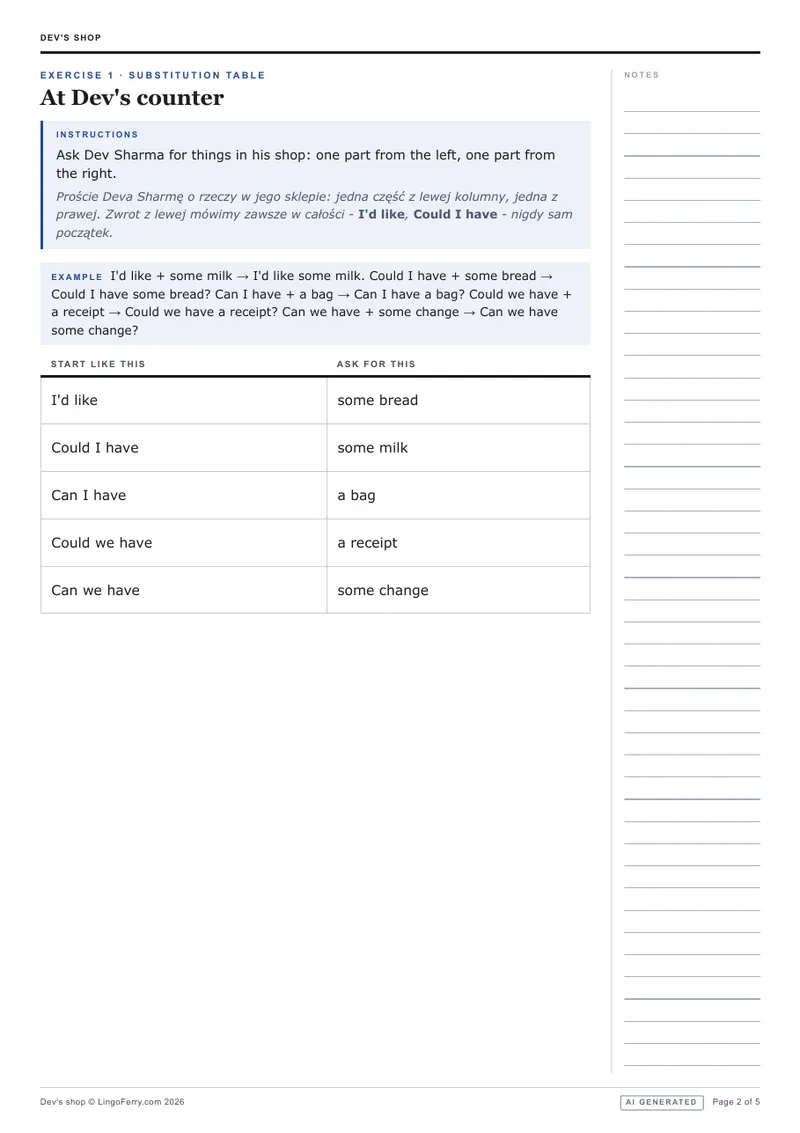
A shopping lesson for A1 adults. It is the evening of the first full day, and Dev's corner shop is the only one still open, so Marta crosses Mill Street for bread and milk. The class starts with a substitution table: five polite openings (I'd like, Could I have, Can I have, Could we have, Can we have) and five things to ask for.
Then comes matching: eight things Marta says, joined to Dev's replies, with two extra answers that are near misses such as forty and fourteen. Three of the pairs need a small sum. The lesson closes with a picture of the shop: one minute on what is on the shelves and what it costs, then buying three things, price first. Afterwards students can ask the price, understand prices in pounds and pence, and ask for what they want politely.
Buy things, ask the price, and ask for what you want politely.
- Grammar
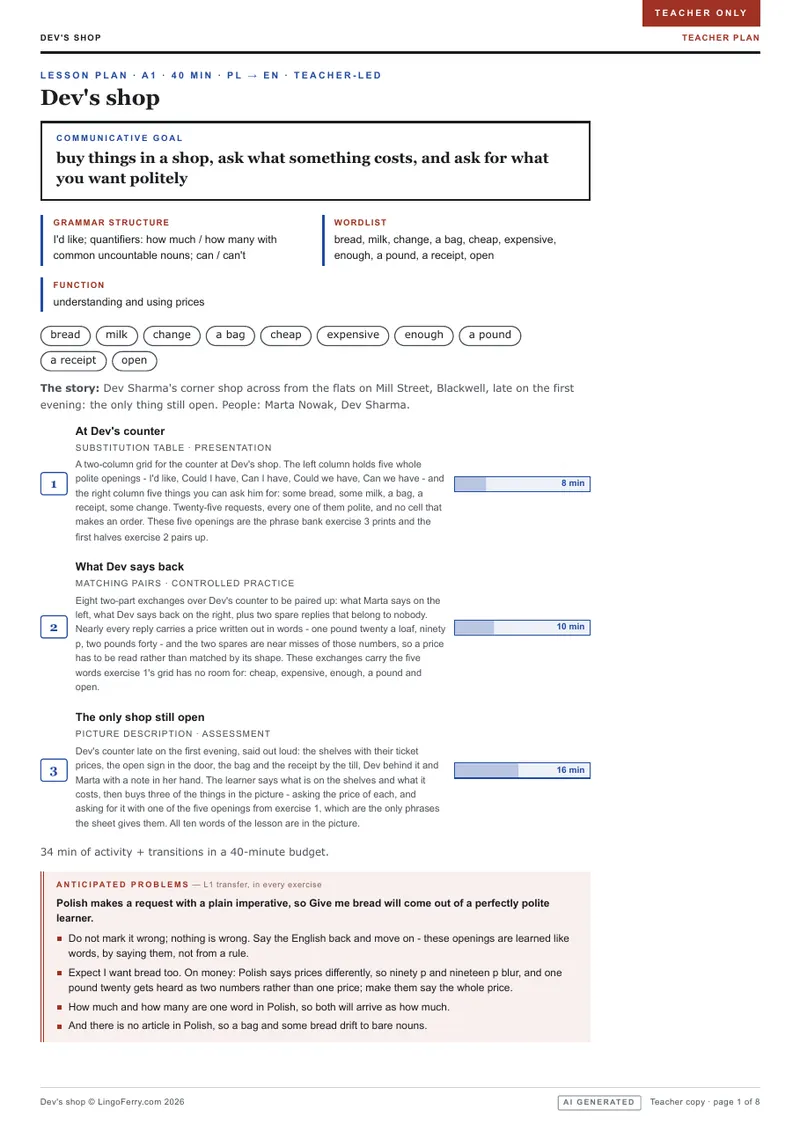
- I'd like; quantifiers — how much / how many; can / can't.
- Function
- Understanding and using prices.
- Words (10)
- breadmilkchangebagcheapexpensiveenoughpoundreceiptopen
Why Polish speakers get this wrong
Polish often makes a request with a plain imperative: Daj mi chleb, Podaj sól. Translated word for word it becomes Give me bread, which is correct English and sounds rude. I want bread, straight from chcę, has the same problem.
The lesson doesn't argue about politeness. It gives five openings and treats them as vocabulary. In the substitution table the left-hand phrase is always said whole, never just its start. The matching exercise uses the same five and no others, and in the picture task students may ask only with the phrases in the box. When Give me two loaves comes up, the teacher notes say to repeat the line with one of the five, hand it back and move on.
Free guide: Could I have a loaf? Why “Give me bread” sounds rude in English →
40 min · 3 exercises
- 1At Dev's counterSubstitution table · Presentation8 min
- 2What Dev says backMatching · Controlled practice10 min
- 3The only shop still openPicture description · Assessment16 min
What Dev says back
Marta Nowak is at Dev Sharma's counter. Join what Marta says to what Dev says back. Two answers on the right are extra.
- Bread is one pound twenty. Could I have two loaves?
- Milk is ninety p. Could we have two, please?
- I'd like some bread and some milk. How much is that?
- How many bags can we have for twenty p?
- I've only got a pound. Is that enough for some milk?
As printed on the student sheet. Answers are in the teacher pack.
- 1Student pack5 pages · A4 PDF
- 2Teacher pack: plan, notes, answer key8 pages · A4 PDF
Questions about this lesson
How long is the lesson, and how many pages?
Forty minutes: a substitution table (8 minutes), matching (10) and a picture description (16). The student pack is 5 pages, the teacher pack 8. The student sheet prints every instruction in English and Polish, and the useful-language box gives a Polish gloss for each opening.
Does the lesson practise prices and numbers?
Yes, prices are its function. The matching exercise turns on numbers that sound alike, forty and fourteen, eighty and eighteen, and the teacher notes include a quick listening check for them before anyone writes. In the final task students read the prices in the picture whole, pounds and pence together.
Should I explain why Give me bread is rude?
The teacher notes advise against it. Say the sentence back with an opening from the table, give it to the learner again and move on. The five openings are learned the way words are learned, by saying them, and nothing is marked wrong.