Block by block
Directions · comparatives
Dev draws a map on a receipt. Isla says it's wrong. Both routes work.
- Level
- A2
- Length
- 50 min
- Exercises
- 4
One-off payment · print for your own groups · 14 days to change your mind · faktura VAT
About this lesson
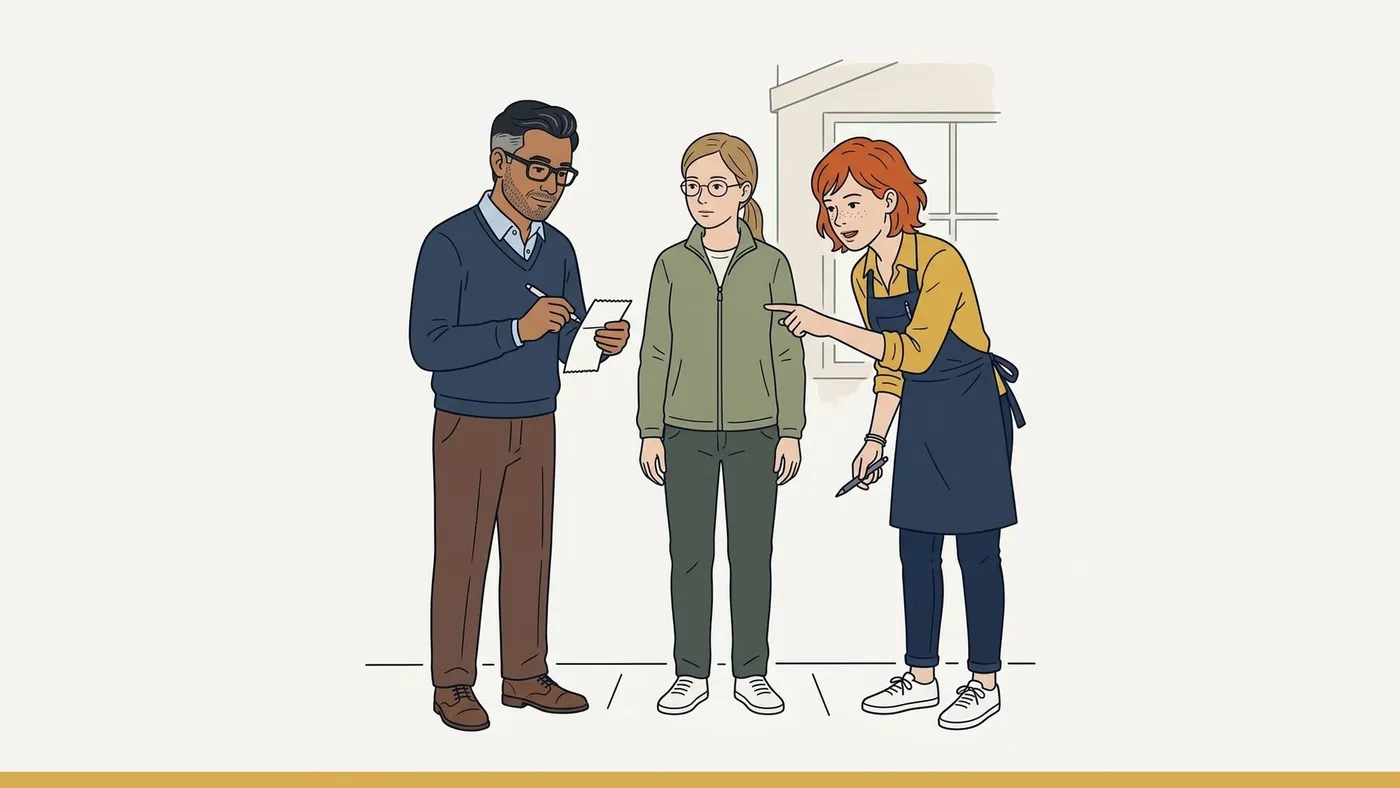
A 50-minute lesson on giving directions and comparing two routes, for A2 groups of Polish adults. Marta asks Dev the way from his shop to the market. Dev draws a map on the back of a receipt. Isla looks at it and says it is wrong. Both routes work.
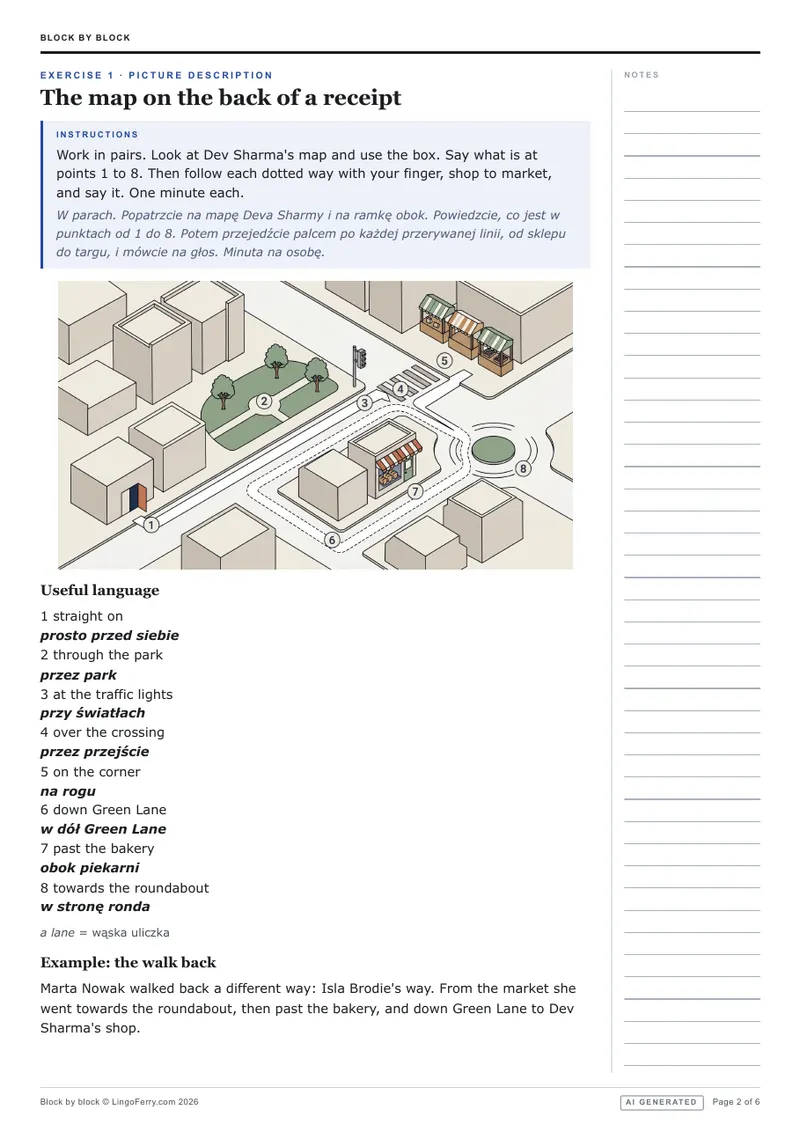
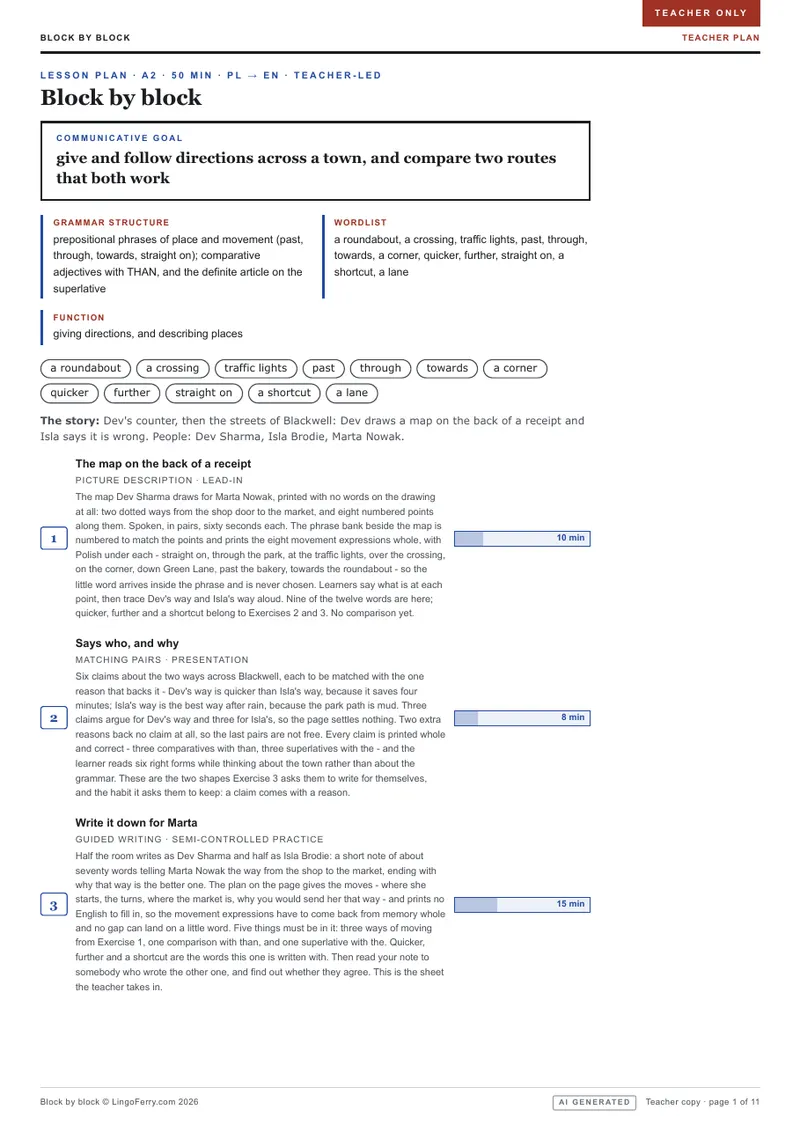
Pairs describe Dev's map with eight numbered phrases: through the park, past the bakery, towards the roundabout. Then they match six claims about the two routes with the reasons behind them, which sets up than and the best. Next, half the class writes Marta a note as Dev and half as Isla, then reads it to someone from the other side. The lesson ends with a team game on a grid of places, played from memory. Afterwards students can explain a route across town and say why one way is better.
Give and follow directions, and compare two routes.
- Grammar
- Prepositional phrases of place, time and movement; comparative adjectives — THAN and the definite article.
- Function
- Directions (A1 function, extended); describing places.
- Words (12)
- roundaboutcrossingtraffic lightspastthroughtowardscornerquickerfurtherstraight onshortcutlane
Why Polish speakers get this wrong
Prepositions do not map one to one. Polish says na końcu ulicy, so learners say "on the end of the street" instead of at the end. Przez covers both through the park and over the crossing, and obok turns into "by the bakery" where English wants past. There is no rule to reach for, and directions need one in almost every line.
So the lesson never asks students to choose the little word. The phrases are given whole in the first exercise, glossed in Polish and tied to numbered points on Dev's map. They are only scored in the final game, where a team claims a square by saying the whole phrase in a sentence. A wrong phrase claims nothing, and if someone asks why, the answer is: the phrase goes that way.
Free guide: At the end of the street, not “on the end”: prepositions of place and movement →
50 min · 4 exercises
- 1The map on the back of a receiptPicture description · Lead-in10 min
- 2Says who, and whyMatching · Presentation8 min
- 3Write it down for MartaGuided writing · Semi-controlled practice15 min
- 4Square by square across BlackwellGame · Review14 min
Says who, and why
Dev Sharma and Isla Brodie both say that their way is better. Match each sentence to the one reason that goes with it. Two reasons are extra.
- 1. Dev's way is quicker than Isla's way, because
- 2. Isla's way is the best way after rain, because
- 3. Isla's way is easier to remember than Dev's way, because
- a. it has one corner and Dev's has three.
- b. both ways end at the same corner of the market.
- c. the traffic lights stop the cars for you.
As printed on the student sheet. Answers are in the teacher pack.
- 1Student pack6 pages · A4 PDF
- 2Teacher pack: plan, notes, answer key11 pages · A4 PDF
Questions about this lesson
How does the game at the end work?
Two teams of three take turns choosing a square with a place on it, such as the park or the bakery, and say in one whole sentence how you get past it. If it is right, they write their letter in it. Students turn the earlier sheets face down first, so it works from memory. It takes 14 minutes.
Can the game be played by a student on their own?
Yes. The sheet has a solo version, "eight out of eleven": the student writes a whole sentence for each square, then gets the list of sentences from the teacher and scores one point for every square where the whole phrase is there. The teacher pack has that list.
Is there a recording?
No. This lesson works from paper: Dev's hand-drawn map is printed on the student sheet with nothing written on it, and the phrases sit in a box beside it. The student pack is six A4 pages and the teacher pack eleven.