All mistakes / A2
At the end of the street, not “on the end”: prepositions of place and movement
It's “at the end of the street”, not “on the end”, even though Polish says „na końcu”. English prepositions of place and movement don't map one to one onto Polish ones: przez can be through, across or over, and obok can be next to or past. The safest way to learn them is as whole phrases.
What it sounds like
What the mistake looks like
Ask a Polish speaker the way and you may hear: “The café is on the end of the street. Go next to the bakery, then go through the street at the lights.” Part of it points the wrong way: “go next to the bakery” sounds as if you should stay beside it, not walk on past.
Directions need a preposition in almost every line, so these slips add up quickly. They are not a sign of weak English, and they last well beyond A2, because there is no single rule behind them. This guide covers places and routes; for in, on and at with days and hours, see the guide to prepositions of time.
Why Polish causes it
Polish and English prepositions overlap only in part. Na covers on („na stole”, on the table), but also at: „na końcu ulicy” (at the end of the street), „na przystanku” (at the bus stop), „na światłach” (at the traffic lights). Learners reach for the most familiar match, na = on, and get “on the end of the street” and “on the bus stop”.
Przez is one Polish word for several English ones. „Przez park” is through the park, because you are inside it. „Przez ulicę” is across the road, from one side to the other. „Przez most” is over or across the bridge. Obok splits too: when nothing moves, „sklep jest obok piekarni” is “the shop is next to the bakery”, but „przejdź obok piekarni” in directions means go past it.
The rule in English
At for a point on the way: at the end of the street, at the traffic lights, at the bus stop, at the roundabout, at the crossroads.
On for a surface, a side or a street: on the left, on the right, on the other side of the road, on the corner (for something standing there: “The café is on the corner”), on Mill Street. In British English in Mill Street is also common.
Movement: through when you are inside something (through the park), across from one side of a flat surface to the other (across the road, across the square), over for going above something (over the bridge) and, in everyday British English, also for crossing a road (over the road, over the crossing), past for going by without stopping (past the bakery), towards for in the direction of (towards the roundabout), down or along for following a street (down Green Lane; down doesn't have to mean downhill), into for going in (into the shop).
Turn left, turn right and go straight on take no preposition at all. “Turn on the left” is not how directions are given.
Three nuances. At the end and in the end are different: at the end of the street is a place, in the end means finally, „w końcu”. On the end of does exist, for something attached to the end of a thing: a hook on the end of a rope. And the corner takes both: on the corner says where something is, at the corner is where you do something (“Turn left at the corner”, “Meet me at the corner”).
How to practise it
Learn directions as whole phrases with the preposition inside: at the end of the street, past the bakery, across the road, at the traffic lights. Don't learn the preposition on its own; there is no rule to rebuild it from.
Draw your route from home to the shop, mark four points on it and describe it aloud: “Go straight on, turn left at the lights, go past the church…” Then describe it backwards. Keep a short list of places where Polish na is English at: na końcu, na przystanku, na światłach, na skrzyżowaniu, na rondzie.
For teachers: gap-fills that ask learners to choose between at, on and in tend to reward guessing. Giving the phrases whole, tied to a map, and scoring whether the whole phrase comes back is usually more productive. When a learner asks why it is past the bakery but through the park, the most useful answer at A2 is that the phrase goes that way.
How lesson A2.2 works on it
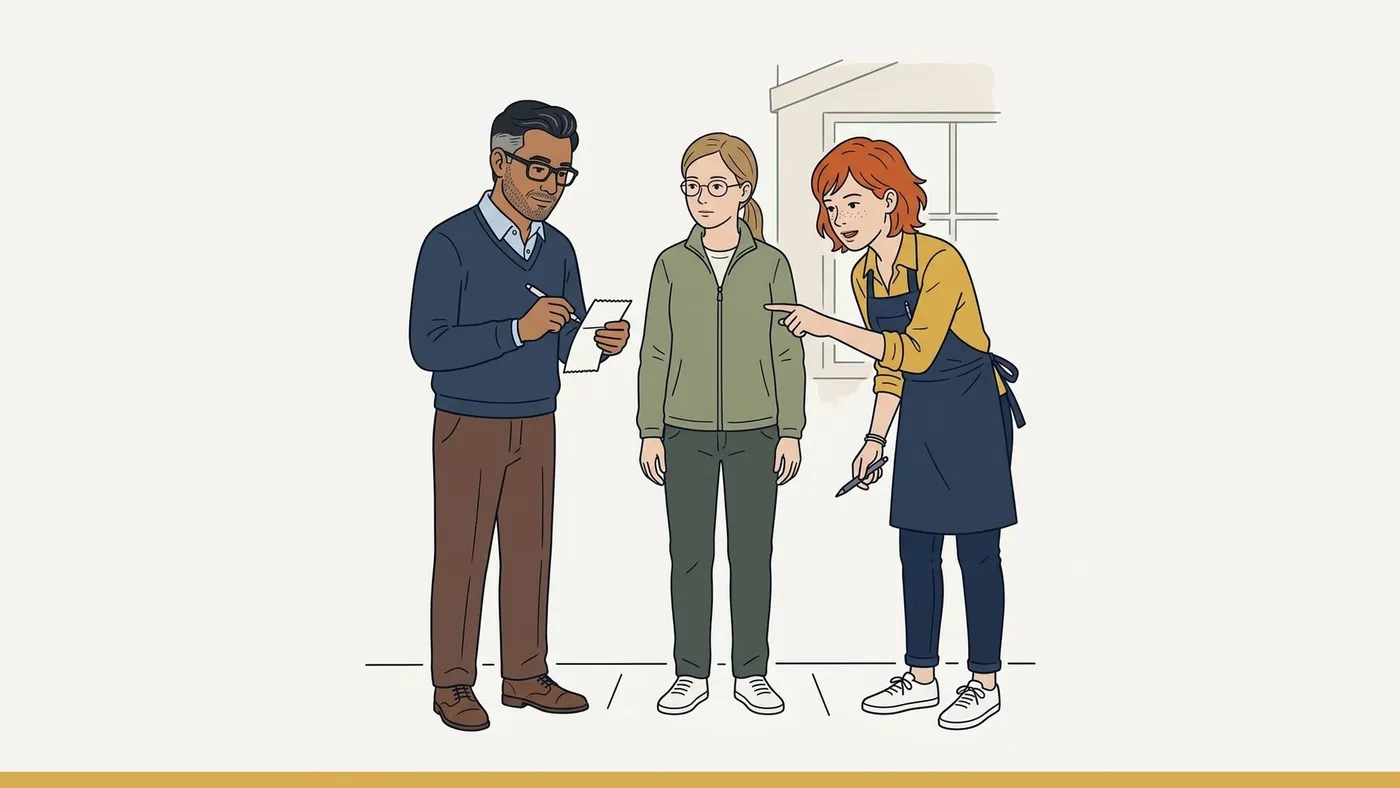
Lesson A2.2 of English for Polish Adults, “Block by block”, takes 50 minutes. Marta asks Dev the way from his shop to the market. Dev draws a map on the back of a receipt, Isla says it's wrong, and both routes work. Alongside the route phrases, the lesson teaches comparatives, for arguing which way is better.
The lesson never asks students to choose, supply or correct the little word. The first exercise gives eight phrases whole, glossed in Polish and tied to numbered points on Dev's map: straight on, through the park, at the traffic lights, over the crossing, on the corner, down Green Lane, past the bakery, towards the roundabout. In the writing task, where half the class writes Marta a note as Dev and half as Isla, the teacher marks the claim and the route, not the prepositions inside the phrases.
The phrases are scored only in the closing team game, played from memory: a team claims a square by saying, in one whole sentence, how you get past that place. A wrong phrase claims nothing, and a solo version on the same grid is included. One thing to say plainly: at the end of the street is not one of the eight phrases and does not come up in the lesson at all. The lesson deals with the trap as a whole, by teaching each phrase as a unit.
Check yourself
Complete the directions with one word: at, on, past, through, across or towards.
- The café is ___ the end of the street.
Answer
at
- Walk ___ the park; there are no cars in there.
Answer
through (or: across)
- Walk ___ the bakery without stopping and take the next left.
Answer
past
- Go ___ the road at the traffic lights, not in the middle.
Answer
across
- Wait for me ___ the bus stop.
Answer
at
- Walk ___ the roundabout, and you'll see the market before you get there.
Answer
towards
- The chemist's is ___ the left, next to the bank.
Answer
on
- The market is ___ the other side of the road.
Answer
on
Block by block
Directions · comparatives