Meet the neighbours
Superlatives · describing people
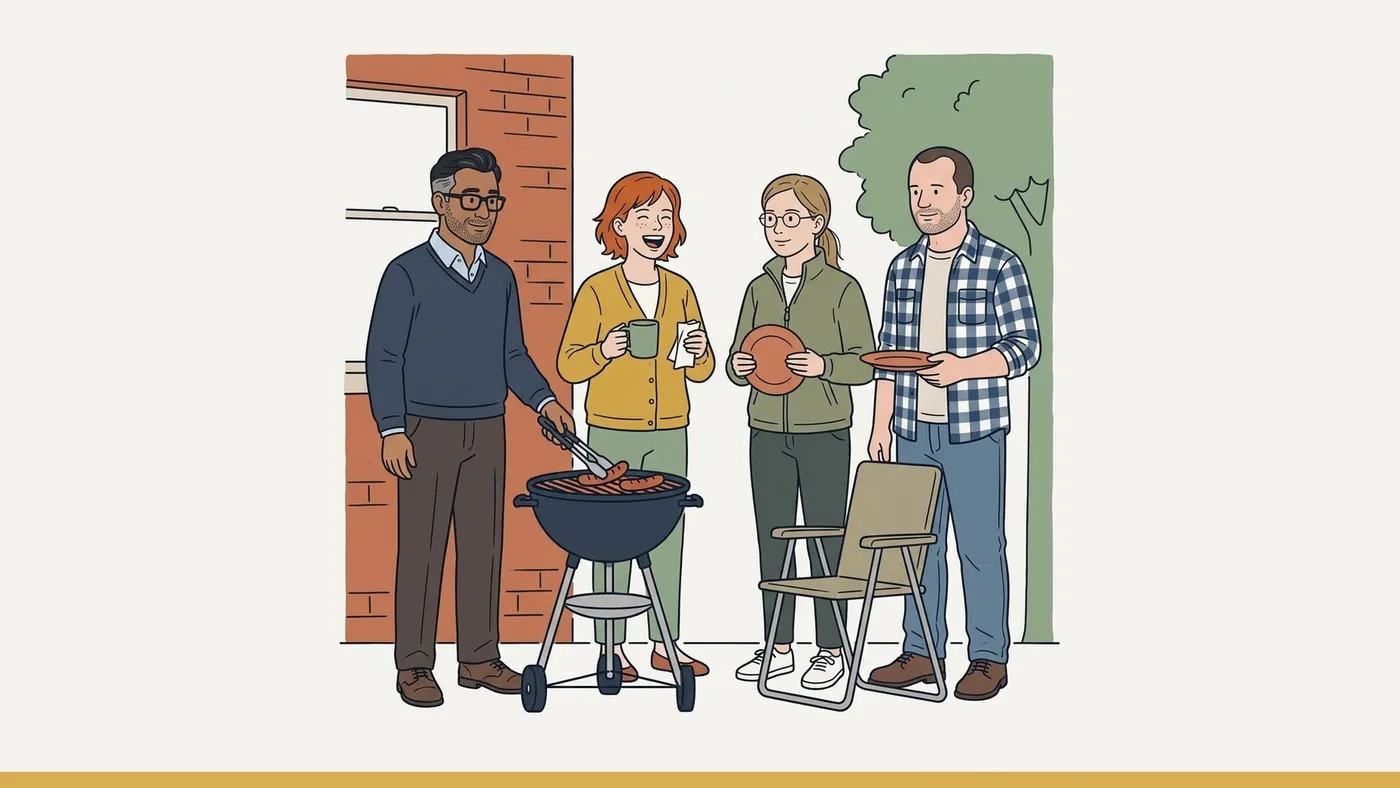
A barbecue in the yard behind the flats. Everyone gets described to somebody else, always a little too generously.
- Level
- A2
- Length
- 60 min
- Exercises
- 5
One-off payment · print for your own groups · 14 days to change your mind · faktura VAT
About this lesson
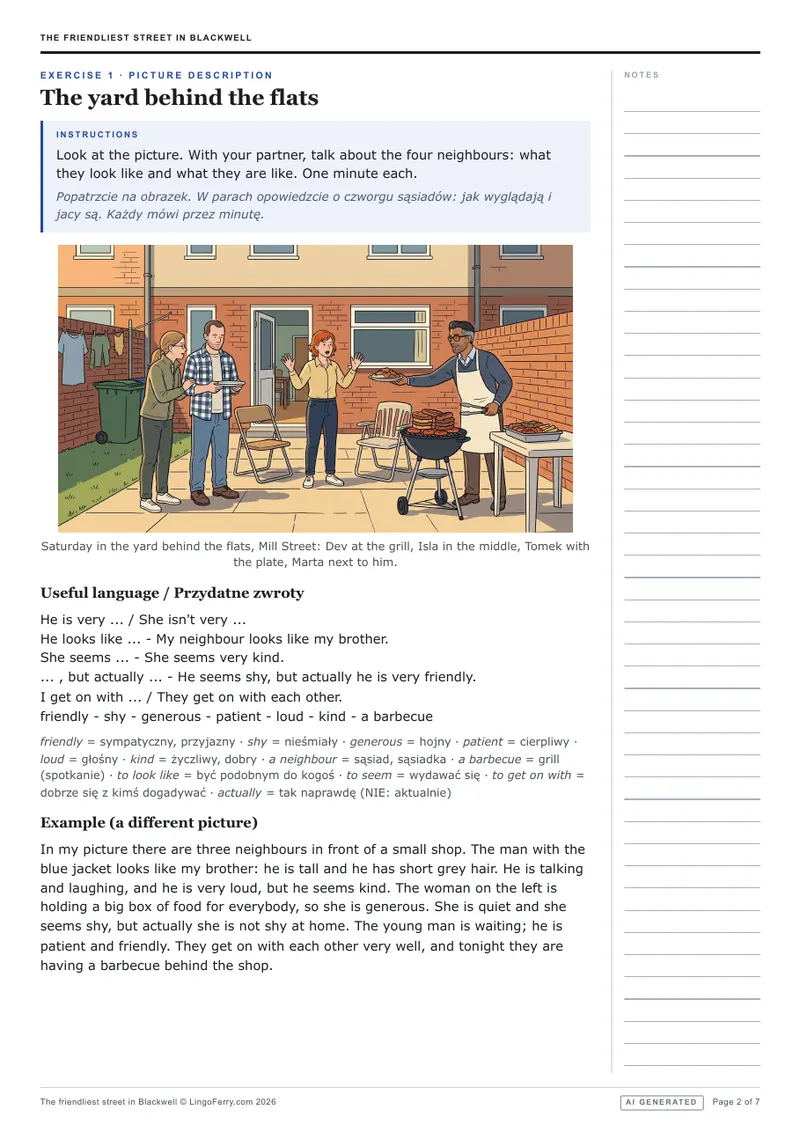
A 60-minute lesson on describing people, for A2 groups of Polish adults: what someone looks like, what they are like and how you feel about them. It is Saturday, and there is a barbecue in the yard behind the flats on Mill Street. All four characters are there, and everyone gets described to somebody else, always a little too generously.
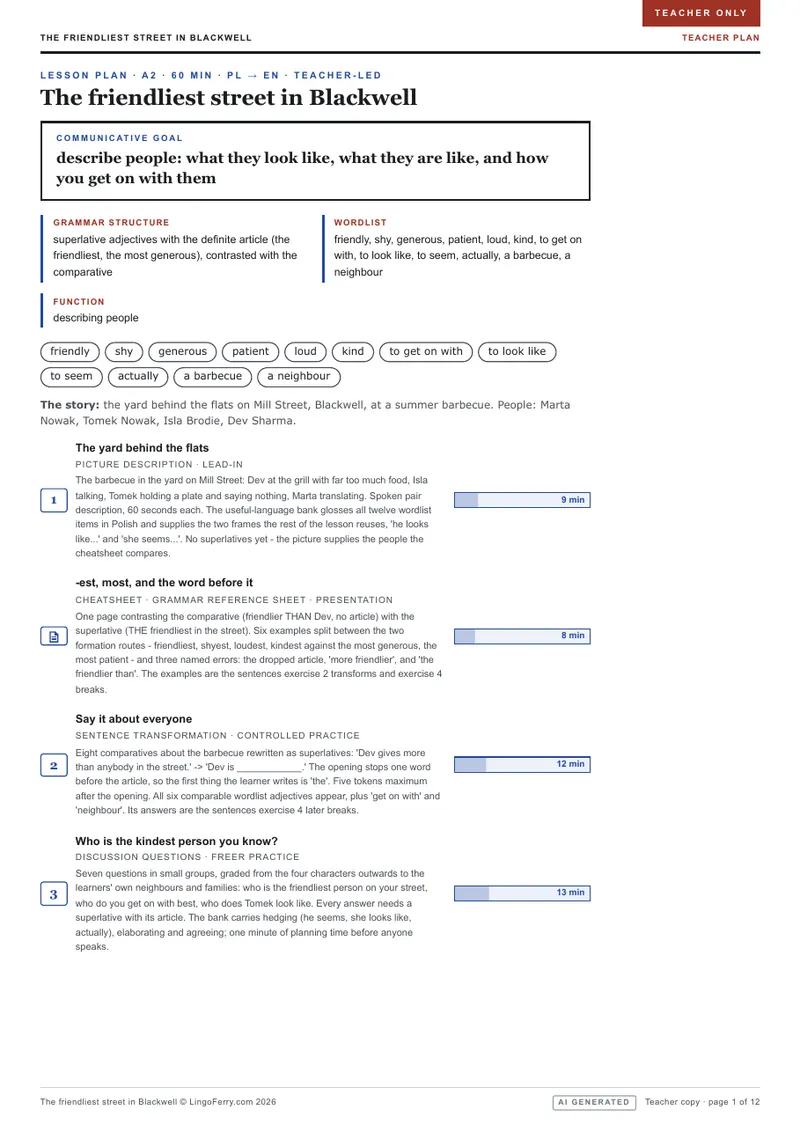
Pairs start by describing the four neighbours in the picture with look like, seem and actually. A cheatsheet contrasts louder than with the loudest. Students then rewrite comparatives as superlatives, discuss the kindest and most patient people they know in groups of three, and finish by correcting Marta's message to her sister after the barbecue. Afterwards they can describe people with the right superlative, the included, and say that someone seems shy but actually isn't.
Describe people — appearance, personality and how you feel about them.
- Grammar
- Superlative adjectives with the definite article; adjectives — personality, description, feelings.
- Function
- Describing people.
- Words (12)
- friendlyshygenerouspatientloudkindget on withthe funniestthe mostlook likeseemactually
Why Polish speakers get this wrong
Polish has no articles and builds every superlative with one prefix, naj-, so najmilszy sąsiad carries first place on its own. English needs a word in front as well, and that word is the. Learners who say "Dev is kindest neighbour" already have the ending right and are missing only the article. Two more transfers follow: double marking ("more friendlier than") and, once the rule has been taught, the leaking onto the comparative ("the shyer than").
The lesson makes the visible, then obligatory, then scored. The cheatsheet sets the two forms side by side: the comparative takes than and no article, the superlative takes the every time, and it prints those three mistakes. The transformations turn comparatives into superlatives, and the final error correction opens with a superlative missing its the. The teacher notes suggest one question to drill: how many people? Two take than; the whole group takes the.
Free guide: Dev is the kindest neighbour: why superlatives need “the” →
60 min · 5 exercises
- 1The yard behind the flatsPicture description · Lead-in9 min
- 2-est, most, and the word before itGrammar cheatsheet · Presentation8 min
- 3Say it about everyoneSentence transformation · Controlled practice12 min
- 4Who is the kindest person you know?Discussion questions · Freer practice13 min
- 5Marta writes it all down wrongError correction · Review10 min
Say it about everyone
Finish the second sentence so that it says the same as the first. Write only the missing words on the line, three words at most.
- Dev is more generous than any other neighbour here. Dev is ............ neighbour here.
- Isla is louder than everybody else at the barbecue. Isla is ............ person at the barbecue.
- Marta is more patient than the other three. Marta is ............ of the four.
- No other neighbour in Blackwell is kinder than Dev. Dev is ............ neighbour in Blackwell.
- Isla seems more confident than the other three. Isla seems ............ of the four.
As printed on the student sheet. Answers are in the teacher pack.
- 1Student pack7 pages · A4 PDF
- 2Teacher pack: plan, notes, answer key12 pages · A4 PDF
Questions about this lesson
My students know -est already. Why a whole lesson?
Because the ending is rarely the problem. A2 learners who say "kindest neighbour" are missing one word, the, and Polish gives them nothing to notice it by. The lesson contrasts the superlative with the comparative, practises the article until it is automatic and checks it in the final error correction.
How long is it, and how is the time split?
60 minutes, in five parts: the picture (9 minutes), the cheatsheet (8), sentence transformation (12), discussion in groups of three (13) and error correction (10). The student pack is seven A4 pages and the teacher pack twelve.
Are the discussion questions personal?
Lightly. The first two are about the people in the picture, so everyone has an answer. Later ones ask about neighbours, family and friends, but only who is the loudest, the most patient or the easiest to get on with. Nothing asks about money, health, work or a difficult relative.