All mistakes / A2
Dev is the kindest neighbour: why superlatives need “the”
An English superlative almost always takes the: “Dev is the kindest neighbour”, “Marta is the most patient of the four”. Polish marks first place with naj- and nothing else, so the is the word that goes missing. The comparative works the other way round: than, and no the.
What it sounds like
What the mistake looks like
The typical sentence is nearly right: “Dev is kindest neighbour on Mill Street.” The -est ending is there, the adjective is right, and the listener understands. One word is missing, the, and without it the sentence sounds clipped, like a headline.
Three more mistakes gather around it. The superlative gets marked twice: “the most friendliest”. The two ways of forming it get mixed: “the patientest”. And once learners know that superlatives need the, it leaks onto the comparative: “Isla is the friendlier than Tomek.”
Describing people brings its own vocabulary traps, such as sympathetic and actually; those are covered in the guide to false friends.
Why Polish causes it
Polish builds every superlative the same way, with the prefix naj-: najmilszy, najgłośniejszy, najcierpliwszy, or najbardziej with longer words. The prefix carries the whole idea of first place. „Dev jest najmilszym sąsiadem” needs nothing else, and since Polish has no articles, there is no slot where the could go.
English splits the job in two. The ending or most shows the degree, and the shows that we mean the one at the top of a group. A Polish speaker hears -est, feels the job is done and stops.
The other mistakes have the same source. Polish marks the degree once, so learners who have met both -est and most sometimes stack them. Polish has one main route, naj-, so the English split between -est for short adjectives and most for long ones is new, and -est gets over-used: “patientest”. And because Polish says „najlepszy na świecie”, many learners translate na as on: “the best on the world”.
The rule in English
One-syllable adjectives take -est: loud, the loudest; kind, the kindest; shy, the shyest. Two-syllable adjectives ending in -y change it to -iest: friendly, the friendliest; easy, the easiest. Most other adjectives of two or more syllables take most: the most generous, the most patient. Irregular: good, the best; bad, the worst; far, the furthest (or the farthest).
The goes in front whenever the superlative picks one out of a group: “Isla is the loudest of the four.” It stays even when no noun follows: “Isla is the loudest.” After the superlative, use in with a place or a group (the best teacher in the world, the kindest neighbour in Blackwell) and of with a number or a plural (the most patient of the four, the youngest of us).
The comparative is the opposite: two people, than, and no the. “Isla is louder than Marta.” A quick test: how many people are you comparing? Two take than; the whole group takes the.
Real exceptions exist, but they are not the Polish mistake. A possessive replaces the: “my best friend”, “Poland's biggest city”. In informal speech the is sometimes dropped when no noun follows (“Which one is cheapest?”), but with the you are always safe. With of the two, careful English uses a comparative with the: “Isla is the taller of the two”. When you compare one thing with itself in different situations, the is usually left out: “The lake is deepest here.” And in formal English most without the can mean very: “You are most kind.” In an ordinary description of people, use the.
How to practise it
Learn the superlative with its article as one unit: the kindest, the most patient, the best. Never practise “kindest” on its own.
Describe your family or your colleagues in five sentences with superlatives: “My brother is the tallest. My mum is the most patient person I know.” Then add two comparatives about the same people, with than and no the. Saying both side by side is what makes the difference stick.
When you read, notice what comes before -est and most. It is almost always the, a possessive or a phrase like one of the.
For teachers: a learner who says “kindest neighbour” already has the form and is missing one word, so correcting the article and leaving the ending alone is enough. Setting the two forms side by side and asking how many people are being compared also catches the article leaking onto the comparative. An error-correction task with one or two sentences that are already right shows who has started to over-correct.
How lesson A2.3 works on it
Lesson A2.3 of English for Polish Adults, “Meet the neighbours”, takes 60 minutes. It is Saturday, there is a barbecue in the yard behind the flats on Mill Street, and everyone gets described to somebody else, always a little too generously. The lesson is designed so that the word the is first visible, then obligatory, then scored.
After a picture lead-in with look like, seem and actually, a cheatsheet sets the two forms side by side: the comparative takes than and no article, the superlative takes the every time. It prints the three mistakes a Polish speaker makes: “Dev is kindest neighbour”, “more friendlier than” and “the friendlier than”. In the sentence transformation, eight comparatives become superlatives, and every gap has printed words on both sides, so the first word the learner writes is the and a comparative would break the sentence.
In the discussion that follows, groups of three talk about the kindest and most patient people they know, with the instruction to use the in every answer; the teacher holds up one finger for a missing the instead of stopping the talk. The lesson ends with Marta's message to her sister after the barbecue: eight sentences with one mistake each, two already correct. The first item is a superlative without the, and another checks a missing a before a singular noun, a different article rule.
Check yourself
Complete each sentence with the comparative or the superlative of the adjective in brackets. Add the where it is needed.
- Dev is ___ neighbour on our street. (kind)
Answer
the kindest
- My grandmother is ___ person in our family. (patient)
Answer
the most patient
- This is ___ café in Blackwell. (good)
Answer
the best
- Anna is ___ than her sister. (friendly)
Answer
friendlier (or: more friendly)
- In English, Tomek is ___ of the four. (shy)
Answer
the shyest
- It was ___ day of my holiday. (bad)
Answer
the worst
- The park is ___ than the high street. (quiet)
Answer
quieter
- Who is ___ person you know? (funny)
Answer
the funniest
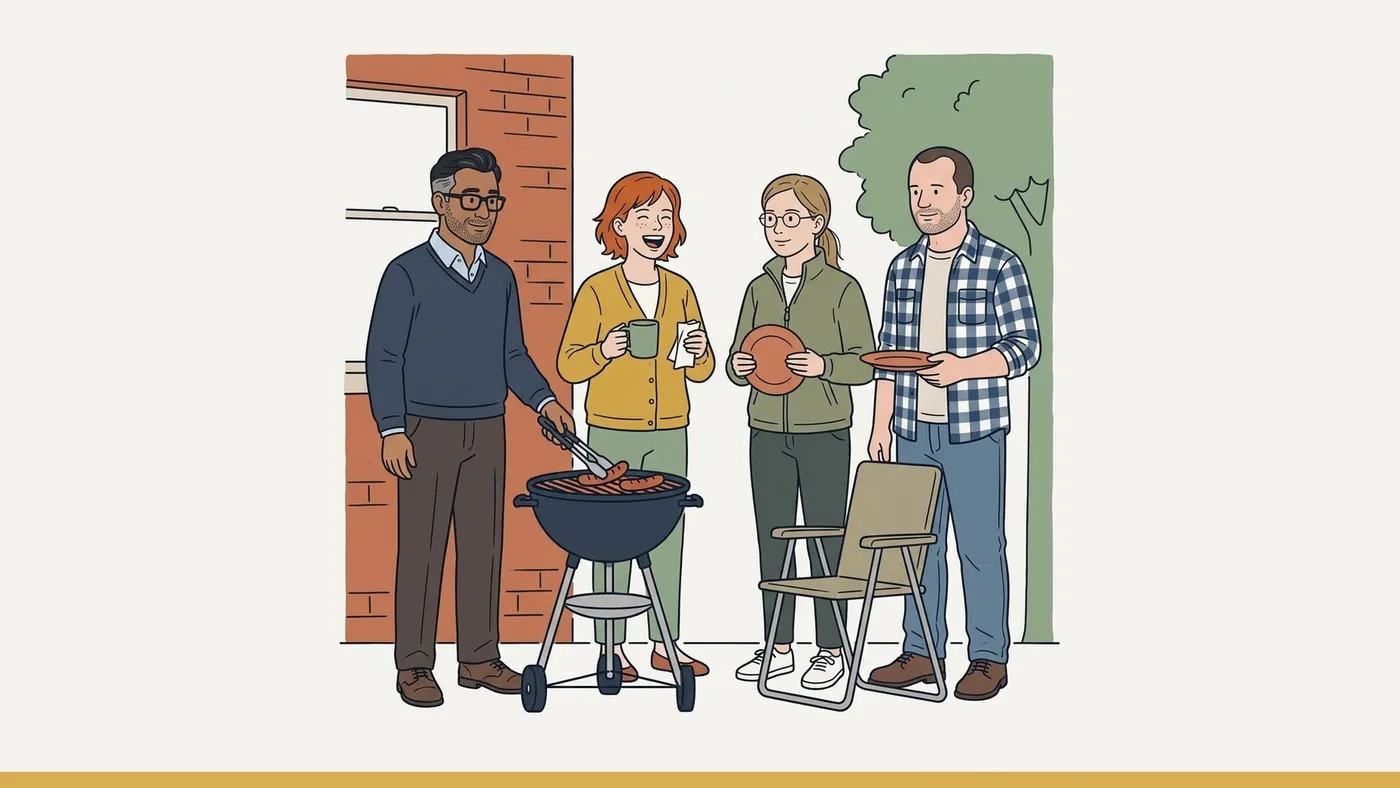
Meet the neighbours
Superlatives · describing people