You have to register
Have to · should
The council, the NI number, the bank, the deposit. Dev keeps a laminated sheet under the till for exactly this.
- Level
- A2
- Length
- 40 min
- Exercises
- 3
One-off payment · print for your own groups · 14 days to change your mind · faktura VAT
About this lesson
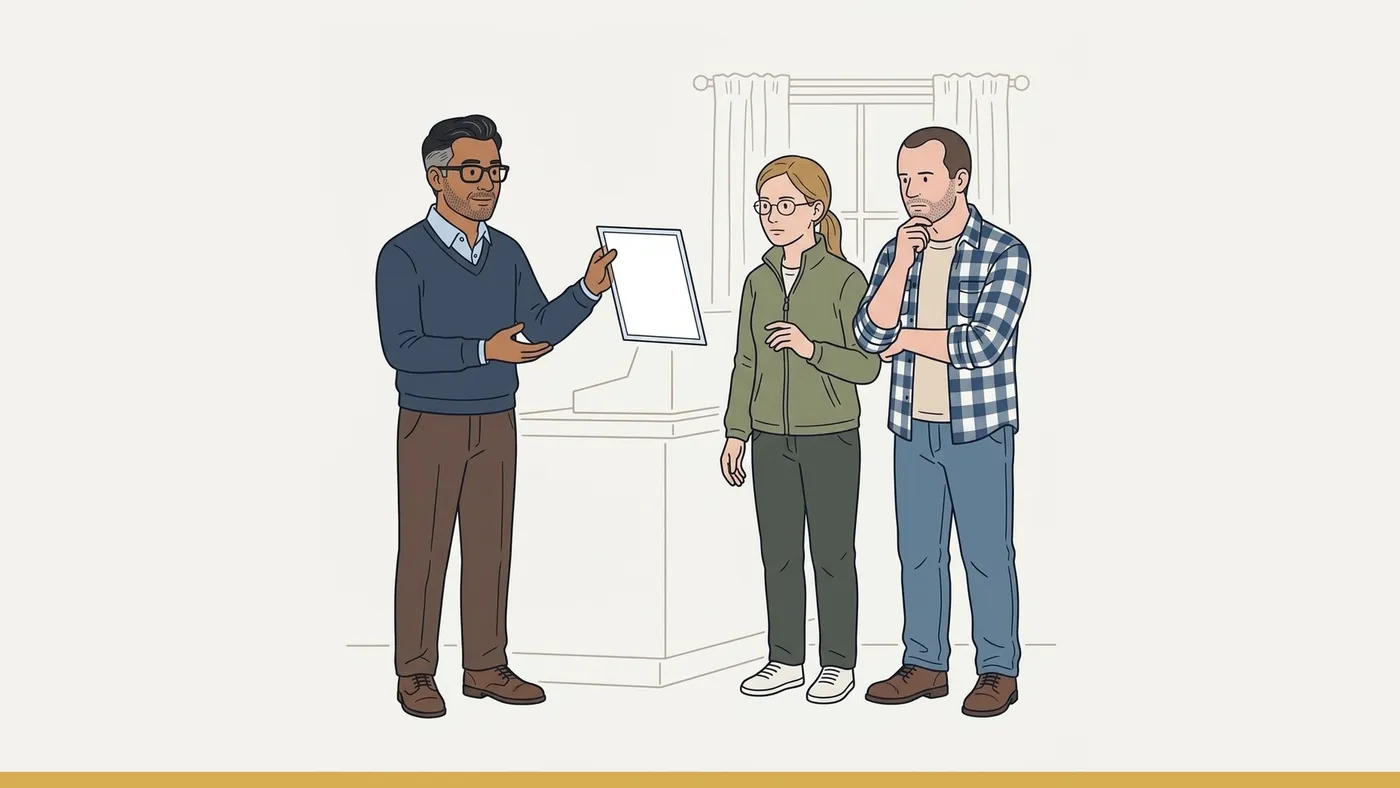
A 40-minute lesson on obligation and polite requests, for A2 groups of Polish adults. The council, the National Insurance number, the bank, the deposit: Dev keeps a laminated sheet under the till listing what a new arrival has to do, and the Nowaks have until Friday.
There is no warm-up. Students first build sentences from a two-column table, one block from each side: Marta has to, Tomek should, register at the council. Then they look at Dev's list in the picture and write eight sentences about Marta and Tomek, including what they don't have to do and what they shouldn't do. The lesson ends with a role play: Tomek wants Dev to fill in his council form, Dev has a queue and won't. Afterwards students can say what they must and needn't do, and ask for help politely.
Say what you must, must not and do not have to do, and ask someone politely to help.
- Grammar
- Have to; should; obligation and necessity.
- Function
- Obligation and necessity; requests.
- Words (11)
- registercouncildeadlineproofdepositlandlordallowedcompulsoryapplyfill insign
Why Polish speakers get this wrong
Polish powinien is one inflected word, and it carries no infinitive marker. English gives learners have to, where to belongs, and they carry it over: "I should to go". The second problem is requests. Wypełnij is an ordinary Polish request, but "Fill in this form for me" sounds like an order in English, and the speaker cannot hear it.
The lesson builds should so that to has nowhere to go. In the first table the subject is welded to its modal on the left, the to of have to printed with it, and nothing on the right starts with to. The written task repeats those frames. In the role play Tomek only gets anywhere by asking properly, with a phrase bank that starts: Could you help me with this, please?
Free guide: I should go, not “I should to go”: modal verbs without to →
40 min · 3 exercises
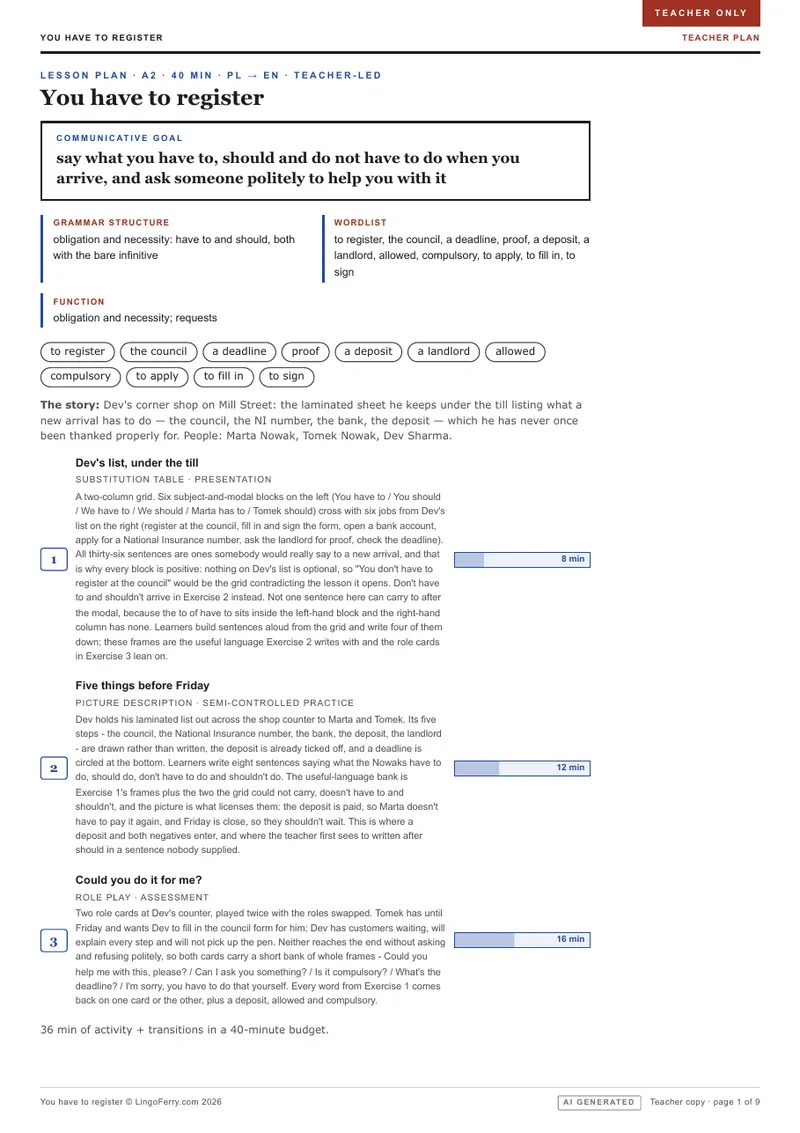
- 1Dev's list, under the tillSubstitution table · Presentation8 min
- 2Five things before FridayPicture description · Semi-controlled practice12 min
- 3Could you do it for me?Role play · Assessment16 min
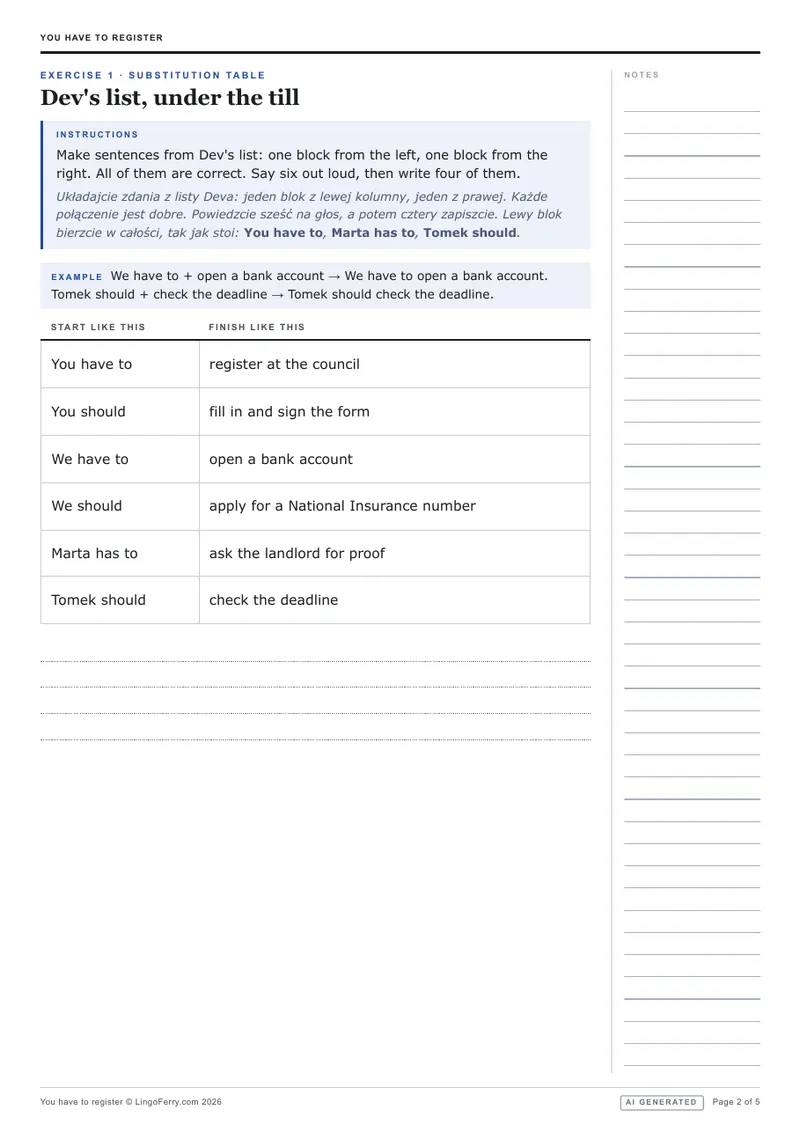
Dev's list, under the till
Make sentences from Dev's list: one block from the left, one block from the right. All of them are correct. Say six out loud, then write four of them.
- You have to | register at the council
- You should | fill in and sign the form
- We have to | open a bank account
- We should | apply for a National Insurance number
- Marta has to | ask the landlord for proof
- Tomek should | check the deadline
As printed on the student sheet. Answers are in the teacher pack.
- 1Student packs A + B (role cards)10 pages · A4 PDF
- 2Teacher pack: plan, notes, answer key9 pages · A4 PDF
Questions about this lesson
Why is this lesson only 40 minutes?
It has three exercises with one shape: show it, write it, use it. The table takes 8 minutes, the writing task 12 and the role play 16. There is no warm-up; the new words come inside the first two exercises and return on the role cards.
How does the role play work?
It comes as two student packs, A and B, each with a cut-out card. Tomek wants his council form filled in for him; Dev knows the rules but volunteers nothing, so Tomek has to ask. Pairs play four minutes, swap roles and play again.
What does the teacher pack tell me to listen for?
Three things in the role play: the extra to after should, pairs working only in imperatives, and Dev explaining everything at once. The notes also expect "What I have to do?" and dropped articles, and suggest boarding a few sentences between the two rounds. The pack is nine A4 pages.