Have you ever…?
Present perfect
Six months in. Isla asks what they have and haven't done in England yet, and is appalled by the answers, in a friendly way.
- Level
- A2
- Length
- 50 min
- Exercises
- 4
One-off payment · print for your own groups · 14 days to change your mind · faktura VAT
About this lesson
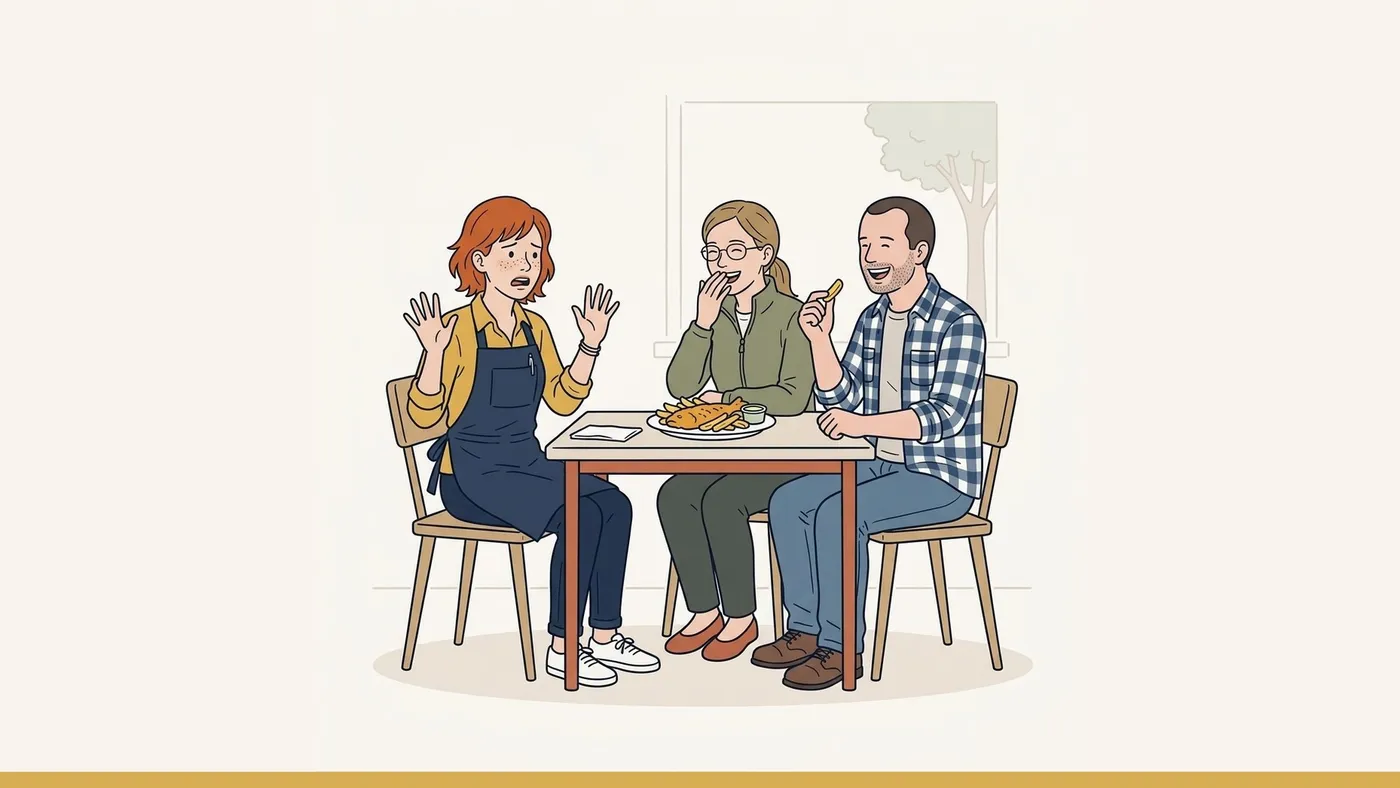
A 50-minute lesson on the present perfect for A2 groups of Polish adults: talking about experiences without saying when. Six months after the Nowaks arrived, Isla asks in her cafe what they have and haven't done in England yet, and is appalled by the answers, in a friendly way.
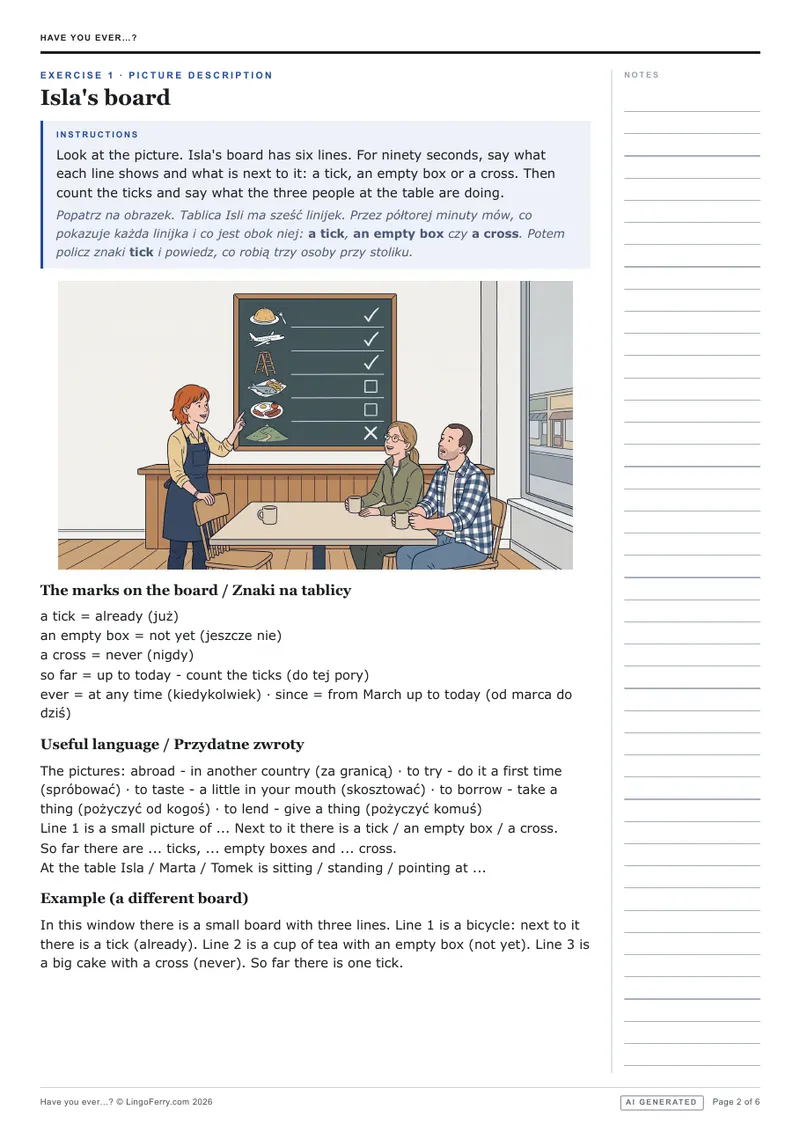
Pairs start with the board behind Isla's counter: six lines, each with a tick, an empty box or a cross, so already, not yet and never make sense before any grammar. A cheatsheet then sets the present perfect beside the past simple and gives one test: name a time and the past simple is right again. Students mingle asking Have you ever…?, follow every yes with When?, and finish by repairing ten sentences. Afterwards they can ask about experiences and switch tense once a time is named.
Talk about experiences you have had, without saying when.
- Grammar
- Present perfect; wh-questions in the past.
- Function
- Describing past experiences.
- Words (11)
- everneveralreadyyetabroadtrytasteborrowlendsinceso far
Why Polish speakers get this wrong
Polish has no perfect tenses. It marks aspect on the verb itself, jadłem against zjadłem, and próbowaliśmy covers both "we tried" and "we have tried". So a Polish speaker asks "Did you ever eat haggis?" and hears nothing wrong. This is the first contact with an error that runs through all of B1.
The lesson turns it into a question of time words. The cheatsheet has two columns, no time named and a time named, and students keep it on the desk all hour. In the mingle every Have you ever…? must be followed by When? or What was it like?, with the answer written in the past simple. The error correction includes two sentences that are already right because they name a time, so students must decide, not change everything.
Free guide: Have you ever or did you ever: why it's “Have you ever eaten haggis?” →
50 min · 4 exercises
- 1Isla's boardPicture description · Lead-in8 min
- 2No when, or a whenGrammar cheatsheet · Presentation8 min
- 3Have you ever…?Find someone who · Controlled practice14 min
- 4Two of these are already rightError correction · Review15 min
Two of these are already right
Isla and the Nowaks are talking about their first six months. Eight sentences have one mistake. Two sentences are correct. Write only the words you change. If a sentence has no mistake, write correct.
- Did you ever borrow money from a friend?
- Marta has been to Scotland in April.
- Marta and Tomek arrived in England six months ago.
- Have you ever ate fish and chips?
- When have you tried haggis?
- Tomek has borrowed already the ladder twice.
As printed on the student sheet. Answers are in the teacher pack.
- 1Student pack6 pages · A4 PDF
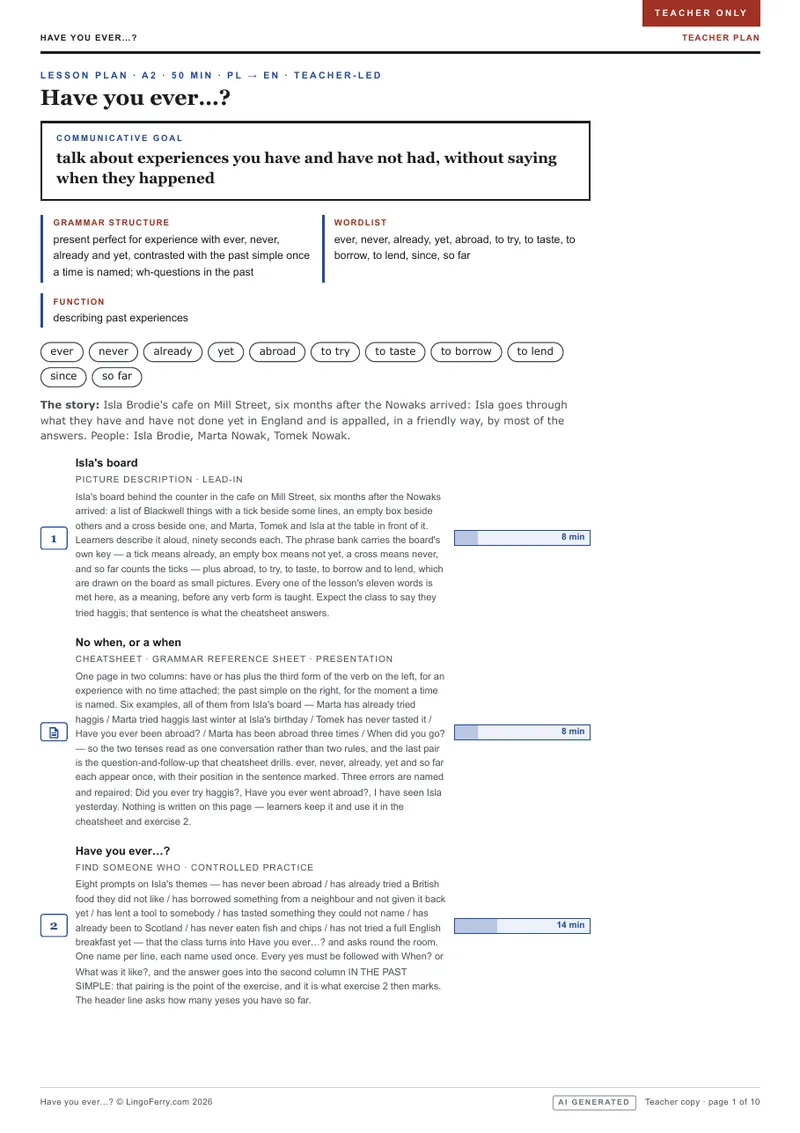
- 2Teacher pack: plan, notes, answer key10 pages · A4 PDF
Questions about this lesson
Does the lesson also cover the past simple?
Yes, as the other half of the choice. The cheatsheet puts the two tenses side by side, and the mingle makes students alternate: Have you ever tasted haggis? Yes. When? I tried it last winter. That alternation is what the lesson is really teaching.
My classroom is small. Does the mingle still work?
The teacher notes cover this. If the room is tight, clear a lane down the middle, or keep half the class seated while the other half moves, and swap after four minutes. The activity takes 14 minutes: two to set up, eight moving and four to report back.
What do I get for this lesson?
A six-page student pack and a ten-page teacher pack, both A4 PDFs. There is no recording. The teacher pack has setup and timing for each part, a rubric for the picture task, and a key to the error correction that explains each answer.