All mistakes / A2
Have you ever or did you ever: why it's “Have you ever eaten haggis?”
To ask about an experience at any point in someone's life so far, British English uses the present perfect: “Have you ever eaten haggis?” The moment you name a time, such as last winter or in 2019, the past simple is right again: “When did you try it?”
What it sounds like
What the mistake looks like
“Did you ever eat haggis?” “Were you ever in Scotland?” “I was never abroad.” None of these is nonsense, and a British listener understands every one. But they sound as if they were about a finished chapter of your life, a job you left or a town you lived in years ago, not about your life so far. For your life so far, English has a different tense.
The mistake has a mirror image, and it usually arrives right after the present perfect has been taught: “I have been to Scotland in April”, “When have you tried it?” Once learners have a new tense, they put it on everything in the past, including sentences that name a time.
Two smaller slips travel with them. The third form of the verb goes missing, as in “Have you ever ate fish and chips?”, and the auxiliary disappears from the question altogether: “You ever tasted Polish food?”
Why Polish speakers make it
Polish has no present perfect. „Jadłeś kiedyś haggis?” „Byłeś kiedyś w Szkocji?” „Nigdy nie byłem za granicą.” All three are in the ordinary past tense, and Polish needs nothing more: kiedyś and nigdy already mean a whole life. Translated word for word, they give did you ever and I was never.
What Polish does mark on the verb is aspect: jadłem against zjadłem, próbowałem against spróbowałem. Some learners treat the perfective form as a Polish present perfect. It isn't one. „Wczoraj zjadłem cały tort” is perfective and still needs the English past simple, “I ate the whole cake yesterday”, because yesterday is a finished time. And „próbowaliśmy” covers both “we tried” and “we have tried”. Aspect is about completion; the present perfect is about a finished time versus the time up to now.
Polish questions add a third problem. They are formed with czy or with the voice alone, so there is no auxiliary to remember: „Jadłeś kiedyś…?” That is where “You ever tasted…?” comes from.
The rule: has a time been named?
Ask one question: have you named a time? If not, and you are talking about experience, anything at any point in your life up to now, use have or has with the third form of the verb: “Have you ever been abroad?” “Marta has already tried haggis.” “Tomek has never tasted it.” “I've been to Scotland three times so far.”
Name a time and the past simple is right again: “She went to Scotland in April.” “I tried it last winter.” A question with when asks for a time, so it normally takes the past simple: “When did you try it?”, never “When have you tried it?” A natural conversation moves between the two: “Have you ever tasted haggis?” “Yes.” “When?” “I tried it last winter.” “What was it like?”
Word order: ever, never and already go between have and the third form; yet goes at the end, in questions and negatives: “They haven't tried fish and chips yet.” Ever belongs mainly in questions; in a plain yes-answer, drop it: “Yes, I've been there twice”, not “I've ever been there”. For a trip you came back from, use been, not gone: “She's gone to Scotland” means she is there now.
“Did you ever…?” is not always wrong. If the period is over, the past simple is correct: “Did you ever go to the festival when you lived in Edinburgh?” asks about years that have ended. American English also uses it more freely. But for your life so far, British English uses the present perfect. Situations that are still going on, as in “I've lived here since March”, are a separate problem, covered in our guide to the present perfect with since and for.
How to fix it
For learners: learn the question as a block, Have you ever + third form. Have you ever been…, eaten…, tried…, lived… Say it until it comes out on its own.
Then practise the switch. Ask a friend, or yourself, three Have you ever…? questions, and after every yes add When? or What was it like?, answered in the past simple. That switch is the real skill.
Keep a short list of verbs whose past form and third form differ, because that is where the mistake shows: be, been; eat, eaten; go, gone; see, seen. With tried or tasted you won't notice anything, because both forms are the same word.
For teachers: don't practise the present perfect on its own. An exercise where every gap is have + third form teaches nothing about the choice. Mix in sentences with a named time that are already correct, and count it as a mistake when learners change them: that is where over-correction shows.
How lesson A2.5 works on it
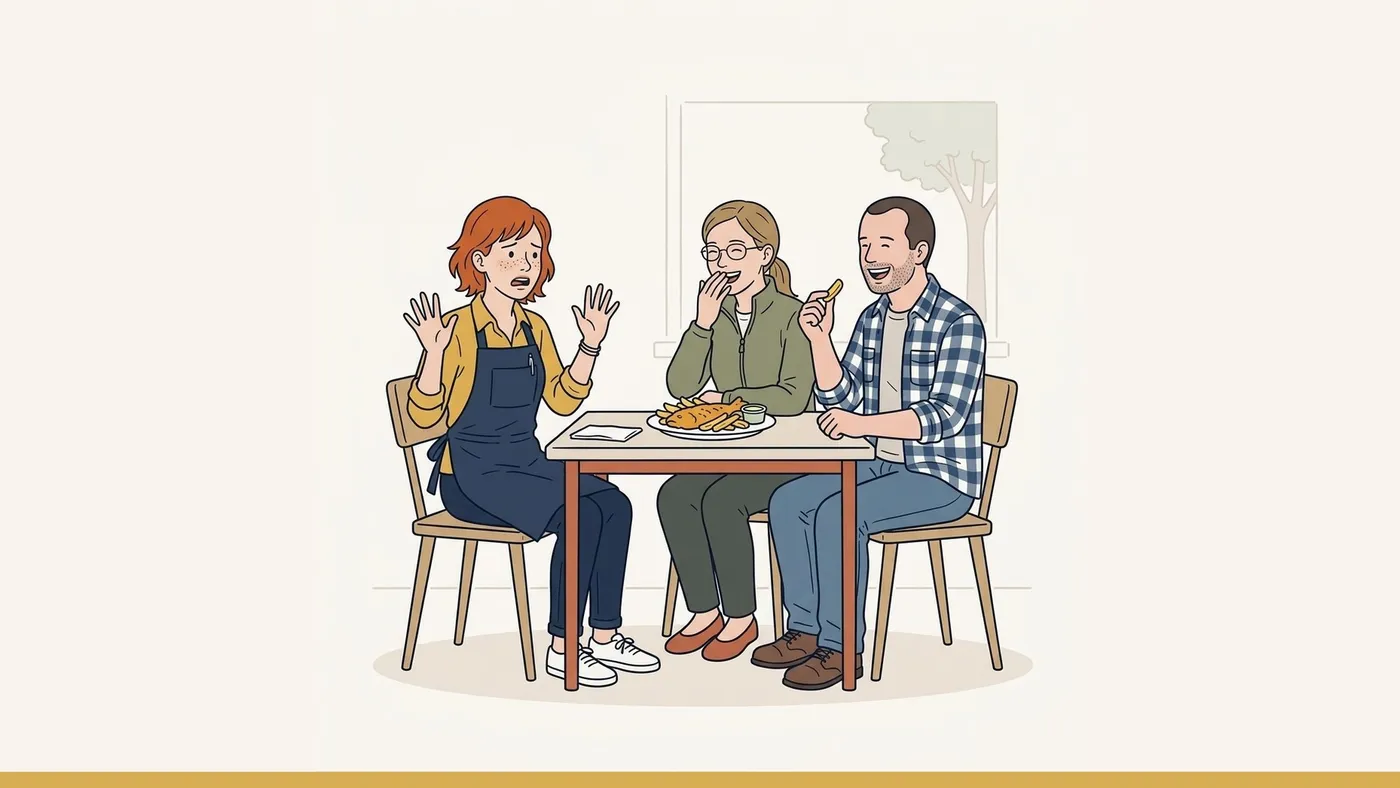
Lesson A2.5, “Have you ever…?”, takes 50 minutes. Six months after Marta and Tomek arrived, Isla goes through the board behind her café counter, the things they have and haven't done in England yet, and is appalled by the answers, in a friendly way.
It opens on that board: six lines, each with a tick, an empty box or a cross, so already, not yet and never have a meaning before any grammar. The teacher notes expect the class to describe it in the past simple and say not to correct it yet. The reference sheet, “No when, or a when”, sets the present perfect beside the past simple in two columns and gives one test: name a time and the past simple is right again.
Then the class stands up for a find-someone-who activity. Everyone asks Have you ever…?, and every yes has to be followed by When? or What was it like?, with the answer written in the past simple. The lesson ends with ten sentences to repair, including “Did you ever borrow money from a friend?” and “When have you tried haggis?”. Two of the ten are already correct because they name a time, so learners have to decide rather than change everything. There is no recording for this lesson.
Check yourself
These sentences are about life experience, in British English. Six have one mistake each and two are correct. Write the correct sentence, or write “Correct”.
- Did you ever try sushi?
Answer
Have you ever tried sushi?
- I have been to Edinburgh last summer.
Answer
I went to Edinburgh last summer.
- Have you ever ate haggis?
Answer
Have you ever eaten haggis?
- When have you visited London?
Answer
When did you visit London?
- She has never been abroad.
Answer
Correct.
- Yes, I've ever been there twice.
Answer
Yes, I've been there twice.
- Isla lent Tomek her ladder in March.
Answer
Correct.
- Have you seen the new film? Yes, I have seen it on Saturday.
Answer
Have you seen the new film? Yes, I saw it on Saturday.
Have you ever…?
Present perfect