If it rains
First conditional · future
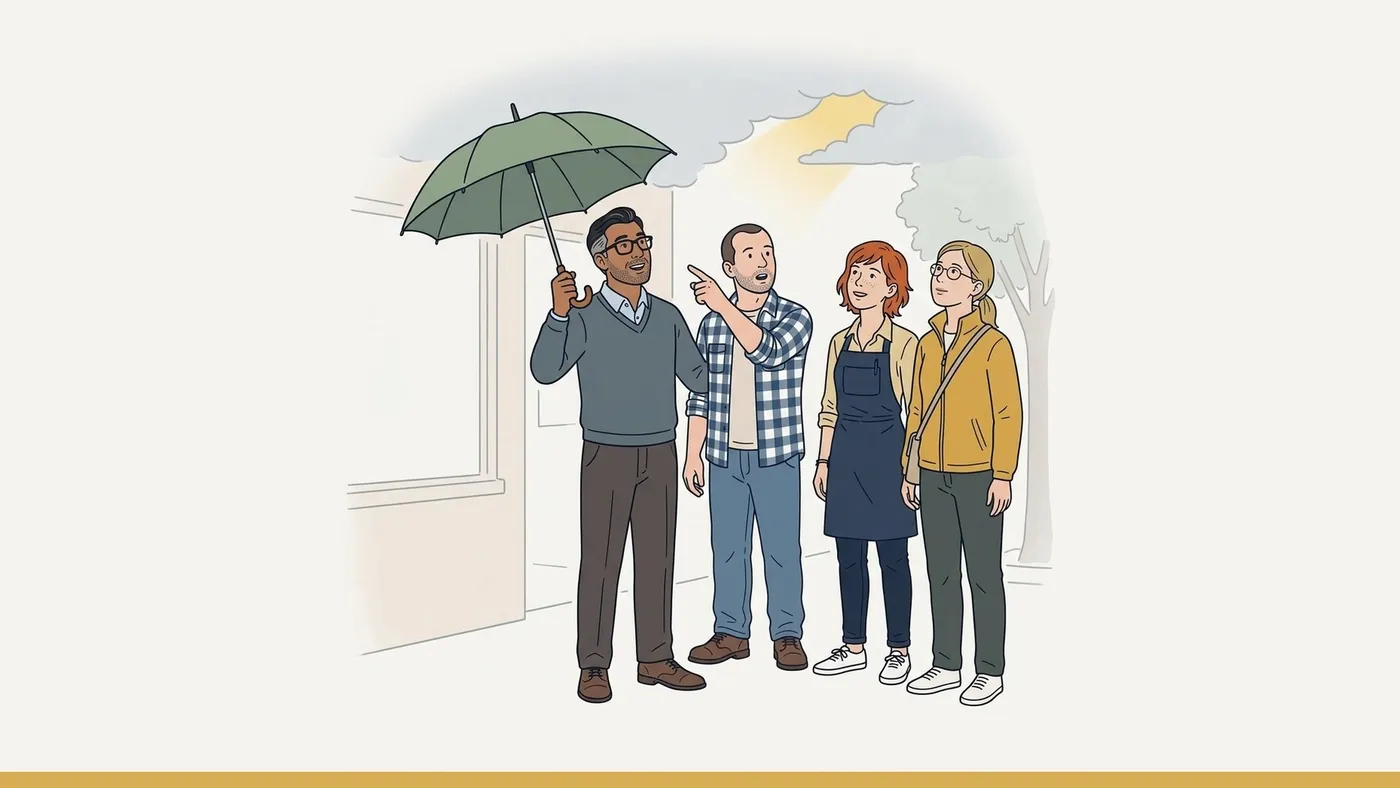
Planning a day out: four people, four opinions, and a forecast that nobody trusts.
- Level
- A2
- Length
- 60 min
- Exercises
- 5
One-off payment · print for your own groups · 14 days to change your mind · faktura VAT
About this lesson
A 60-minute lesson on plans, suggestions and conditions, for A2 groups of Polish adults. On a Thursday evening in Isla's cafe, the four characters plan a Saturday walk up the hill: four opinions, and a forecast that nobody trusts.
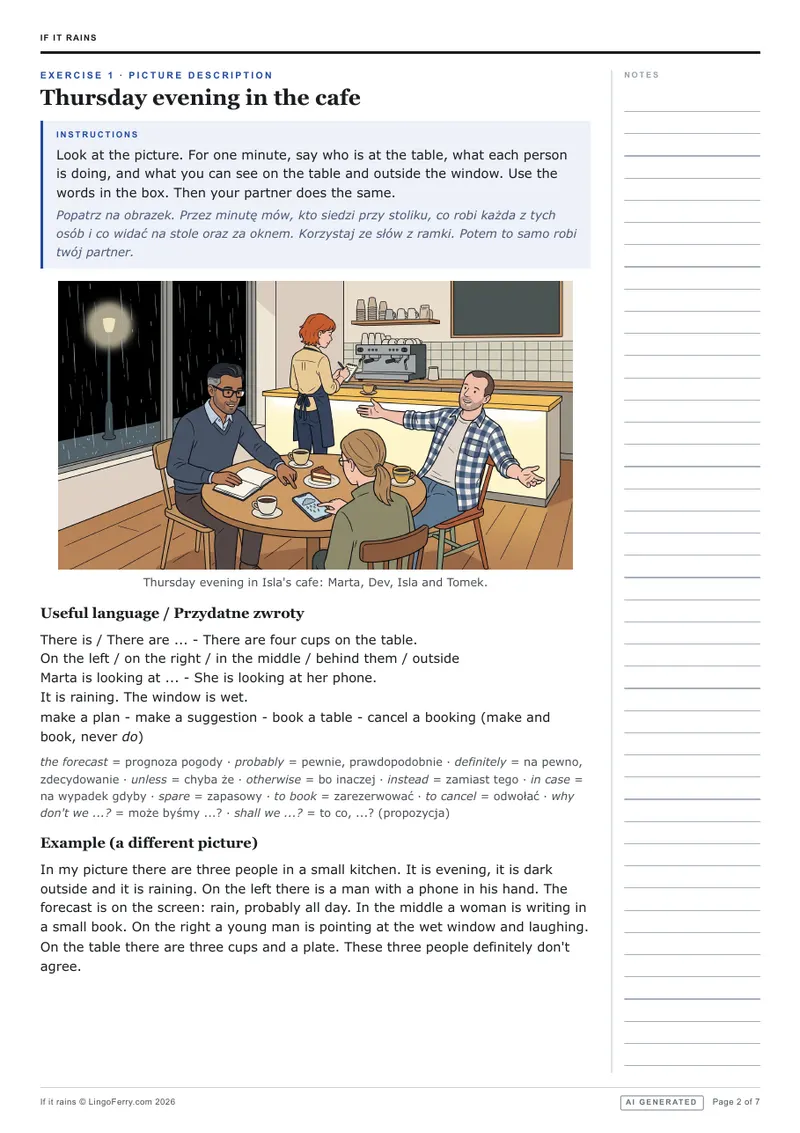
Pairs describe the cafe table, with a box that glosses the new words in Polish and fixes four phrases: make a plan, make a suggestion, book a table, cancel a booking. Students read the Thursday conversation, where each person talks about Saturday in a different way. Then they fill in Friday's text messages with the present, will or going to. A role play follows: Saturday morning, rain, played twice with roles swapped. Ten sentences from the weekend close the lesson. Afterwards students can make and answer suggestions and say what happens if the plan changes.
Make plans and suggestions, and say what will happen if something else happens.
- Grammar
- Zero conditional; first conditional; future time — will and going to; present continuous for future.
- Function
- Suggestions.
- Words (12)
- forecastunlessprobablydefinitelywhy don't weshall webookcancelinsteadotherwisesparein case
Why Polish speakers get this wrong
Polish zrobić covers both make and do, so English collocations go wrong in a predictable way: "Let's do a plan", "Shall we do a booking?". Nothing in the Polish sentence tells the learner which verb English wants. Plans are made, not done, and tables are booked.
The lesson treats these as fixed phrases, not a rule. The box in the first exercise prints make a plan, make a suggestion, book a table and cancel a booking, with the note "make and book, never do", and the teacher says them aloud with the class. The notes tell the teacher to give the sentence back with make or book every time do a plan comes up that day. The final error correction plants both mistakes, and the feedback goes back to the four phrases.
Free guide: Make or do: why it's “Let's make a plan”, not “Let's do a plan” →
60 min · 5 exercises
- 1Thursday evening in the cafePicture description · Lead-in9 min
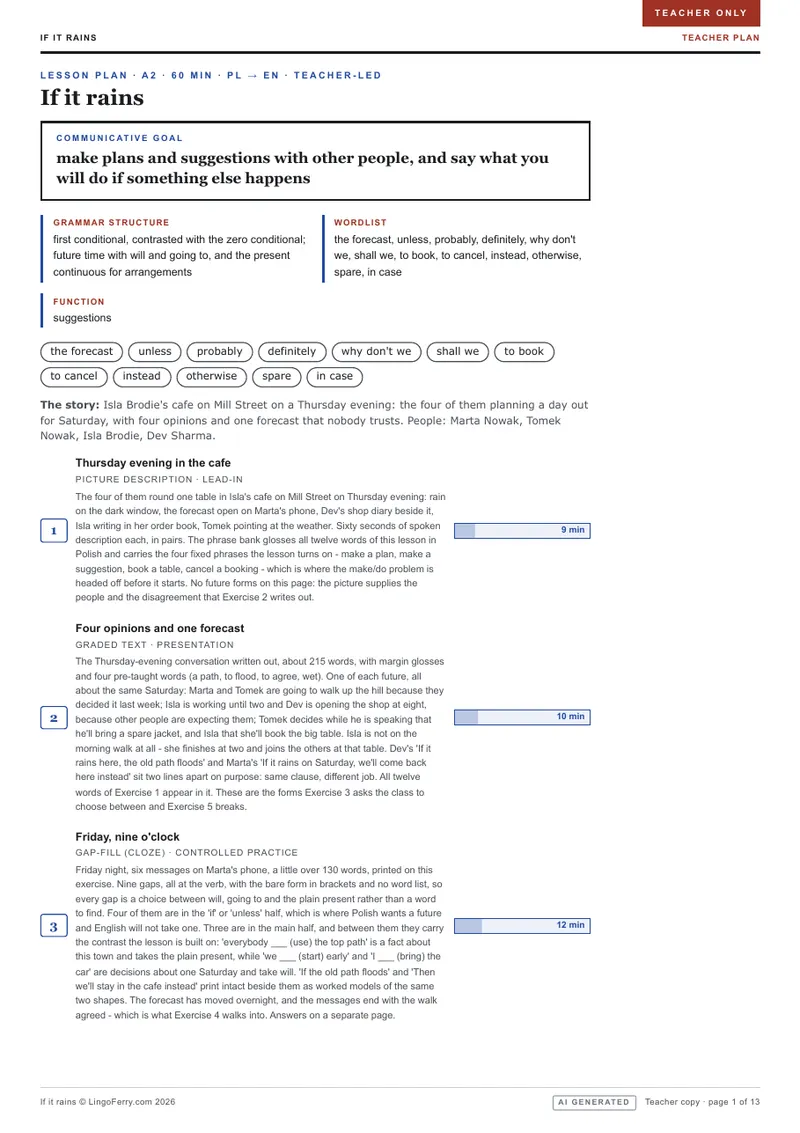
- 2Four opinions and one forecastGraded reading · Presentation10 min
- 3Friday, nine o'clockGap fill · Controlled practice12 min
- 4Cancel it or goRole play · Freer practice16 min
- 5Ten things somebody got wrongError correction · Review11 min
Ten things somebody got wrong
These ten sentences are all about the same Saturday. Eight sentences have one mistake. Two are correct. Write the correct words. If a sentence has no mistake, write correct.
- If it will rain on Saturday morning, we'll come back here instead.
- We decided last week, so I will walk up the hill on Saturday.
- Why don't we do a plan for Saturday before we go home?
- Shall we do a booking for the big table at two o'clock?
- The forecast says rain from eleven, so we'll probably cancel the walk.
- We'll walk up the hill on Saturday unless it doesn't rain.
As printed on the student sheet. Answers are in the teacher pack.
- 1Student packs A + B (role cards)14 pages · A4 PDF
- 2Teacher pack: plan, notes, answer key13 pages · A4 PDF
Questions about this lesson
Which future forms does the lesson cover?
Four: the zero and first conditional, will, going to and the present continuous for arrangements. They are not taught as four systems. They come from four people deciding about the same Saturday, and the gap-fill makes students choose the form each situation needs.
How long does it take?
60 minutes, in five parts: the picture (9 minutes), the conversation (10), the gap-fill (12), the role play (16) and the error correction (11). If time runs short, the teacher notes say which five error-correction sentences to read aloud at the end.
Are there role cards?
Yes. The lesson comes with two student packs, A for Tomek and B for Isla, each with a cut-out card and the same phrase bank for suggestions. Each card has a different goal, so the pair has to negotiate. The teacher pack is 13 A4 pages.