All lessons / B1 · Plans & surprises
If I had the money
Second & third conditionals
What each of them would do with five thousand pounds, and what they'd have done last year.
- Level
- B1
- Length
- 50 min
- Exercises
- 4
One-off payment · print for your own groups · 14 days to change your mind · faktura VAT
About this lesson
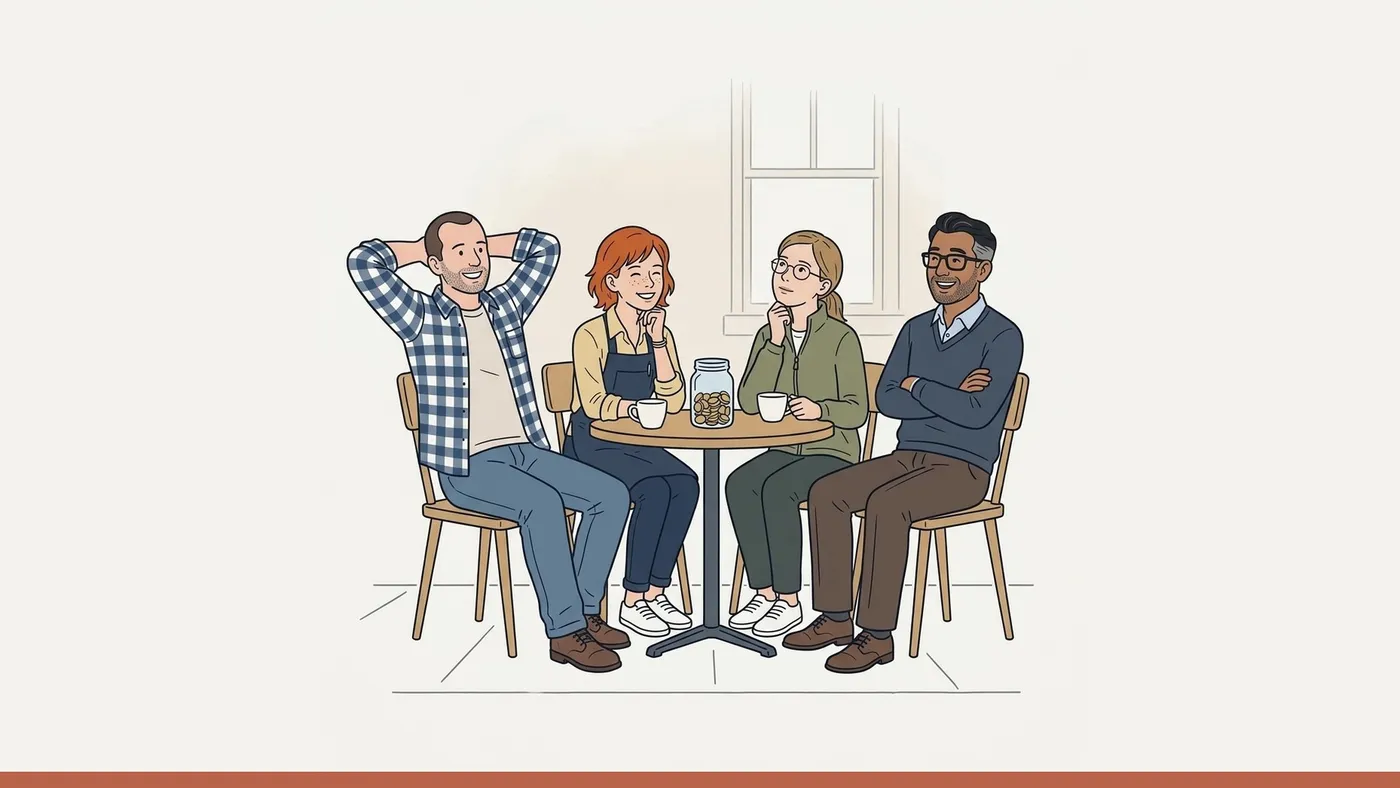
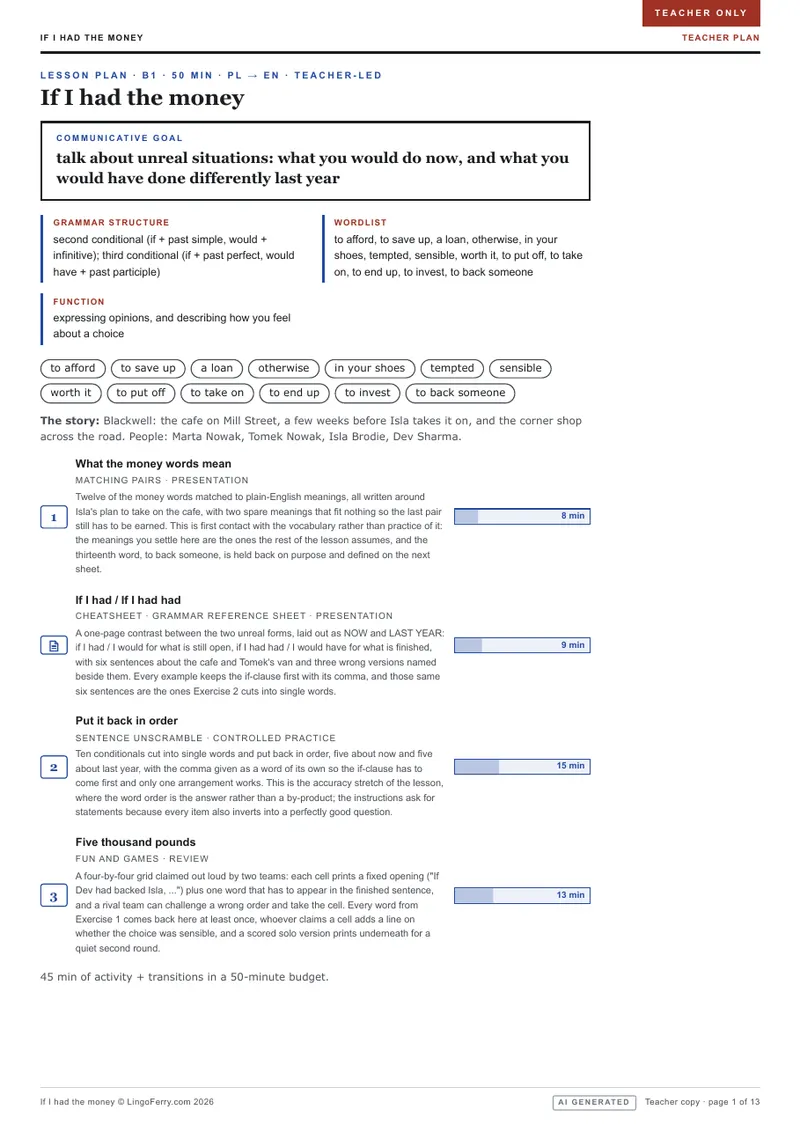
A 50-minute lesson for B1 groups who know the conditional forms but still get the order of the words wrong. The question is simple: what would Isla, Marta, Tomek and Dev do with five thousand pounds, and what would they have done with it last year? Nobody actually has the money.
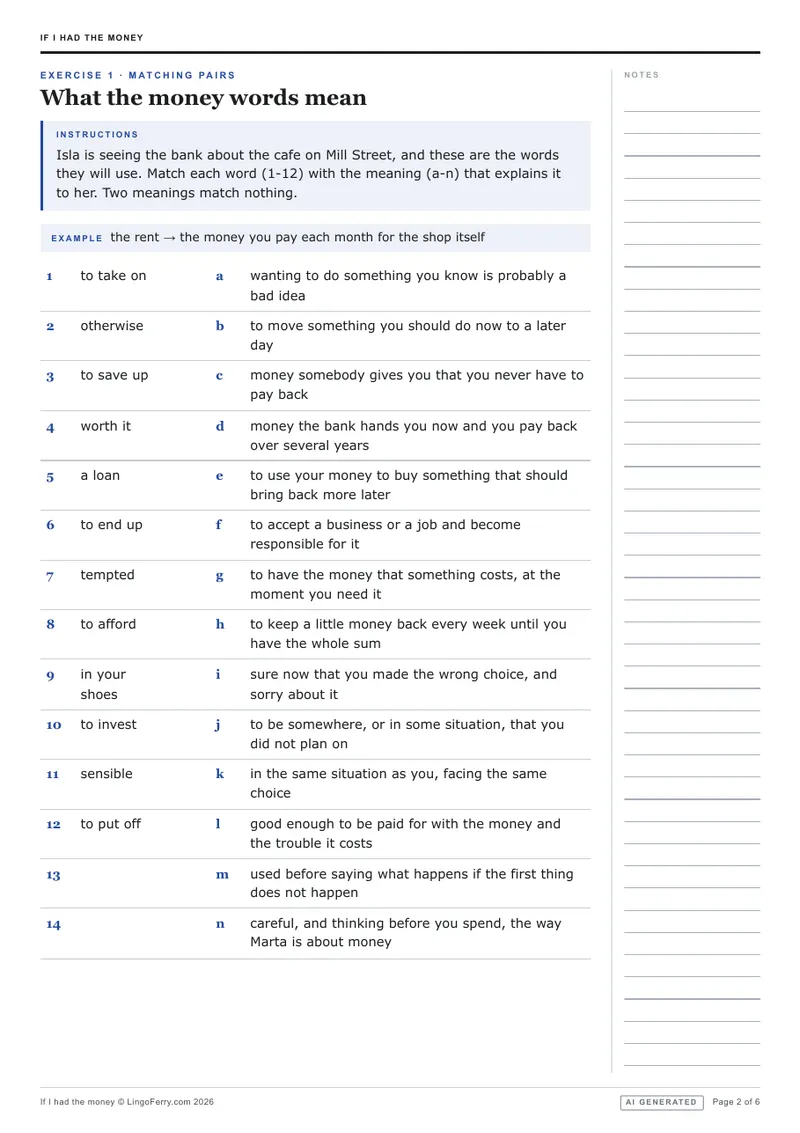
Students match the money words (afford, save up, a loan, worth it) to their meanings. A one-page reference puts the two unreal forms side by side as NOW and LAST YEAR, and shows three orders that go wrong. Then ten sentences to rebuild from loose words, with the comma as one of the pieces. The lesson ends with noughts and crosses on a four-by-four grid, where a cell is won with a correct conditional said out loud. Afterwards students can talk about unreal situations, now and in the past.
Talk about unreal situations, now and in the past.
- Grammar
- Second conditional; third conditional.
- Function
- Describing feelings and emotion; expressing opinions.
- Words (13)
- affordsave uploanotherwisein your shoestemptedsensibleworth itput offtake onend upinvestback
Why Polish speakers get this wrong
Polish word order is free because case endings show who does what. „Gdybym te pieniądze miał” is fine Polish: the object can come first and the meaning survives. English has no endings to lean on, so the subject comes before the verb and the object after it: If I had the money, not If the money I had. Two more faults come with it in conditionals: would inside the if-part, and then would I take it on in a statement.
The lesson scores the order, not the presence of would. The reference sheet names all three wrong orders. In the unscramble exercise the comma is a piece to place, and each statement has only one correct order. In the grid game a cell is lost if the subject does not come before would.
Free guide: Word order in English: why it's “If I had the money”, not “If the money I had” →
50 min · 4 exercises
- 1What the money words meanMatching · Presentation8 min
- 2If I had / If I had hadGrammar cheatsheet · Presentation9 min
- 3Put it back in orderSentence unscramble · Controlled practice15 min
- 4Five thousand poundsGame · Review13 min
Put it back in order
Put the words in order to make one correct sentence. Write a statement, not a question. The comma is one of the words, so put it where it belongs.
- on / she / the / , / had / take / would / if / money / she / it
- said / any / I / had / , / would / money / if / have / had / yes / I
- tempted / the / I / afford / , / would / if / rent / could / I / be
- your / would / I / shoes / if / , / him / were / ask / I / in
- worry / me / would / Dev / , / if / not / backed / I
As printed on the student sheet. Answers are in the teacher pack.
- 1Student pack6 pages · A4 PDF
- 2Teacher pack: plan, notes, answer key13 pages · A4 PDF
Questions about this lesson
Can one student play the game alone?
Yes. The sheet prints a solo round: play the diagonal, cells 1, 6, 11 and 16, write each sentence out and score three points a cell if all three rules hold. Then write the score down and try to beat it on the other diagonal the next day.
Why is there no warm-up or reading?
With four exercises, the plan spends the first twenty minutes agreeing the words and showing the wrong orders, and nothing new comes after that. Six of the ten unscramble items are the sentences from the reference sheet, and the grid asks for the same structures from memory.
What does the teacher pack cover?
Thirteen pages: the plan, keys and notes for each exercise. The notes say what to accept as well as what to correct: I would take it on if I had the money is correct English with no comma, and a question such as Would I take it on? counts as unfinished, not wrong.