All lessons / B1 · Plans & surprises
Somebody must have been here
Modals of deduction
They come home to a mended step, a finished shelf and a plant on the windowsill. Nobody admits to anything.
- Level
- B1
- Length
- 60 min
- Exercises
- 5
One-off payment · print for your own groups · 14 days to change your mind · faktura VAT
About this lesson
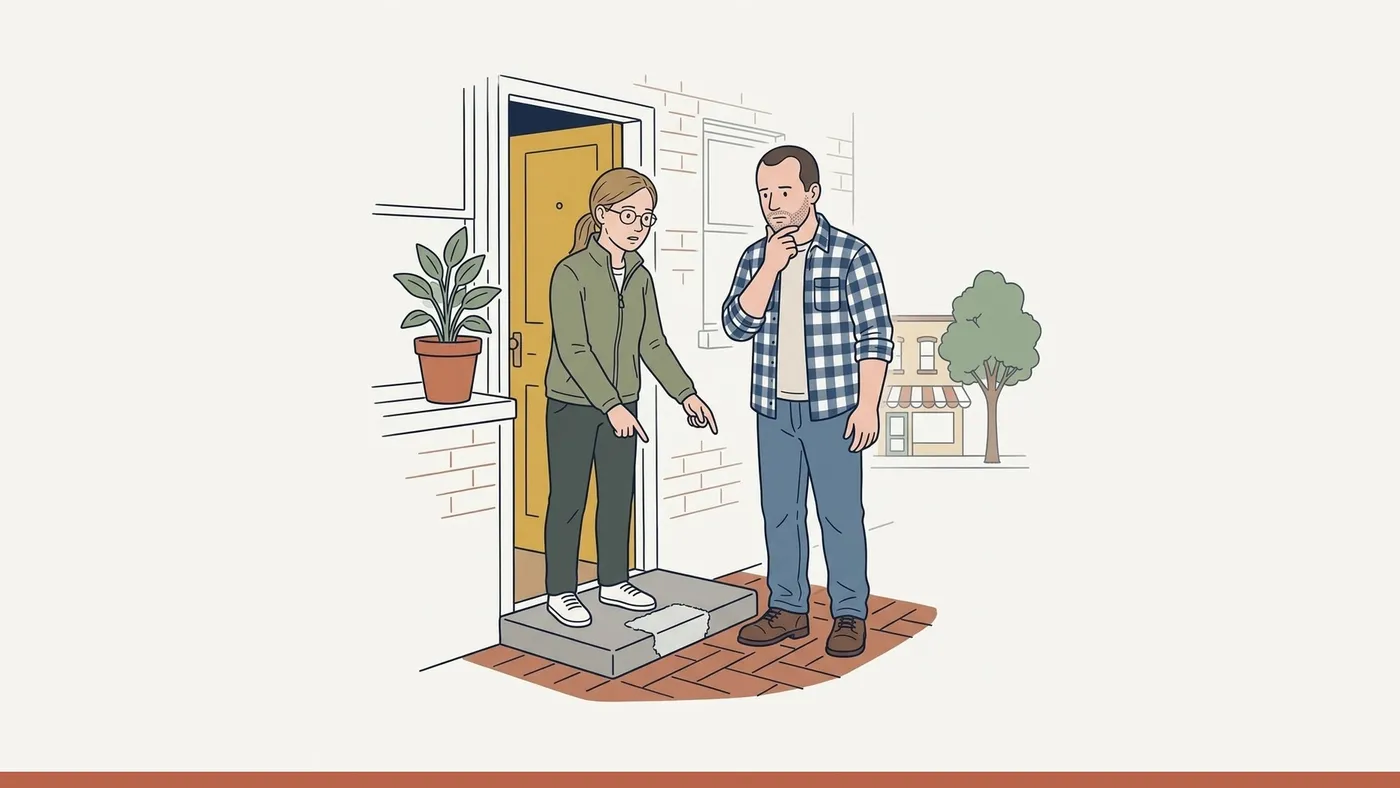
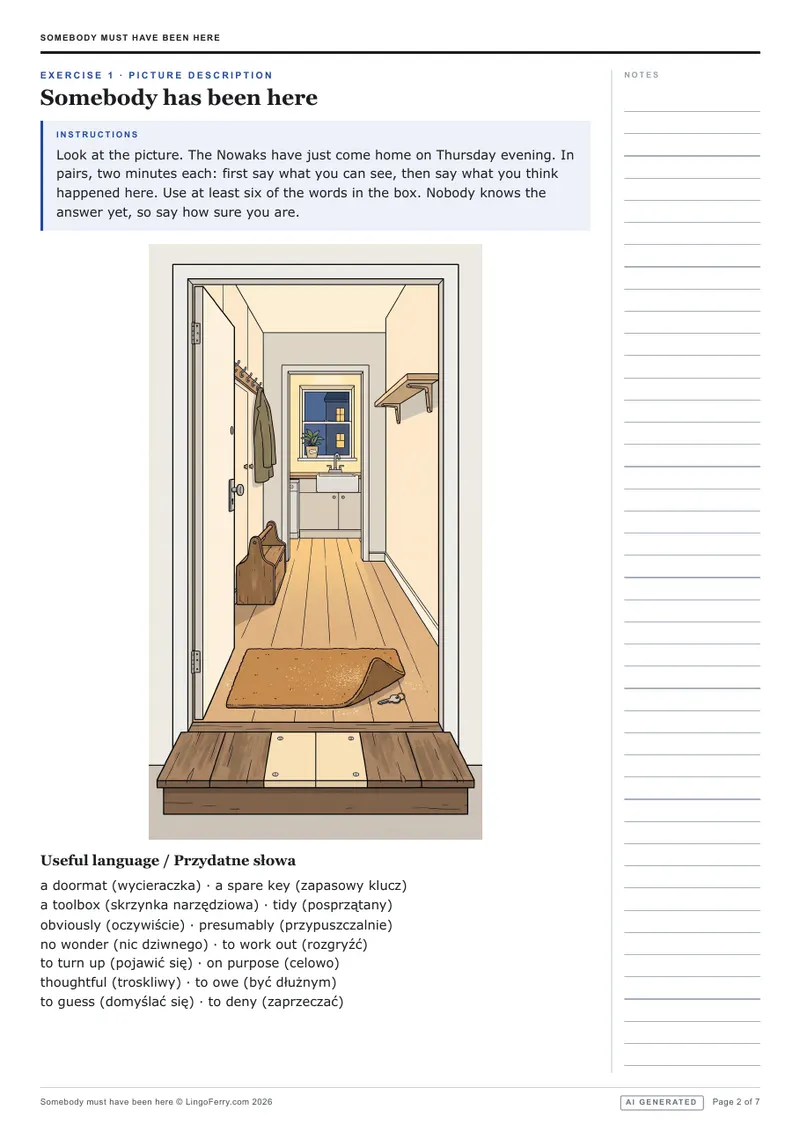
A 60-minute lesson for B1 groups ready to guess what happened and say how sure they are. The Nowaks come home on a Thursday evening to a mended front step, a finished shelf and a plant on the kitchen windowsill that nobody bought. Nobody admits to anything.
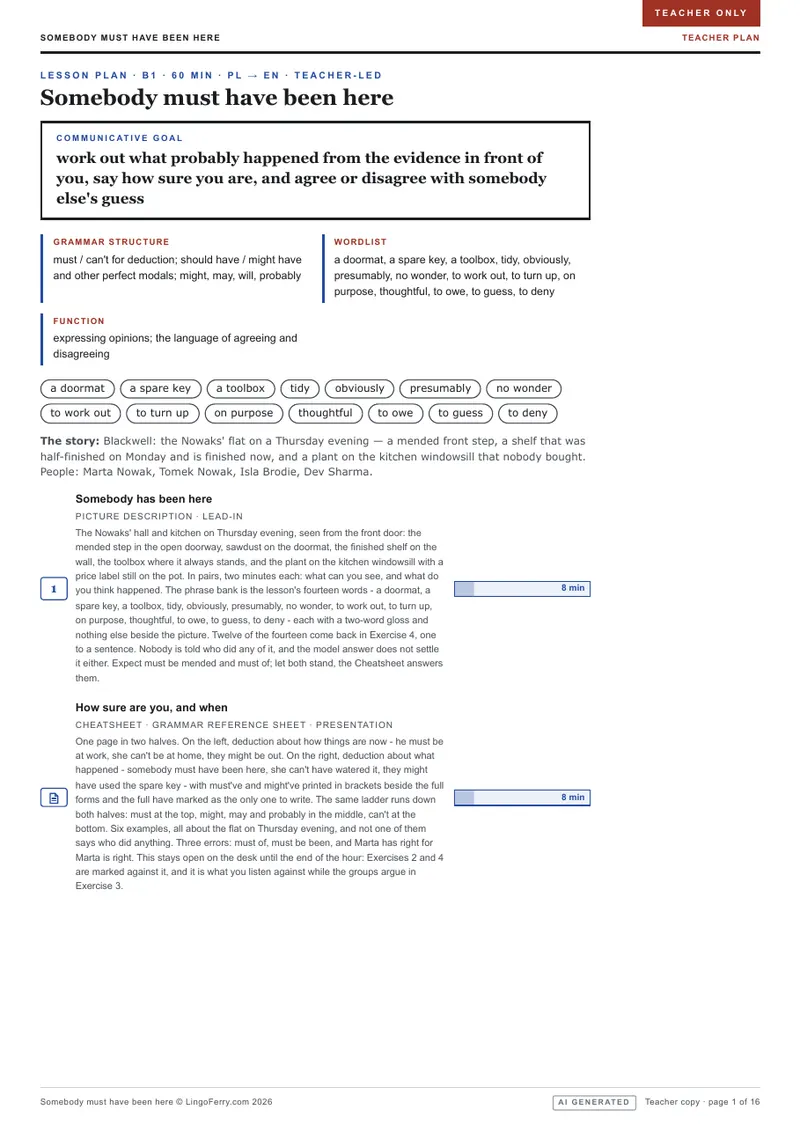
Pairs describe the hall from a picture: first what they can see, then what they think happened. A one-page reference sets out must, might, may, probably and can't as a ladder of certainty, about now and about the past. Students rewrite eight sentences from printed evidence, argue in groups about who did it with a phrase bank for agreeing and disagreeing, and finish by correcting twelve sentences that give away the answer. Afterwards they can work out what probably happened and say how sure they are.
Work out what probably happened, and say how sure you are.
- Grammar
- Must / can't for deduction; should have / might have and other perfect modals; might, may, will, probably.
- Function
- Expressing opinions; the language of agreeing and disagreeing.
- Words (14)
- doormatspare keytoolboxtidyobviouslypresumablyno wonderwork outturn upon purposethoughtfuloweguessdeny
Why Polish speakers get this wrong
Polish mieć covers states that English marks with be. „Mam rację” is I'm right, „mam szczęście” is I'm lucky, „ma czterdzieści lat” is it's forty years old. Once have becomes the verb for states, cold and hunger follow it across, even though Polish says „jest mi zimno” and „jestem głodny”: I have cold, Tomek had hungry.
In the picture task and the group argument, the notes say to say the sentence back with the right verb and move on. The reference sheet lists Marta has right among its three mistakes. The final correction page is built on this one habit: every modal in it is already correct, and nine of the twelve sentences use have where English needs be. Three are correct, to catch anyone who changes everything.
Free guide: “I have cold”, “It has 20 years”: when Polish mieć isn't have in English →
60 min · 5 exercises
- 1Somebody has been herePicture description · Lead-in8 min
- 2How sure are you, and whenGrammar cheatsheet · Presentation8 min
- 3Say how sure you areSentence transformation · Controlled practice12 min
- 4Well, who was it thenDiscussion questions · Freer practice14 min
- 5So it was youError correction · Review12 min
So it was you
Read all twelve in order. Nine have one mistake; three are right: write correct.
- Marta has right: nothing was forced, so they must have used the spare key.
- The kitchen had cold, but the flat was tidy, so they can't have hurried.
- The step has forty years, and presumably the same person mended it.
- No wonder Tomek had hungry: he must have been working since six.
- A plant nobody here bought has turned up on the windowsill, so it must be a present.
As printed on the student sheet. Answers are in the teacher pack.
- 1Student pack7 pages · A4 PDF
- 2Teacher pack: plan, notes, answer key16 pages · A4 PDF
Questions about this lesson
How long does it take?
60 minutes in five steps: picture description 8, reference sheet 8, sentence transformation 12, group discussion 14, error correction 12. For the discussion the notes suggest about two minutes a question, with question 5, who finished the shelf, the one worth the time.
Does the discussion have an answer key?
No, on purpose. The notes tell you not to confirm or reject any name a group offers. The answer comes in the final exercise: read in order, the twelve sentences say who mended the step, who left the plant and who was never there.
What is in the teacher pack?
Sixteen pages: the plan, keys, a model answer and rubric for the picture task, and notes on setup, timing and likely mistakes. They say to expect must of and can't of all over the rewriting exercise, and to write the full have on the board once and leave it there.