All mistakes / A1
Could I have a loaf? Why “Give me bread” sounds rude in English
In English, “Give me bread” is grammatical and still sounds rude. Polite requests are built as questions or softened statements: “Could I have a loaf, please?” or “I'd like a loaf, please.”
What it sounds like
What the mistake looks like
A Polish speaker walks into a shop and says: “Give me bread.” Or: “I want a coffee.” There is nothing wrong with the grammar. The person behind the counter still hears an order, and possibly a customer having a bad day.
Adding “please” helps less than you would think. “Please give me the receipt” is still an instruction, only a politer one. It is what you might say to a colleague who keeps ignoring you, not to someone who is serving you.
The awkward part is that the speaker usually has no idea. They meant to be polite, they even said please, and the other person went slightly cold. Neither side knows why.
Why Polish causes it
In Polish, the imperative is an ordinary way to ask for things. „Podaj mi sól” at the dinner table offends nobody. With strangers, Polish adds „proszę” and the formal Pan/Pani: „Proszę mi dać chleb”, „Poproszę bochenek chleba”. The politeness lives in those words and in the tone of voice, while the request itself can stay a plain statement or a command.
Translated word for word, „Proszę mi dać chleb” becomes “Please give me bread”, and „Chcę kawę” becomes “I want a coffee”. „Poproszę” has no one-word English equivalent, so learners reach for the nearest verb they know: give or want.
English puts politeness somewhere else: in indirectness. Instead of telling the other person what to do, you ask whether something is possible (“Could I have…?”, “Can I have…?”) or say what you would like, with a conditional (“I'd like…”). The distance built into could and would is what makes the request polite. Please is the finishing touch, not the whole job.
The rule in English
To ask for something for yourself, in a shop, a café or at the table: “Could I have a loaf, please?”, “Can I have a bag?”, “I'd like a coffee, please.” Could is a touch more polite than can, but at a shop counter both are fine. For two or more people: “Could we have the bill, please?”
To ask someone to do something: “Could you pass the salt?”, “Can you help me with this?”, or, more formally, “Would you mind closing the window?”
Watch “I'd like”. It is short for “I would like”, and it is not the same as “I like”. “I like coffee” is a fact about your tastes. “I'd like a coffee” is an order at the counter.
The imperative does have a place in English: instructions (“Turn left at the church”), recipes, warnings (“Watch out!”) and offers, where it actually sounds warm: “Have a biscuit”, “Come in”, “Sit down”. Between people who know each other well it is fine too. What it does badly is ask a stranger for something. And “I want” is not banned either: “I want to go home” is a perfectly normal sentence. It is just not how you order.
How to practise it
Learn the openings as whole blocks, the way you learn single words: I'd like, Could I have, Can I have. Do not assemble them from parts every time. At the counter there is no time for assembly.
Pick one opening and use it for everything for a week. “Could I have…” works for bread, a ticket, the bill and the Wi-Fi password. Put please at the end, where it most often goes: “Could I have the bill, please?”
For teachers: explaining politeness at A1 is slow and abstract. Recasting works better. When a learner says “Give me bread”, say the request back with a polite opening and let them repeat it. No lecture, no side-by-side comparison. Role play at a counter gives the phrases a reason to exist, and it brings prices and numbers along for free.
How lesson A1.3 works on it
Lesson A1.3 of English for Polish Adults, “Dev's shop”, takes place on the evening of the first full day in Blackwell, when Dev's corner shop across Mill Street is the only one still open. Marta crosses the road for bread and milk. Dev works out which flat she has taken before she tells him, and puts a second loaf in the bag without charging for it. The lesson takes 40 minutes.
It opens with a substitution table: five openings on the left (I'd like, Could I have, Can I have, Could we have, Can we have) and five things from the shop on the right, with all twenty-five combinations usable at a real counter. Next, learners match Marta's requests to Dev's replies, which also practises prices, including the difference between forty and fourteen. It ends with a picture of the shop: learners say what is on the shelves and what it costs, then buy three things using only the phrases in the box.
The teacher notes take a deliberate line. When a learner says “Give me bread” or “I want bread”, the teacher says the sentence back with one of the five openings, hands it back to the learner and moves on, without comparing the two versions. At A1 the openings are learned the way words are learned: by saying them.
Check yourself
Make each sentence a polite request. Start with the words in brackets and end with please.
- Give me a coffee. (I'd like)
Answer
I'd like a coffee, please.
- Give me a bag. (Can I have)
Answer
Can I have a bag, please?
- I want some milk. (Could I have)
Answer
Could I have some milk, please?
- Give us the bill. (Could we have)
Answer
Could we have the bill, please?
- Close the window. (Could you)
Answer
Could you close the window, please?
- I want two loaves. (I'd like)
Answer
I'd like two loaves, please.
- Give me a receipt. (Could I have)
Answer
Could I have a receipt, please?
- Help me with this bag. (Can you)
Answer
Can you help me with this bag, please?
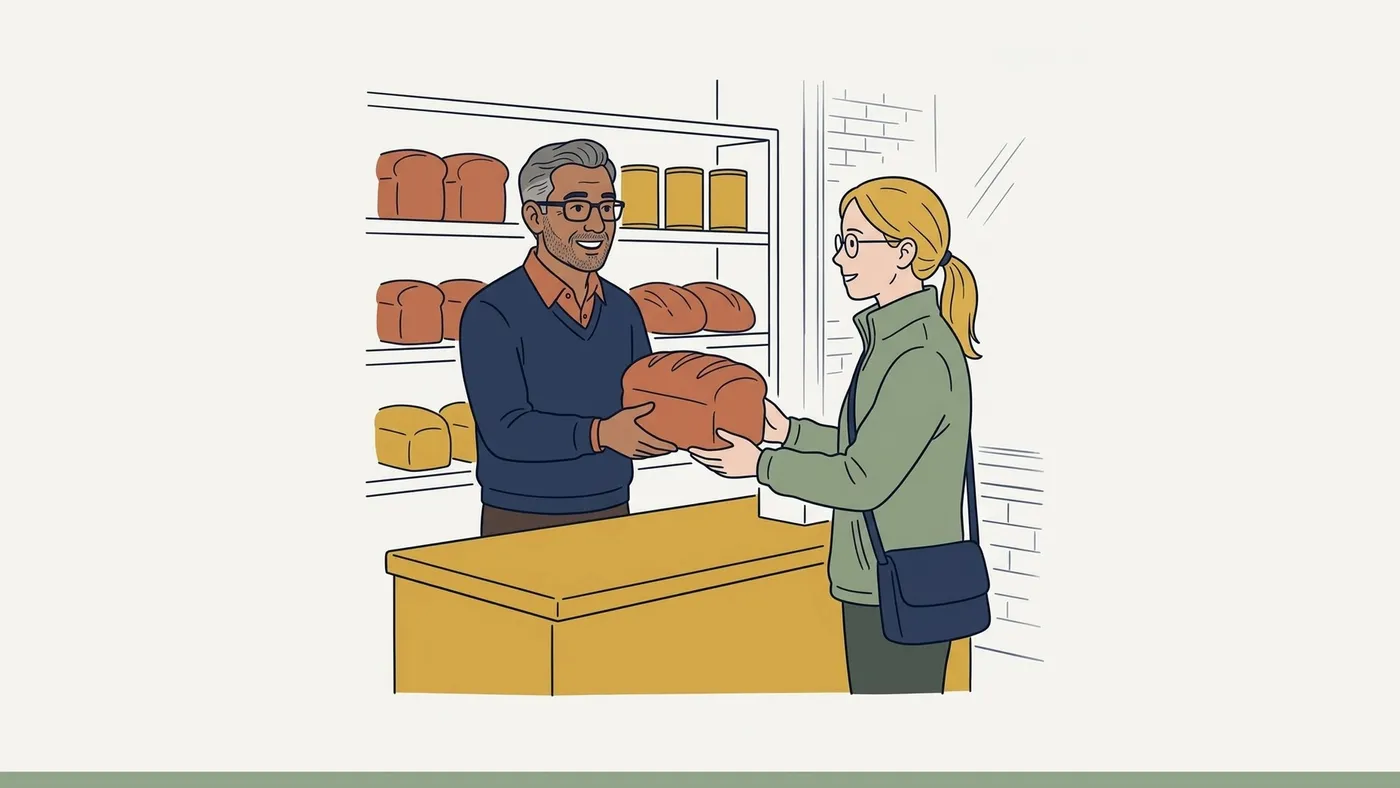
Dev's shop
I'd like · how much / how many