All mistakes / A1
I'm working now, not I work now: present simple vs present continuous
Use the present continuous (am/is/are + -ing) for what is happening at this moment: “I'm working now”, not “I work now”. Keep the present simple for habits and routines: “I work every day.” Polish uses one present tense for both, which is why the choice feels invisible.
What it sounds like
What the mistake looks like
Your phone rings. “What are you doing?” “I cook dinner.” The answer is understandable and wrong. An English speaker hears a statement about your habits, something like “I am a person who cooks dinner”, not news about what is happening in the kitchen right now.
Other versions: “Look, it rains.” Or “Where do you go?” said to someone walking out of the door. Then there is the half-repaired form, where the -ing arrives but the auxiliary does not: “Tomek putting up a shelf now.”
Once learners discover the continuous, the mistake often flips over: “Every day I am going to work by bus.” The problem is not the -ing ending. It is the choice.
Why Polish causes it
Polish has one present tense. „Pracuję” means both I work and I'm working, and context does the rest: „Teraz pracuję”, „Codziennie pracuję”. A Polish speaker has never had to choose, so English asks a question that Polish grammar never asks.
Polish does have aspect, dokonany and niedokonany, and it is tempting to map it onto English. It does not fit. „Pracuję” is imperfective and covers both the habit and the present moment. Perfective verbs in the present form, such as „zrobię”, refer to the future. So aspect will not tell you which English present to use.
Polish marks “right now” with words: teraz, właśnie, w tej chwili. English uses those words and changes the verb as well, so “I work now” still has the habit form.
The rule in English
Present continuous: am/is/are + verb-ing. Use it for what is happening at the moment of speaking (“She's cooking dinner”, “Listen, the baby's crying”), for temporary situations around now (“I'm staying with my sister this month”) and, later on, for fixed plans (“I'm meeting Dev tomorrow”). Negatives and questions use the same am/is/are: “He isn't working”, “Are you working?”
Present simple: the base form of the verb, with -s for he, she and it. Use it for habits, routines and things that are generally true: “I work at the hospital”, “He finishes at four”, “Water boils at 100 degrees.” Negatives and questions use do/does: “He doesn't work at night”, “Does she drink tea?”
Time words help. Now, right now, at the moment, and Look! or Listen! usually go with the continuous. Every day, every evening, on Mondays and never usually go with the simple. Usually and always are less reliable: “She's usually reading at ten” is good English, and so is “He's always working late”, which often sounds like a complaint.
Some verbs describe states rather than actions and normally stay in the simple form even when you mean right now: know, like, want, need, understand, believe. “I know the answer”, not “I'm knowing the answer”. (Yes, “I'm loving it” exists, in casual speech and in advertising. It is not where to start.)
One last catch: “I work now” can be correct when “now” means these days, in contrast with the past: “I used to study, but I work now.” That describes a general situation, so it takes the simple form. The meaning decides, not the word “now”.
How to practise it
Before each present-tense sentence, ask yourself one question: now, or every day? It sounds too simple to work, and it works.
Describe what you see. On the bus, in a café, at the window: “A man is reading. Two kids are running. It's starting to rain.” Then say what those people probably do every day. Two tenses, one scene.
Say am, is and are out loud, contractions included. “He's working” and “He working” differ by one sound, and that sound is the grammar.
For teachers: give the class the cue words before the tense names. A learner who knows that “now” and “at the moment” call for is + -ing, and “every day” calls for the plain verb, can make the choice long before they can explain it. Mixed tasks matter more than single-tense drills: if every gap is continuous, nobody has to choose anything.
How lesson A1.5 works on it
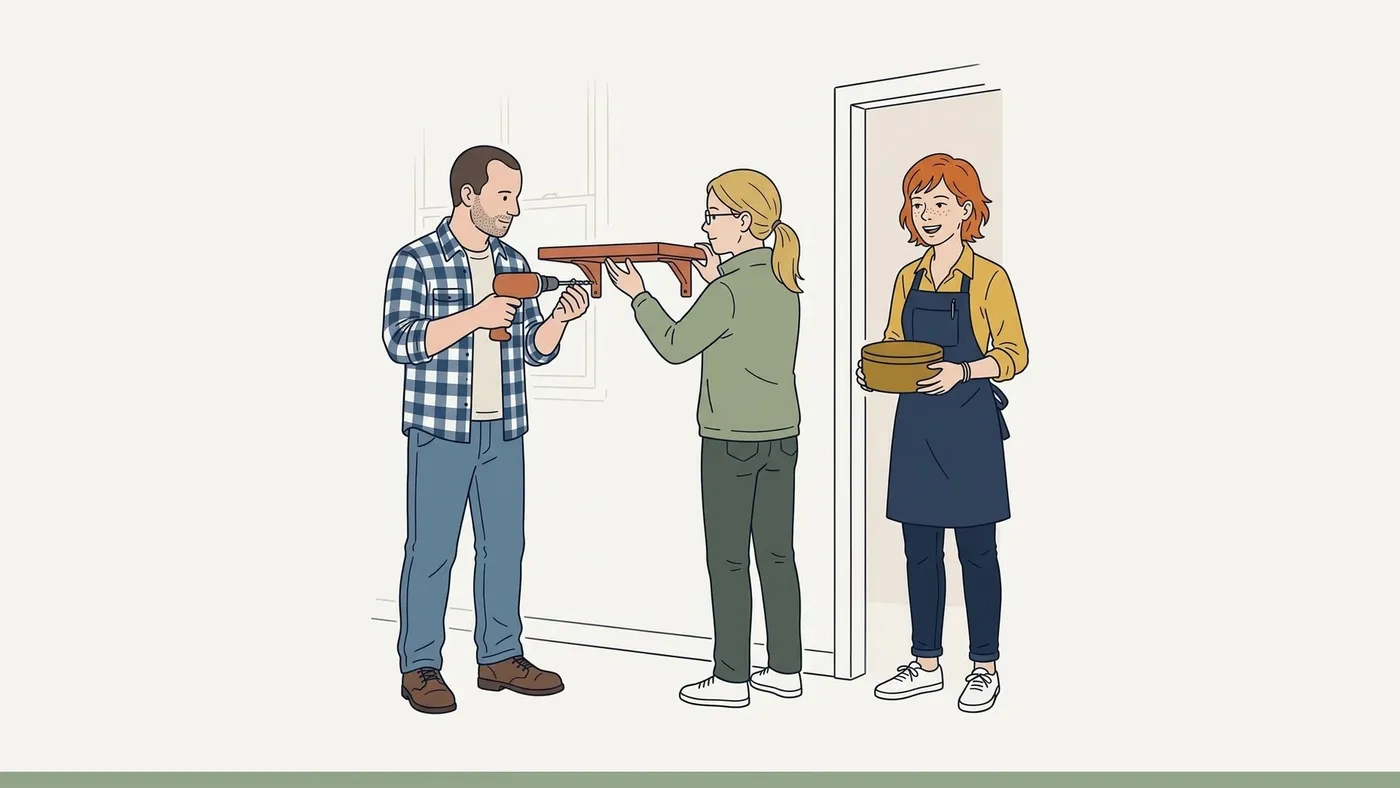
Lesson A1.5 of English for Polish Adults, “Right now”, is the one the course builds around this mistake. At ten at night Isla knocks at flat 4B with a tin of biscuits, for the tea she has with Marta every night. Tonight Tomek is putting up a shelf with a drill, Marta is holding it, and Isla ends up holding the spirit level.
The lesson takes 50 minutes. A reference sheet, “Now, and every day”, sets the two forms side by side with the words that choose between them, each with its Polish translation, and stays on the desk for the whole lesson. A gap-fill about that evening follows, in which two verbs appear twice, once in each form, so a learner who reads the verb instead of the cue word runs out of options. Then learners describe a picture of the kitchen: three things happening right now, three things that happen every evening at ten.
It ends with a team game on a board of twelve squares. A team wins a square only by saying the whole sentence in the form its time word demands, and a missing “is” leaves the square open for the other side. The teacher notes suggest answering the error with “now, or every day?” rather than giving the form.
Check yourself
Put the verb in brackets into the present simple or the present continuous and write the whole sentence. Use full forms (I am, not I'm). The time words help you choose, but remember the verbs that describe states.
- Listen! The baby ___. (cry)
Answer
Listen! The baby is crying.
- Tomek ___ at four o'clock every day. (finish)
Answer
Tomek finishes at four o'clock every day.
- Right now Marta ___ the shelf. (hold)
Answer
Right now Marta is holding the shelf.
- Isla never ___ at night. (work)
Answer
Isla never works at night.
- I ___ an email at the moment. (write)
Answer
I am writing an email at the moment.
- Every evening we ___ TV. (watch)
Answer
Every evening we watch TV.
- ___ you ___ now? (work)
Answer
Are you working now?
- I ___ the answer now. (know)
Answer
I know the answer now.
Right now
Present continuous