All mistakes / A2
Make or do: why it's “Let's make a plan”, not “Let's do a plan”
Make is usually for creating or producing something: a cake, a plan, a decision. Do is for activities, tasks and work: homework, the shopping, a favour. Polish zrobić covers both, so the choice has to be learnt phrase by phrase, with a rule of thumb to help.
What it sounds like
What the mistake looks like
“Let's do a plan.” “Shall we do a booking?” “Sorry, I did a mistake.” “I have to make my homework.” The meaning is always clear, and that is why the mistake survives for years: nobody misunderstands, so nobody corrects it. But each sentence has the wrong verb, and a British listener notices at once.
It goes both ways. Some learners use do for almost everything, because do feels like the neutral translation of robić. Others, once they have been corrected a few times, swing the other way and say “make homework” or “make the shopping”.
Behind the same Polish verb hides a third group: phrases where English wants neither make nor do. „Zrobić zdjęcie” is take a photo, „zrobić imprezę” is have or throw a party, „zrobić przerwę” is take or have a break.
Why Polish speakers make it
Polish has one verb, robić or zrobić, where English has two. „Zrobić plan”, „zrobić zakupy”, „zrobić obiad”, „zrobić komuś przysługę”, „zrobić pranie”: in Polish they all use the same verb. English splits them: make a plan, do the shopping, make lunch, do someone a favour, do the washing. Nothing in the Polish sentence tells you which English verb is coming.
Polish often has a more precise verb for careful speech: „popełnić błąd”, „zaplanować”, „zarezerwować stolik”. But in everyday conversation „zrobić” is enough, and everyday conversation is what gets translated in your head.
So this is a collocation problem, not a grammar problem. Collocations are words that simply go together, and they can't be worked out by logic; they have to be heard and remembered. That is why a rule only takes you part of the way.
The rule of thumb, and the phrases that break it
A rule of thumb: use make when something exists afterwards that wasn't there before. Make a cake, make tea, make a list, make a noise, make a mess, make a plan, make a decision. Use do for activities, work and tasks, often with -ing nouns or with general words: do the shopping, do the washing-up, do the cleaning, do homework, do a course, do exercise, do your job, do something, do nothing.
The fixed phrases matter more than the rule, because many of them don't follow it. With make: make a mistake, make a phone call, make an appointment, make a booking, make a suggestion, make an offer, make a complaint, make an effort, make progress, make money, make friends, make the bed. With do: do someone a favour, do your best, do business, do damage, do harm, do good, do your hair.
Some real nuance. In British English you will also hear take a decision, mostly in formal or official language; make a decision is the everyday choice. For an exam, British English says take, sit or do an exam, and all three are correct. Make dinner is cooking one meal; do the cooking is the job in general. And often the most natural English uses a separate verb altogether: people book a table rather than make a booking, and plan Saturday rather than make a plan for Saturday.
Finally, the phrases that take neither: take a photo, take or have a break, have a shower, have or throw a party.
How to fix it
For learners: learn phrases, not verbs. Don't write “do = robić” on a flashcard; write “do the shopping”, “make a mistake”, “do me a favour”. The noun decides, so learn each noun together with its verb.
Keep two short lists, make and do, and add a phrase every time you meet one in a book, a series or a conversation. Start with the ones you need every week: the shopping, the washing-up, homework, a phone call, an appointment, a mistake.
When you catch yourself thinking „zrobić…”, stop for a second and look at the noun that comes next. Either you know its verb, or it is time to look it up.
For teachers: correct it quickly and the same way every time: say the phrase back with the right verb and let the learner repeat the whole sentence. Hearing make a plan ten times in one lesson does more than explaining the rule once. Group the phrases by topic, such as a day out, housework or the office, rather than handing out a list of forty.
How lesson A2.6 works on it
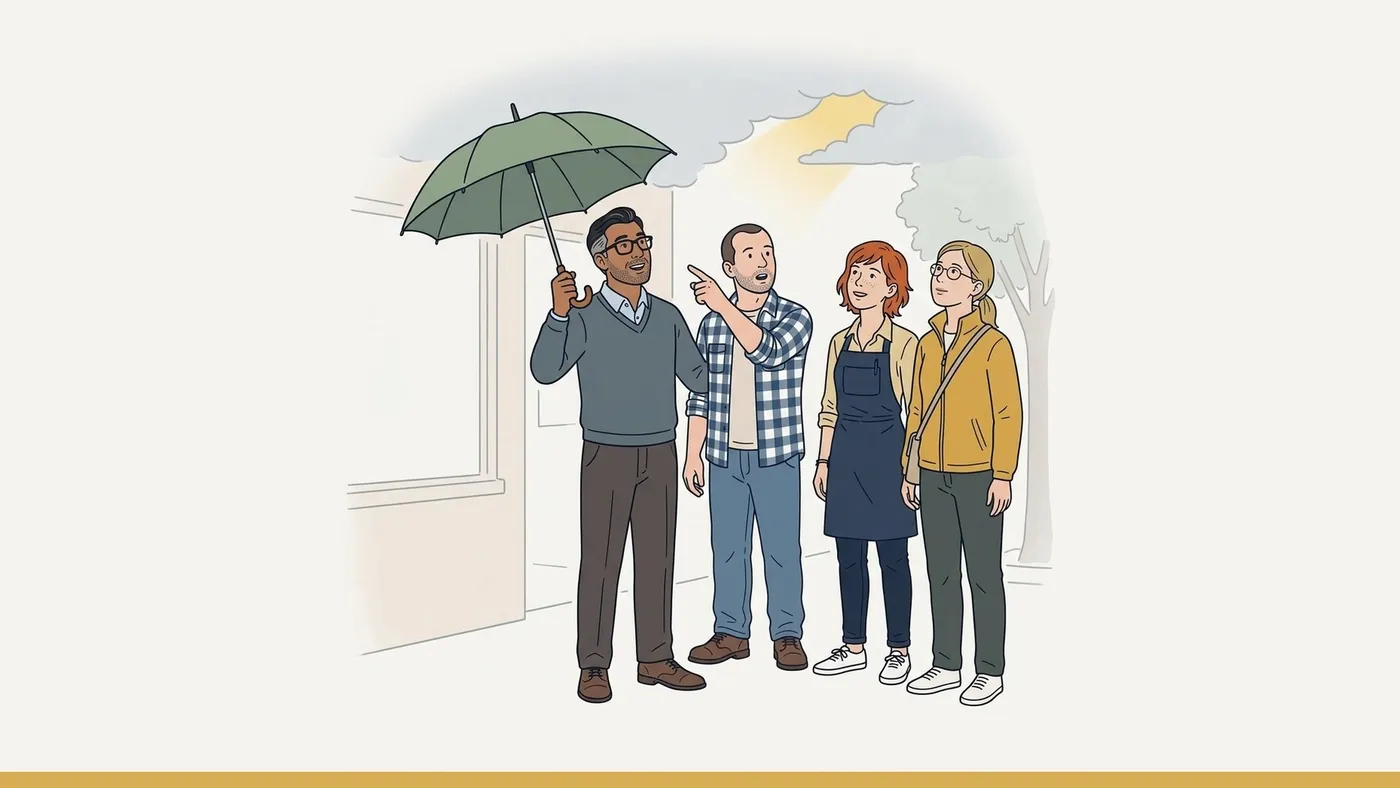
Lesson A2.6, “If it rains”, takes 60 minutes. Its grammar is the first conditional and ways of talking about the future: on a Thursday evening in Isla's café, the four characters plan a Saturday walk, with four opinions and a forecast that nobody trusts. Make and do is not the topic of the lesson; it deals with the mistake through a few fixed phrases.
In the first exercise, a picture description, the phrase box prints make a plan, make a suggestion, book a table and cancel a booking, with the note “make and book, never do”, and the teacher says them aloud for the class to repeat. The teacher notes expect “do a plan” and “do a booking” and tell the teacher to say the line back with make or book every time it comes up that day.
The final exercise, ten sentences about the same Saturday, includes “Why don't we do a plan for Saturday before we go home?” and “Shall we do a booking for the big table at two o'clock?”. The key accepts book the big table or make a booking, and the feedback goes back to the four phrases. The other collocations in this article, such as homework, a favour or a photo, are not in the lesson.
Check yourself
Write make or do in the correct form.
- Can you ___ me a favour?
Answer
do
- I always ___ the same mistake with this word.
Answer
make
- Who ___ the washing-up last night?
Answer
did
- Let's ___ a plan for Saturday.
Answer
make
- I need to ___ a phone call before nine.
Answer
make
- She ___ her homework after dinner every day.
Answer
does
- We usually ___ the shopping on Fridays.
Answer
do
- Please don't ___ so much noise!
Answer
make
If it rains
First conditional · future