All lessons / B1 · Plans & surprises
Since March
Present perfect continuous
Isla has been working double shifts since March and won't say why. Marta works it out.
- Level
- B1
- Length
- 60 min
- Exercises
- 5
One-off payment · print for your own groups · 14 days to change your mind · faktura VAT

About this lesson
A 60-minute lesson for B1 groups who still say I work here since March. Isla has been working double shifts at the café since March and won't say why. Marta notices, and works it out: Isla has been saving to buy the café.
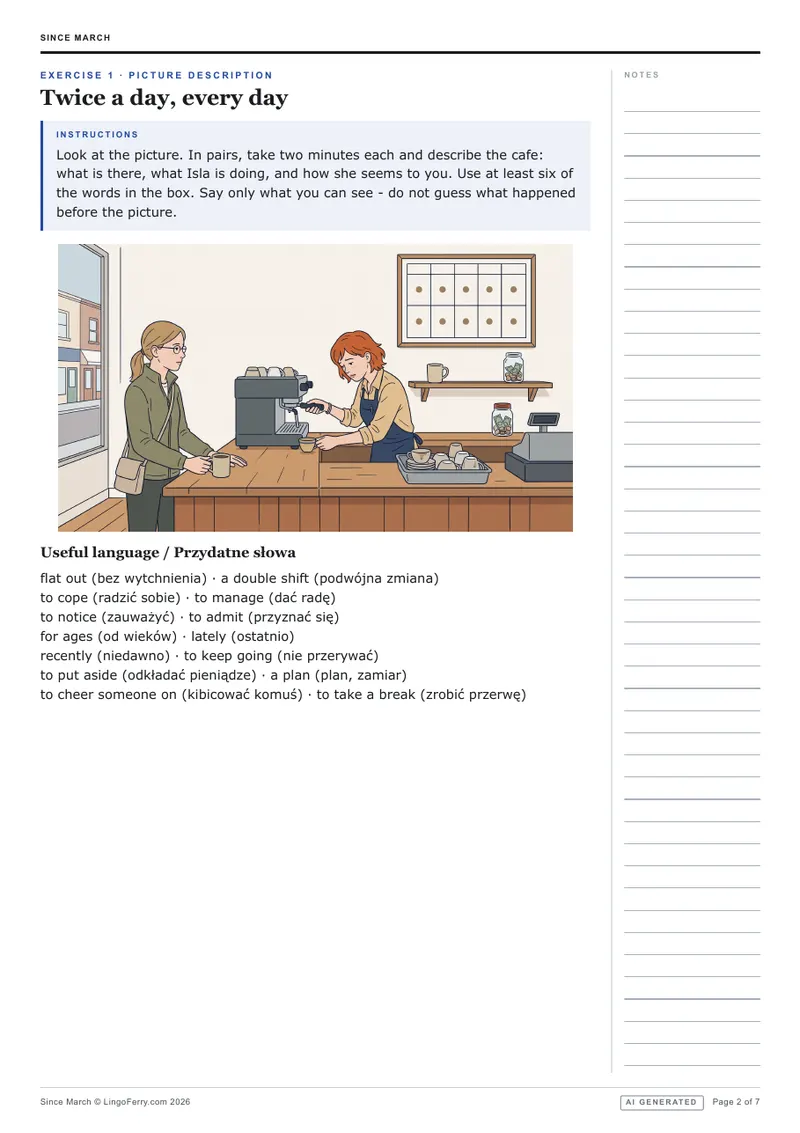
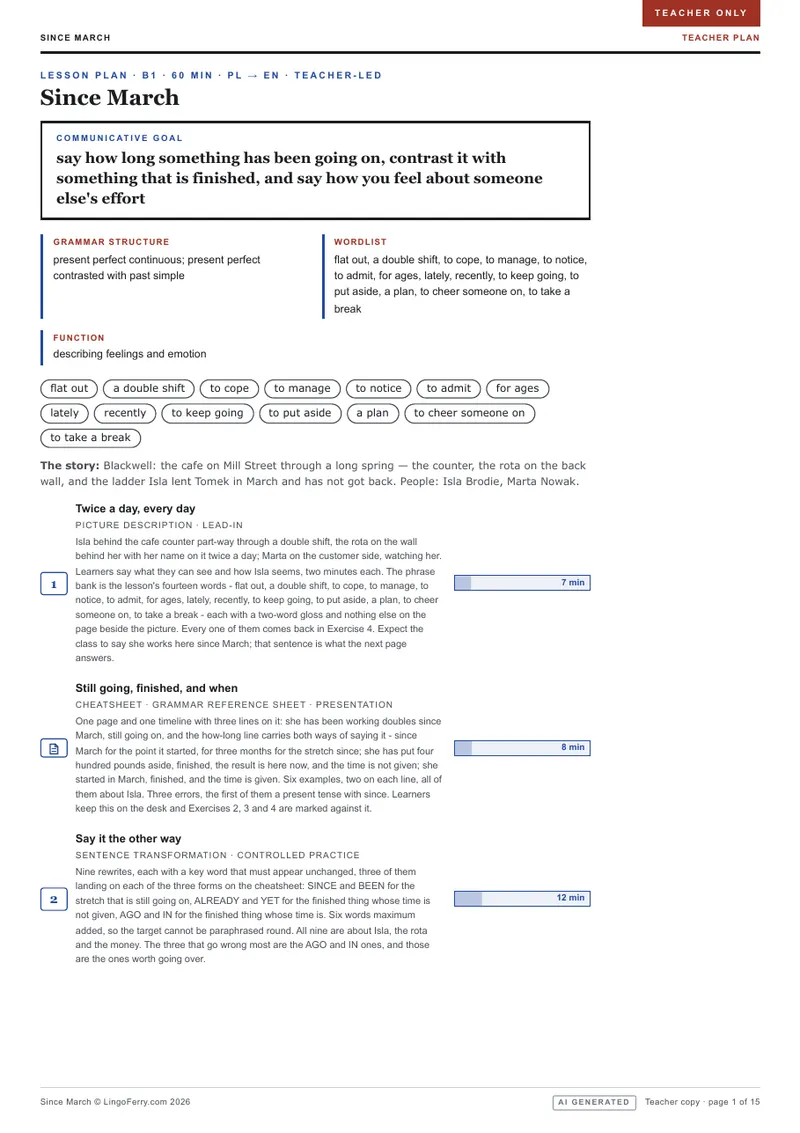
Pairs describe a picture of the café counter using fourteen words from a box. A one-page reference then separates three meanings: still going on, finished with no time said, finished with the time said. Students rewrite nine sentences around a key word (BEEN, AGO, YET), rebuild a short text about Isla's spring in groups of three, and finish by correcting twelve sentences, three of them already right. Afterwards they can say how long something has been going on and contrast it with something finished.
Say how long something has been going on, and contrast it with something finished.
- Grammar
- Present perfect continuous; present perfect contrasted with past simple.
- Function
- Describing feelings and emotion.
- Words (14)
- flat outdouble shiftcopemanagenoticeadmitfor ageslatelyrecentlykeep goingput asideplancheer ontake a break
Why Polish speakers get this wrong
Polish has no perfect tenses. Something that started in March and is still going on takes the present: „pracuję tu od marca”. Word for word, that gives I work here since March, and to a Polish ear nothing is missing. Two faults travel with it: since before a length of time, because Polish od covers both since and for, and a present perfect next to a named time such as last Tuesday.
The error usually arrives in the first minute of the picture task; the notes say to write it on the board and leave it until the reference sheet answers it. The rewriting exercise gives three items to each meaning, so nobody gets through on the continuous alone. The last page mixes nine errors with three correct sentences.
60 min · 5 exercises
- 1Twice a day, every dayPicture description · Lead-in7 min
- 2Still going, finished, and whenGrammar cheatsheet · Presentation8 min
- 3Say it the other waySentence transformation · Controlled practice12 min
- 4What Marta worked outDictogloss · Semi-controlled practice20 min
- 5Nine wrong, three rightError correction · Review11 min
Nine wrong, three right
Twelve sentences about Isla's spring at the cafe. Nine have one mistake; three are correct. Write the correct words. If a sentence has no mistake, write correct.
- Isla works double shifts since March.
- Marta has noticed Isla's name on the rota three weeks ago.
- Isla has put four hundred pounds aside so far.
- Isla has been working flat out since the whole spring.
- Isla has admitted her plan to Marta last Tuesday.
As printed on the student sheet. Answers are in the teacher pack.
- 1Student pack7 pages · A4 PDF
- 2Teacher pack: plan, notes, answer key15 pages · A4 PDF
- 3Recording (MP3), 0:45Also plays from the QR code on the sheet
Questions about this lesson
How long does the lesson take?
60 minutes in five steps: picture description 7, reference sheet 8, sentence transformation 12, dictogloss 20, error correction 11. The notes say which parts to protect when time runs short, for example the pair work in the picture task rather than the whole-class round.
Is there audio for the dictogloss?
Yes. The text for "What Marta worked out" is recorded as a 45-second MP3, with a QR code on the student sheet. The teacher pack also prints the script, with a note to read it at normal speed: a slow reading turns the task into dictation.
Does it work without the earlier lessons?
Yes. Every lesson in the course works on its own. What the class needs to know about Isla, the double shifts, the jar of money and the café for sale, comes up inside this lesson. The story is a bonus if you follow it, not a requirement.