All lessons / B1 · Plans & surprises
She said the café was closing
Reported speech
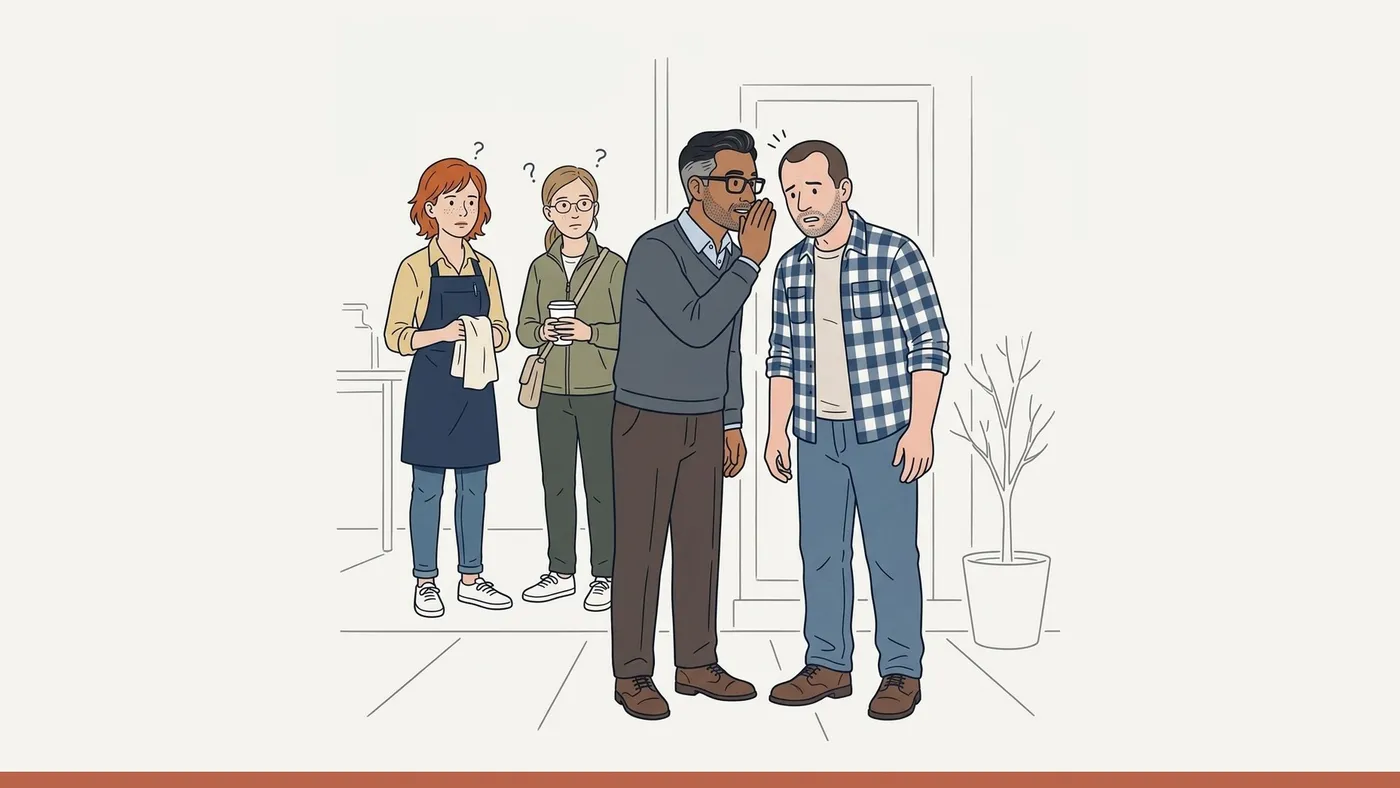
A rumour goes round Mill Street that the café is closing. Four people repeat it, and each time it changes.
- Level
- B1
- Length
- 50 min
- Exercises
- 4
One-off payment · print for your own groups · 14 days to change your mind · faktura VAT
About this lesson
A 50-minute lesson for B1 groups who report speech in Polish order: She said me the café closes. A rumour goes up Mill Street that the café is closing. On the way back down it is corrected: Isla is shutting for a fortnight, for a refit, because she is buying it.
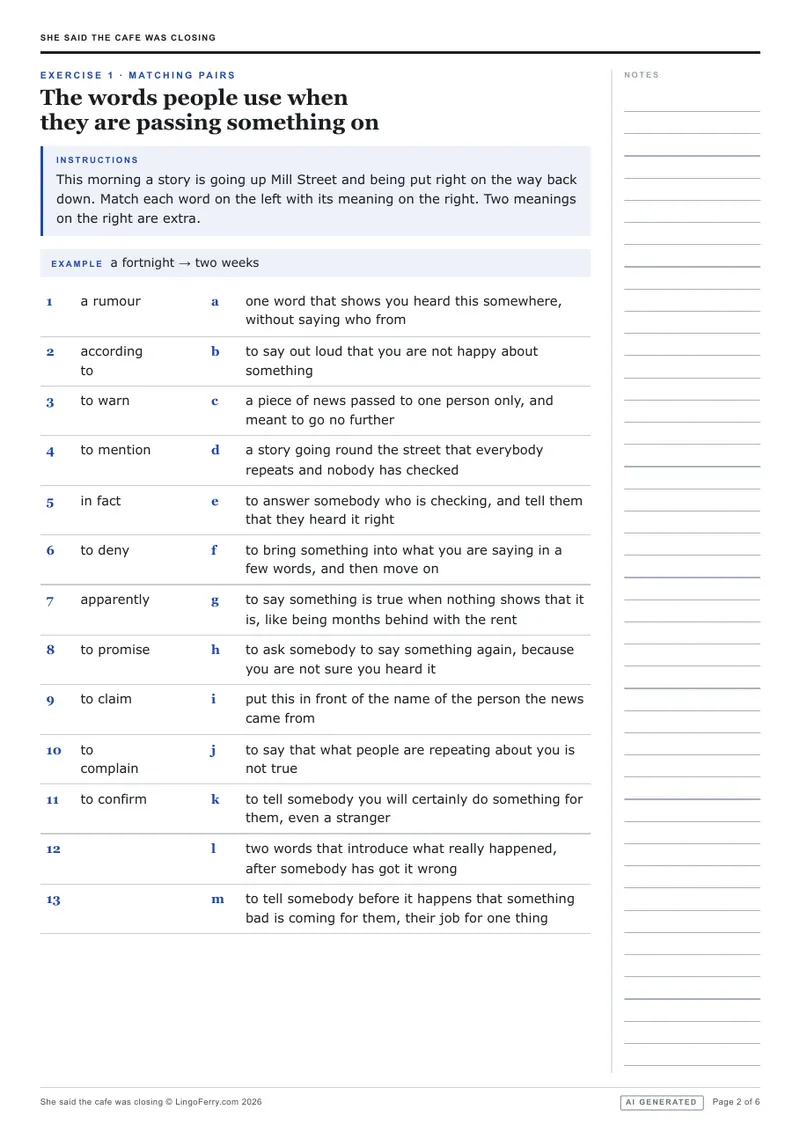
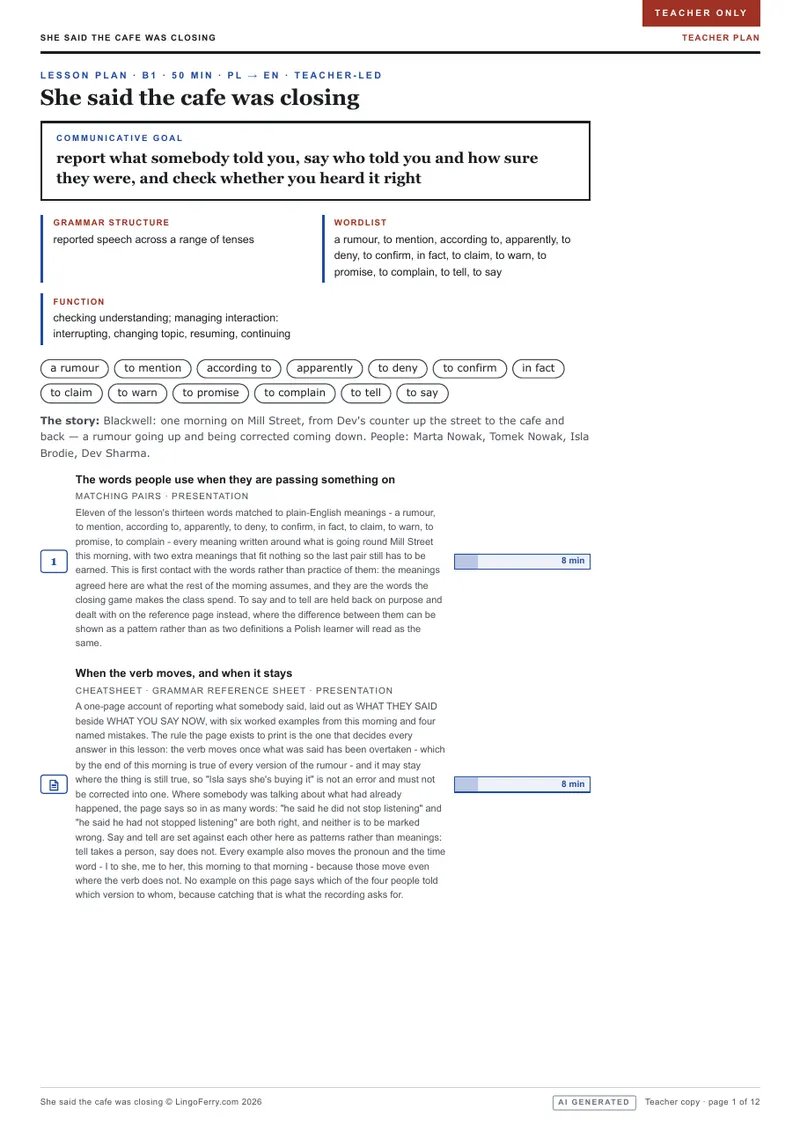
Students match eleven reporting words (a rumour, apparently, deny, confirm) to their meanings. A one-page reference shows when the verb moves back and when it may stay, with said and told set against each other. Then a recording: four people tell the same story four ways, and the gaps are the words that say who told whom. The lesson ends with a team game in which a square is won by reporting one of the morning's lines correctly. Afterwards students can report what someone told them and check what they heard.
Report what someone told you, and check whether you heard it right.
- Grammar
- Reported speech across a range of tenses.
- Function
- Checking understanding; managing interaction.
- Words (13)
- rumourmentionaccording toapparentlydenyconfirmin factclaimwarnpromisecomplaintellsay
Why Polish speakers get this wrong
Polish has no backshift. „Powiedziała, że kawiarnia się zamyka” keeps the tense the speaker used, so She said the café closes feels like a faithful translation. Polish also has one verb, powiedzieć, for both said and told, and it can always take a person: „powiedziała mi”. That gives She said me.
The verb has to move back where events have overtaken the words, and here they have: by the end of the morning the café is not closing and Isla is not behind with the rent. So He claimed she's months behind is audibly wrong, while She said she's buying it is still correct, and the notes say never to correct it. In the game four squares are scored on the verb, the rest on the reporting word and the listener.
Free guide: Reported speech: why it's “She told me the café was closing” →
50 min · 4 exercises
- 1The words people use when they are passing something onMatching · Presentation8 min
- 2When the verb moves, and when it staysGrammar cheatsheet · Presentation8 min
- 3Who told you that?Listening gap fill · Controlled practice17 min
- 4That is not what he saidGame · Review12 min
That is not what he said
Two teams of four. Report a square in one sentence with its word and any listener. Right: your letter goes in. Wrong: Team B tries. Challenge a claim to take one back.
- Dev: "That's what I was told." (say)
- Isla: "I told Dev on Tuesday." (say)
- Dev: "I did not stop listening." (deny)
- Marta to Tomek: "That isn't what he said." (tell)
- Mrs Aitken to Isla: "You're losing your job." (warn)
- The garage man: "She's months behind." (according to)
As printed on the student sheet. Answers are in the teacher pack.
- 1Student pack6 pages · A4 PDF
- 2Teacher pack: plan, notes, answer key12 pages · A4 PDF
- 3Recording (MP3), 1:07Also plays from the QR code on the sheet
Questions about this lesson
Is there a recording?
Yes. Exercise 2, "Who told you that?", uses a 67-second MP3 of four people on Mill Street, with a QR code on the student sheet. The notes ask you to play it twice and not to read lines aloud yourself, because a teacher's voice stresses exactly the words the gaps test.
Can I use it with one student?
The team game is written for two teams of four, but the sheet also prints a solo round: the student reports every square and scores it on the teacher's list, and twelve out of sixteen wins. The matching, the reference sheet and the listening work the same with one learner.
What is in the teacher pack?
Twelve pages with the plan, keys and notes for each exercise. The notes say what to accept as well as what to correct: She said she's buying it is good English, and only the four starred squares in the game are scored on the verb. They also warn that over-correction starts as soon as the rule lands.