All mistakes / B1
Since and for: why it's “I've been working here since March”, not “I work here since March”
When something started in the past and is still going on, English uses the present perfect, often the continuous: “I've been working here since March.” “I work here since March” is how Polish says it, and English won't take it.
What it sounds like
What the mistake looks like
“I work here since March.” “We live in England for two years.” “How long do you learn English?” Every word is right, the meaning is clear, and the verb is in the wrong tense. To English ears the present simple is for habits and permanent facts, and then a since or a for arrives with nothing to attach to.
It is one of the most stubborn mistakes Polish speakers make in English. Learners who know the present perfect perfectly well on paper still say “I work here since March” in conversation, because the sentence is so short and so normal in Polish that it comes out before any rule can step in.
Two more travel with it. One is since and for swapped: “since three months”, “since ages”, “since a long time”. The other appears once the present perfect has been learnt: it spreads to finished times, as in “I've started in March”.
Why Polish speakers make it
Polish has no present perfect. For something that started in the past and is still going on, Polish uses the present tense: „Pracuję tu od marca.” „Mieszkamy w Anglii od dwóch lat.” „Jak długo uczysz się angielskiego?” In Polish that is exactly right, because the action is happening now. Translated word for word, it gives the English mistake.
The second cause is „od”. Polish uses one word for the starting point and for the length: „od marca” and „od trzech miesięcy”. English splits it in two: since March, for three months. With one Polish word covering both, learners choose one English word, usually since, and use it for both.
It helps to see where the two languages agree. „Pracowałem tam dwa lata” describes a job that is over, and so does “I worked there for two years”. The past matches. What English adds is a tense for a stretch of time that reaches up to now, and Polish covers that with the present.
The rule: is it still going on?
Ask one question: is it still going on? If it is, and you are saying how long, use the present perfect. The continuous, have been + -ing, is the usual choice for activities: “I've been working here since March.” “She's been saving for three months.”
State verbs such as know, be, like and have (meaning own) don't normally take -ing, so use the present perfect simple: “I've known her since school.” “We've had this car for ten years.” “He's been here since six.” With live and work both forms are fine: “I've lived here for two years” and “I've been living here for two years” mean nearly the same, and the continuous sounds more temporary.
Since + the starting point: since March, since 2019, since Monday, since I moved here. For + the length: for three months, for two years, for ages, for a long time. After since, a clause usually takes the past simple: “since I moved here”, not “since I have moved”.
If the time is finished and named, use the past simple, however recent it feels: “I started in March.” “She moved here three months ago.” Ago, last Tuesday and in March close the time, and the present perfect can't stand next to them. Compare: “I've been working here since March” (still going), “I started in March” (the start, finished), “I worked there for two years” (the whole job, finished).
How to fix it
For learners: learn the question as a chunk: “How long have you been…?” How long have you been living here, working there, learning English. Once the question comes out automatically, the answer follows in the same tense.
Tell your own story in three sentences, one for each form: “I've been living in Bristol for three years. I moved here in 2023. I've changed jobs twice.” Say it until it's boring.
Treat „od” as a warning light. When you catch yourself thinking „od…”, stop and choose: a point (since) or a length (for), and have or have been in front of the verb.
For teachers: expect the mistake early and let it come out. A sentence the class produced itself is a better starting point than one from a book. Correct since and for quickly: name it, fix it, move on. Save the time for the harder distinction, the named finished time, because that is where learners will argue that “three weeks ago” is recent enough for a perfect.
How lesson B1.2 works on it
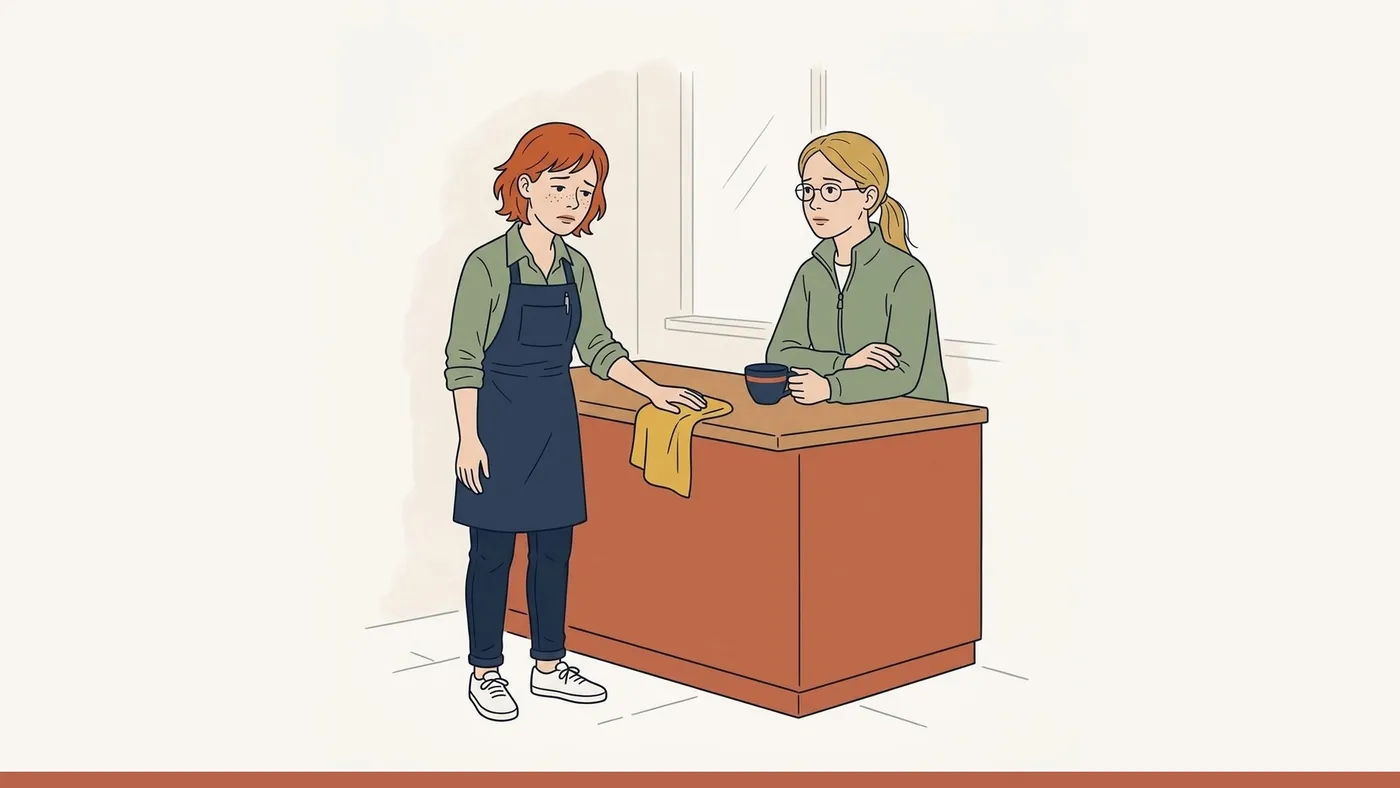
Lesson B1.2, “Since March”, takes 60 minutes. Isla has been working double shifts at the café on Mill Street since March and won't say why. Marta notices, and works it out.
It opens on a picture of the café counter: the rota on the wall with a mark in every box, a mug of tea going cold. The class describes it, and the teacher notes predict that “she works here since March” will come out in the first minute. The teacher writes it on the board exactly as said and leaves it uncorrected for now.
The reference sheet, “Still going, finished, and when”, sets out three forms and one question that decides between them: has the time been said out loud? The class then transforms sentences around fixed key words such as BEEN, SINCE, AGO and YET, rebuilds a short text about Isla's spring from notes in a dictogloss (the download includes a recording, and a QR code on the sheet plays it) and finishes with twelve sentences to correct. Three are already right, which shows who is changing every has to has been.
Check yourself
Seven sentences have one mistake each and one is correct. Write the correct sentence, or write “Correct”.
- She works at the café since March.
Answer
She's been working at the café since March. (or: She's worked)
- We've been waiting since twenty minutes.
Answer
We've been waiting for twenty minutes.
- How long do you know Dev?
Answer
How long have you known Dev?
- I've moved here three years ago.
Answer
I moved here three years ago.
- They are married for ten years.
Answer
They've been married for ten years.
- He's been learning English since he has arrived.
Answer
He's been learning English since he arrived.
- I haven't seen her for ages.
Answer
Correct.
- My brother is in hospital since Monday.
Answer
My brother has been in hospital since Monday.
Since March
Present perfect continuous