All mistakes / B1
Reported speech: why it's “She told me the café was closing”
When you report what someone said and the situation has changed since, English moves the verb back a tense: “The café is closing” becomes “She said the café was closing.” And tell needs a person after it, while say doesn't: she told me, she said.
What it sounds like
What the mistake looks like
“She said me the café closes.” “He told that he was busy.” “Tomek said the café closes for good”, when by the end of the morning it turns out the café isn't closing at all. Two different mistakes sit in these sentences, and they often come together.
The first is the verb inside the report: the tense the speaker used is copied straight in, even when events have overtaken it. The second is the reporting verb itself: said and told are swapped, or said gets a person straight after it.
Neither stops anyone understanding you, and that is why both last. But “He said me” sounds wrong to a British ear at once, and a report in the present tense about something that has turned out false sounds as if you still believe it.
Why Polish speakers make it
Polish has no backshift. „Powiedziała, że kawiarnia się zamyka” keeps the present tense of the original words, and that is correct, natural Polish. „Powiedział, że jest zmęczony” means he was tired when he said it. Translate either word for word and you get “She said the café closes” and “He said he is tired”.
Polish also has one verb, powiedzieć, where English has say and tell, and powiedzieć can always take a person: „powiedziała mi”, „powiedział Tomkowi”. That gives “She said me” and “He said Tomek”. The reverse happens too: „powiedział, że…” comes out as “He told that…”, because tell feels like the natural translation of a verb that so often has a person.
A related Polish pattern is „Powiedziała mi, żebym zadzwonił”. English uses tell + person + to: “She told me to call”, not “She said me to call” or “She said that I call”.
The rule: when the verb moves, and when it can stay
Say and tell first. Tell + person: “She told me”, “He told Marta that…”. Say without a person, or with to + person: “She said that…”, “She said to me that…”. Tell also goes with a few nouns and no person: tell a story, tell the truth, tell a lie, tell a joke.
Backshift. When the reporting verb is in the past (said, told), the verb in the report usually moves one step back: is closing → was closing, will → would, can → could, has done → had done. “I'll ring the landlord tomorrow” → “He said he would ring the landlord the next day.” People, places and times move too: I → she, this morning → that morning, tomorrow → the next day, here → there.
The nuance many textbooks skip: the move is needed where events have overtaken the words, and optional where they are still true. If Isla said “I'm buying the café” and she still is, both “She said she's buying it” and “She said she was buying it” are good English. But if the man at the garage claimed she was months behind with the rent and she isn't, “He claimed she's months behind” sounds as if you agree with him; it has to be was. A past simple in the original may stay as it is: “He said he didn't stop listening” and “He said he hadn't stopped listening” are both correct.
With the reporting verb in the present, nothing moves: “Dev says the café's closing.”
How to fix it
For learners: learn two frames and say them until they are automatic: told me that… and said that…. If you want a person after said, add to: said to me.
When you report something, ask: is it still true? If it has changed, finished or turned out false, move the verb back. If it is still true, you may leave it, and moving it is also correct.
Practise on real news. Report something a friend told you yesterday: “She told me she was changing jobs.” “He said the flat was too expensive.” Short, true sentences, every day.
For teachers: expect over-correction as soon as the rule lands. Learners start moving every verb and marking “She said she's buying it” as wrong. Build tasks on quotations whose situation has clearly closed, a rumour that turned out false or a plan that changed, so that a missing backshift is really wrong and the item actually tests something. Correct said me every time; it is short and easy to fix.
How lesson B1.3 works on it
Lesson B1.3, “She said the café was closing”, takes 50 minutes. A rumour goes up Mill Street that the café is closing. On the way back down it is corrected: Isla is shutting for a fortnight, for a refit, because she is buying it. That ending matters, because once the rumour is proved wrong, a report in the present tense is audibly wrong.
Students match eleven reporting words, such as rumour, apparently, deny and confirm, to their meanings. The one-page reference sheet, “When the verb moves, and when it stays”, shows when the verb must move back and when it may stay, with said and told set against each other. Then comes a 67-second recording, which a QR code on the sheet plays: four people tell the same story four ways, and the ten gaps are the words that say who told whom, such as Isla told me, I was told and Dev says.
The lesson ends with a team game, “That is not what he said”, in which a square is won by reporting one of the morning's lines correctly. Only four squares are scored on the verb, the ones whose content is false by the end of the morning; the rest are scored on the word printed in the square and on who the listener was. The teacher notes say never to correct “She said she's buying it”, because it is still true.
Check yourself
Items 1 to 4: write said or told. Items 5 to 8: report the words in one sentence, starting as shown. In each of these the situation has changed since, so the verb moves back. That after said or told is optional.
- She ___ me the news on Tuesday.
Answer
told
- He ___ that the shop opens at eight.
Answer
said
- Dev ___ us a funny story about the delivery.
Answer
told
- She ___ to me that she was sorry.
Answer
said
- Tomek, yesterday (the café isn't closing after all): “The café is closing for good.” → Tomek said…
Answer
Tomek said the café was closing for good.
- Dev, last week (he forgot): “I'll ring the landlord tomorrow.” → Dev said…
Answer
Dev said he would ring the landlord the next day. (or: the following day)
- The man at the garage, to Tomek (he was wrong): “She's months behind with the rent.” → The man at the garage told Tomek…
Answer
The man at the garage told Tomek she was months behind with the rent.
- Marta, to Isla, this morning (she has changed her mind since): “I can't come on Saturday.” → Marta told Isla…
Answer
Marta told Isla she couldn't come on Saturday.
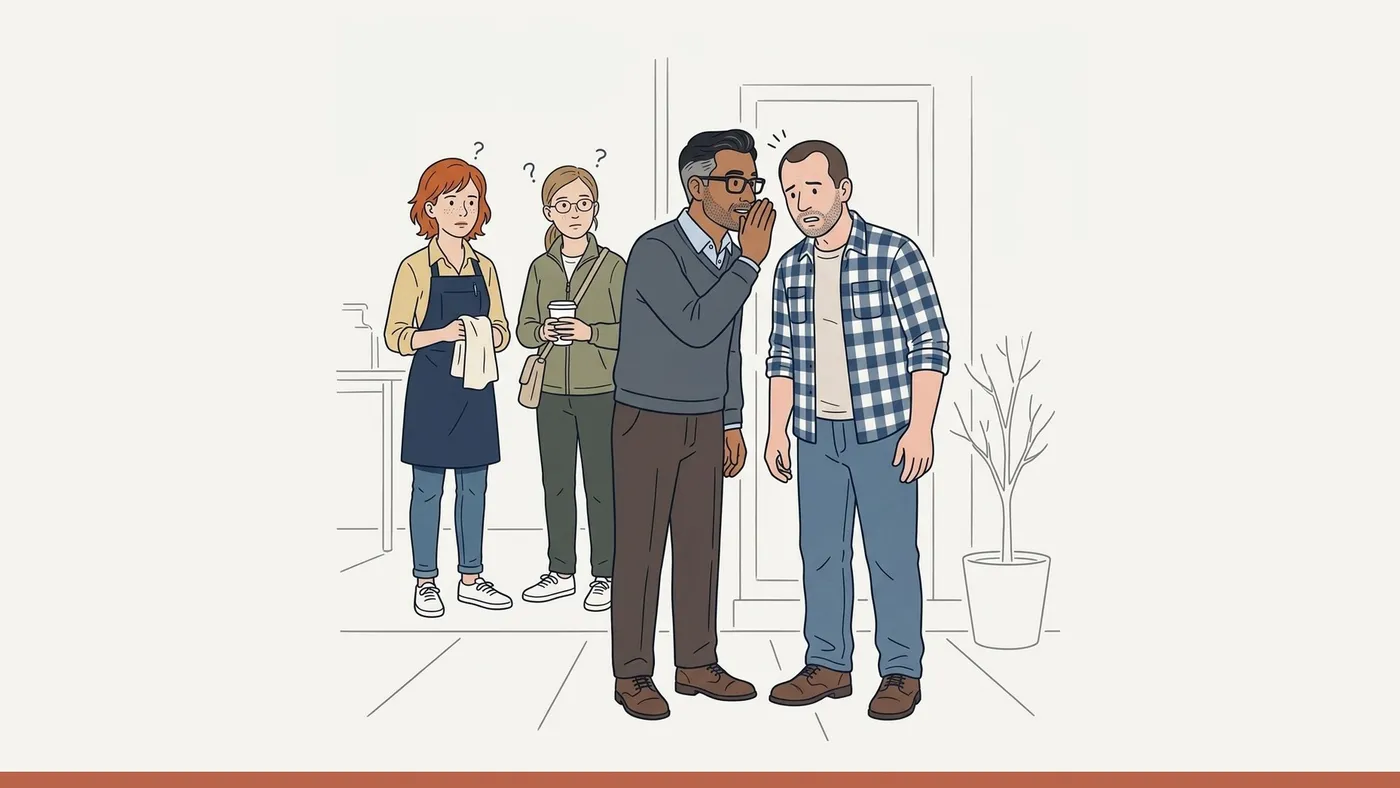
She said the café was closing
Reported speech