All mistakes / B1
“I have cold”, “It has 20 years”: when Polish mieć isn't have in English
Many things Polish says with mieć, English says with be: “I'm 34”, “You're right”, “We were lucky”, “The house is 20 years old.” Once have becomes the verb for states, it spreads further, to “I have cold” and “I have hungry”, where English also needs be: “I'm cold”, “I'm hungry”.
What it sounds like
What the mistake looks like
“You have right.” “We had luck.” “The house has 20 years.” “I have 34 years.” And, one step further: “I have cold”, “Tomek had hungry”. Each is a Polish sentence in English words, and each needs be instead of have.
Some of them cause real confusion. “I have cold” is very close to “I have a cold”, which means you are ill, not that you would like the window shut. “It has 20 years” leaves the listener waiting for the rest of the sentence.
The mistake survives well into B1 and beyond, because the Polish phrases behind it are among the most frequent in the language. They come out in conversation before any rule has a chance to step in.
Why Polish speakers make it
In Polish these are fixed phrases made of mieć and a noun: „mieć rację”, „mieć szczęście”, „mieć 34 lata”, „mieć ochotę”, „mieć nadzieję”, „mieć dość”. English expresses most of them with be and an adjective, or with a different verb altogether: be right, be lucky, be 34, feel like, hope, be fed up.
Cold and hunger are different even in Polish: we say „jest mi zimno” and „jestem głodny”, not mieć. So “I have cold” is not a direct translation. It happens because the pattern spreads: once have is the verb a learner uses for how they are, other states follow it across. That is why it helps to treat the whole group as one habit rather than as a list of separate phrases.
Polish also gives things an age the same way as people: „Dom ma dwadzieścia lat” becomes “The house has 20 years”. English needs be, the number and old: “The house is 20 years old.”
The rule: be for states, have for things you have
Be + adjective for states: I'm cold, I'm hot, I'm hungry, I'm thirsty, I'm tired, you're right, you're wrong, we were lucky (or we were in luck). “It's cold” is about the weather or a room: “The kitchen was cold.”
Age: be + number. For people, “I'm 34” or “I'm 34 years old”, never “I'm 34 years” and never “I have 34 years”. For things, be + number + years old: “The step is forty years old.” The word old is the part learners leave off.
Other mieć phrases have their own English verbs: „mam nadzieję” is I hope; „mam ochotę na” is I feel like or I fancy; „mam dość” is I'm fed up with or I've had enough of; „mam na imię” is my name is; „mam urodziny” is it's my birthday.
Where have is right: illnesses and symptoms take have: have a cold, have a headache, have a temperature, have flu. So “I have a cold” means you are ill, and “I'm cold” means you need a jumper. Have is also fine for possessions, time, problems and ideas: “I have an idea”, “We haven't got time”. In speech, British English often uses have got for these.
How to fix it
For learners: learn the English phrases as blocks, with the person: I'm right, you're right, I'm lucky, I'm 34, it's ten years old. Say them aloud until they stop sounding strange.
Make a short list of your own mieć phrases, the ones you use every day in Polish, and write the English next to each. Most learners need fewer than ten.
When you notice have coming out before cold, hungry, right, lucky or a number of years, stop and swap it for be. If you are not sure, ask yourself: am I describing a state? Then it is probably be.
For teachers: correct it by saying the sentence back with the right verb and moving on; learners usually hear the difference. Write mieć on the board once, with the patterns it replaces, be + adjective and be + number + old, and point at it rather than explaining again. In an error-correction task, include a few correct sentences with have, such as have a cold or have a headache, so that learners don't start replacing every have they see.
How lesson B1.4 works on it
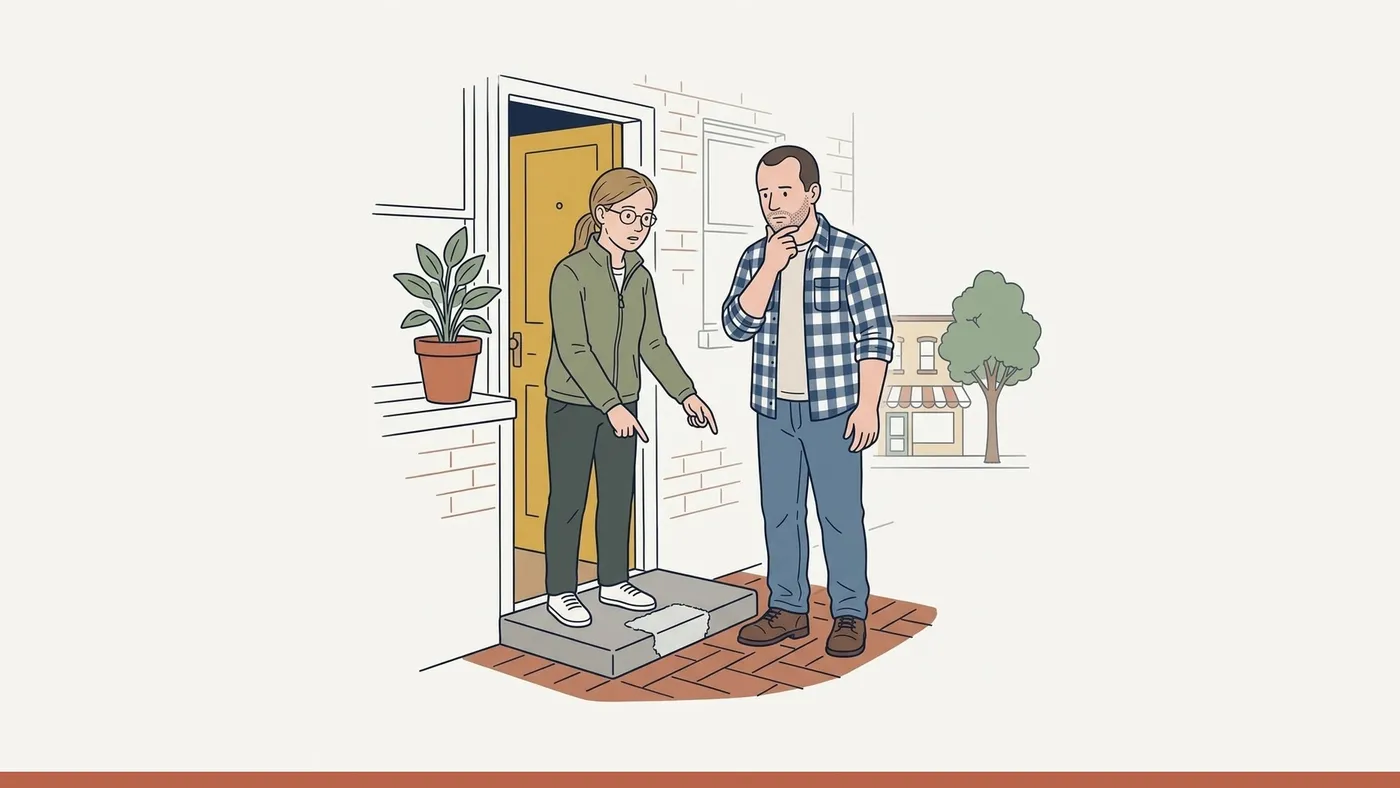
Lesson B1.4, “Somebody must have been here”, takes 60 minutes. Its grammar is modals of deduction: the Nowaks come home to a mended front step, a finished shelf and a plant on the kitchen windowsill that none of them bought, and nobody admits to anything. The mieć habit is not the topic, but the lesson comes back to it several times.
In the picture description the teacher notes say to give the sentence back with the right verb and move on; in the group discussion, to hold up one finger and let the speaker repair it. The reference sheet lists “Marta has right” among its three mistakes to avoid, next to two modal errors.
The final exercise, “So it was you”, is built on this one habit. Every modal in it is already correct, and nine of the twelve sentences use have where English needs be: “The kitchen had cold”, “The step has forty years”, “the Nowaks have luck”, “Tomek had hungry”. Three are correct, to catch anyone who changes everything. The key points out that the age sentence needs old as well as is, and accepts both lucky and in luck. Read in order, the twelve sentences also reveal who mended the step and who left the plant.
Check yourself
Six sentences have one mistake each and two are correct. Write the correct sentence, or write “Correct”.
- Can you close the window? I have cold.
Answer
Can you close the window? I'm cold.
- My daughter has seven years.
Answer
My daughter is seven. (or: is seven years old)
- You have right, the shop closes at six.
Answer
You're right, the shop closes at six.
- I can't come to work today. I have a temperature.
Answer
Correct.
- This bridge has two hundred years.
Answer
This bridge is two hundred years old.
- We had luck: the last train was late.
Answer
We were lucky: the last train was late. (or: We were in luck)
- I'm not hungry, but I have a headache.
Answer
Correct.
- I have hope you can come.
Answer
I hope you can come.
Somebody must have been here
Modals of deduction