All mistakes / A2
A, an, the and uncountable nouns: why it's “some information”, not “two informations”
Information, advice, furniture and luggage are uncountable in English: no a, no plural, so you say “some information”, never “two informations”. And a singular countable noun almost never stands alone: it needs a, an, the or another word in front of it.
What it sounds like
What the mistake looks like
It comes in two halves. The first is a gap: “I have appointment at ten”, “She is doctor”, “Can you give me form?” A singular countable noun turns up with nothing in front of it, and to a Polish ear nothing is missing.
The second half adds something that shouldn't be there: “two informations”, “a good advice”, “our furnitures”, “my luggages”. These aren't careless. They are nouns that are perfectly countable in Polish, carried into English with their Polish grammar still attached.
Both halves last. Plenty of learners who handle the present perfect with ease still ask for “an information” at the station.
Why Polish speakers make it
Polish has no articles at all. „Mam wizytę o dziesiątej” says everything it needs to. Whether you mean a visit or the visit comes from context, word order or a word like „ten” or „jakiś”, and most of the time Polish simply leaves it unsaid. So the Polish default in front of a noun is nothing, and nothing carried into English gives “I have appointment”.
The uncountables are a separate problem. In Polish you can have „dwie informacje”, „dobre rady”, „nowe meble” and „bagaże”. English treats information, advice, furniture and luggage as a mass, like water or sand. The same goes for news („wiadomości”), homework („zadania domowe”), hair when you mean all the hair on your head („włosy”) and money, although „pieniądze” is plural in Polish. The Polish plural looks right, so the English -s follows it.
The rule: start with the noun
Start with the noun, not the article. Ask: can I count it? One form, two forms: countable. Advice, information: not.
A singular countable noun needs a word in front of it: a, an, the, my, this, one. The exceptions are a handful of fixed phrases such as at home, by bus and in bed. Use a or an for one of many, or the first time you mention something: “I filled in a form.” Use the when both people know which one: the second mention (“The form came back.”), or when there is only one in the place (“Ask at the desk.”, “the receptionist”). A or an depends on the sound, not the letter: an appointment, an hour, but a university.
Plural and uncountable nouns can go without an article when you mean things in general: “Forms are boring.” “Furniture is expensive.” When you mean particular ones, use the: “The furniture in the flat is old.”
Uncountable nouns take no a or an and no -s, and the verb is singular: “The information is on the website.” For an amount, use some, any, much or a lot of. To count, use a piece of: “a piece of advice”, “two pieces of information”. Ask “How much luggage?”, but “How many bags?”
One nuance: some nouns are both. Coffee is uncountable as a drink, but in a café “two coffees” means two cups. Experience is uncountable as knowledge (“I have experience”) and countable as an event (“It was a strange experience”). Information, advice, furniture and luggage are not in this group. They never take -s.
How to fix it
For learners: learn nouns with the word in front. Not “form” but “a form”, not “advice” but “some advice”. It's one extra syllable, and it saves you deciding later.
Keep a short list of the nouns that are uncountable in English but countable or plural in Polish: information, advice, furniture, luggage, news, homework, equipment, hair, money. Say each one with some and with a piece of until “an advice” starts to sound wrong.
When you read, stop at a noun and ask why it has a, the or nothing. Two minutes a day of this does more than a page of rules.
For teachers: expect omission more than wrong choice. A learner who says “form” usually knows the rule and skipped the word, so correct it every time, in speaking too. Gap-fills need a text, not single sentences: the second-mention rule can't be practised in a sentence that mentions something once. And give a “no word” option, so you can tell a decision from a blank.
How lesson A2.1 works on it
Lesson A2.1, “A, an, the”, takes 50 minutes. Marta registers at the surgery on Blackwell high street. Her form comes back twice, and the receptionist who helps her fix it turns out to be from Gdańsk.
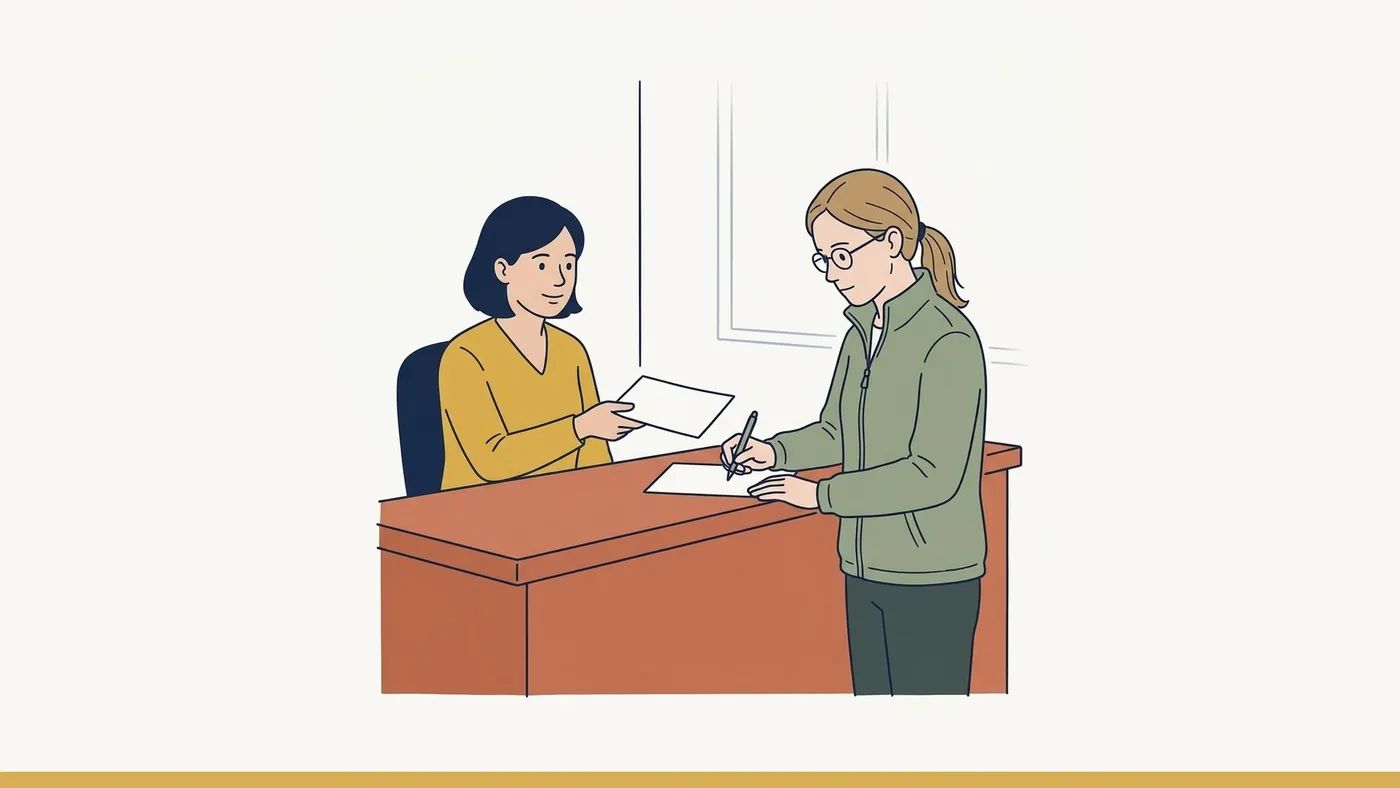
The lesson treats the article as part of the noun. The class describes a picture of the reception desk with a phrase bank in which every noun is printed with a, an or some: a form, an appointment, some advice, a piece of paper. A one-page reference sheet sets countable against uncountable and gives the rule in plain words: the first time, a form; the second time, the form.
A gap-fill tells the story of the form that came back, and every gap falls on an article or a quantifier. The word bank includes “no word here”, so a blank has to be a choice. The lesson ends with Marta retelling her afternoon: eight sentences with one mistake each (a appointment, furnitures, luggages, informations, an advice, much forms, many advice, a missing a) and two that are already right, one of them with “a piece of advice”, to catch learners who now distrust the word. The teacher notes say what to listen for at each stage.
Check yourself
Seven sentences have one mistake each and one is correct. Write the correct sentence, or write “Correct”.
- I'm looking for a flat with furnitures.
Answer
I'm looking for a flat with furniture.
- My sister is nurse.
Answer
My sister is a nurse.
- Can I ask you for an advice?
Answer
Can I ask you for some advice? (or: for a piece of advice / for advice)
- How many luggage have you got?
Answer
How much luggage have you got?
- The news are good.
Answer
The news is good.
- I bought a sofa yesterday. A sofa is blue.
Answer
I bought a sofa yesterday. The sofa is blue.
- She has an university degree.
Answer
She has a university degree.
- I need a piece of information about the train.
Answer
Correct.
A, an, the
Articles · countable nouns