All mistakes / B2
Formality without pan and pani: how to sound polite in English
Polish shows respect in the grammar: „Musi pan tu podpisać” is perfectly polite. English has only you, so politeness has to come from the words around it: “Would you mind signing here?”, “Could you let me know by Friday?”. Drop the pan, keep the rest, and you get “You must sign here”, which sounds like an order.
What it sounds like
What the mistake looks like
In a shop or a café, a Polish speaker at B2 is usually fine: could I have and I'd like are learned early, and the A1.3 guide covers them. The trouble starts in longer, more serious exchanges: negotiating with a landlord, writing to an agency, disagreeing at work. There the sentences come out grammatical and far too bare: “You must send the contract.” “I want an answer by Friday.” “You didn't understand me.”
To the Polish speaker these feel neutral, even polite, because in Polish pan or pani would have supplied the politeness. In English, without that layer, what is left sounds like an order or an accusation. The listener doesn't think you have a grammar problem. They think you are being difficult.
Why Polish causes it
Polish separates ty, for people you know well, from pan, pani and państwo for everybody else, with the verb in the third person: „Czy mógłby pan…?”, „Proszę pani, czy…”. This grammatical politeness does most of the work, so the rest of the sentence can stay direct. „Musi pan tu podpisać” and „Proszę mi to przesłać” are entirely polite in Polish.
English lost this distinction centuries ago: the familiar thou dropped out of standard English, and you now covers everyone, friend and stranger alike. Translate „Musi pan tu podpisać” and the pan simply vanishes, leaving “You must sign here”. Must and the imperative say nothing about respect, so the sentence lands as a command.
Polish speakers also tend to hear English softening as excessive, even insincere: “I was wondering if you could possibly…” sounds to a Polish ear like a lot of words for a small request. But in English those words are the equivalent of pan: they show that you are not taking the other person's agreement for granted.
The rule: politeness through word choice
English builds formality from a handful of small tools, and a polite sentence usually uses two or three at once.
Questions instead of statements: “Could you send the contract?” rather than “You must send the contract”. Would you mind + -ing is more formal still: “Would you mind signing here?”
The distance of modal verbs: could, would and might are softer than can, will and must. For a requirement, need to is softer than must: “You'll need to sign here” presents the signature as part of the process, not as your will.
The past and the continuous for distance: “I was wondering if…”, “I wanted to ask about the deposit.” The past tense here doesn't refer to the past; it just takes a step back.
Softeners: I'm afraid, I'm not sure, perhaps, a bit, just. “I'm afraid we can't agree to that tonight.” “I'm not sure that works for us.”
We and the passive, to take the pressure off the other person: “We'll need a signature”, “The form needs to be signed.” In a negotiation, phrases such as in principle, on the understanding that and I take the point, but… let you disagree without sounding hostile.
Titles: Mr, Mrs or Ms with the surname. Ms is the safe choice for a woman at work or when you don't know which she prefers; if she signs herself Mrs, use that. Don't put a title before a first name: not “Mr Tomek” (from „pan Tomek”), but Mr Nowak, or just Tomek. British workplaces move to first names quickly; follow the other person's lead.
A nuance: the imperative isn't banned. On forms, signs and in instructions, “Please sign here” is normal, because it is a step in a procedure, not a personal demand. What sounds wrong is a bare imperative or must aimed at someone whose agreement you need: a landlord, a colleague, a stranger.
How to practise and fix it
Collect whole sentences, not words: Would you mind…?, Could you let me know…?, I'm afraid…, I take the point, but…, In principle, yes. Keep them on a list and read it before a difficult phone call or email.
Check your emails for must, want and bare imperatives. Each has its place, but in a request to a landlord, an office or a colleague, turn it into a question or add a softener: “I want the keys on Friday” → “Would it be possible to have the keys on Friday?”
For teachers: treat a blunt request from a Polish learner as a missing phrase, not rudeness. Point at a phrase bank and let the learner say it again. A role play with something at stake, such as a negotiation or a complaint, brings the problem out far more reliably than a shopping dialogue.
How lesson B2.6 works on it
Lesson B2.6, “Four names on one lease”, is the last lesson of the course and takes 60 minutes. After the viewing of the flat above the café, the four have until six to agree how the rent is split, and nobody wants the smallest room. Its grammar is relative clauses, passives and reported speech; formality is handled through vocabulary and a role play rather than as a grammar point.
In the role play, “The smallest room”, pairs negotiate on role cards, Tomek against Isla, and each card comes with a phrase bank for exactly this, such as In principle, yes, but not like that, and I take the point, but I cannot sign off on that tonight. The teacher notes warn that a pair arguing in bare imperatives is following Polish „daj” and „zrób” into English, and that give me the ground floor sounds like a row to everyone but them. They say to treat a blunt request as a missing phrase, not rudeness, point at the bank and let the learner say it again with put forward.
The lesson ends with Marta's letter to the landlord: ten sentences to correct. Its mistakes are in relative clauses, passives and reported speech rather than politeness, but the whole letter is written in a formal register, and for one sentence the notes suggest asking learners which of two correct versions Marta would write to a landlord.
Check yourself
Rewrite each sentence so it sounds polite and suitably formal. Start with, or use, the words in brackets.
- You must sign the form. (Would you mind)
Answer
Would you mind signing the form? (or: Would you mind signing the form, please?)
- Tell me when the keys are ready. (Could you let me know)
Answer
Could you let me know when the keys are ready? (or: Could you let me know when the keys are ready, please?)
- I want to ask about the deposit. (I was wondering if I could)
Answer
I was wondering if I could ask about the deposit.
- We can't agree to that. (I'm afraid)
Answer
I'm afraid we can't agree to that.
- Send me the inventory by Saturday. (Could you)
Answer
Could you send me the inventory by Saturday? (or: Could you send me the inventory by Saturday, please?)
- Dear Mr Tomek, (his surname is Nowak)
Answer
Dear Mr Nowak,
- You have to pay the deposit before Friday. (You'll need to)
Answer
You'll need to pay the deposit before Friday.
- Yes, but not like that. (In principle)
Answer
In principle, yes, but not like that.
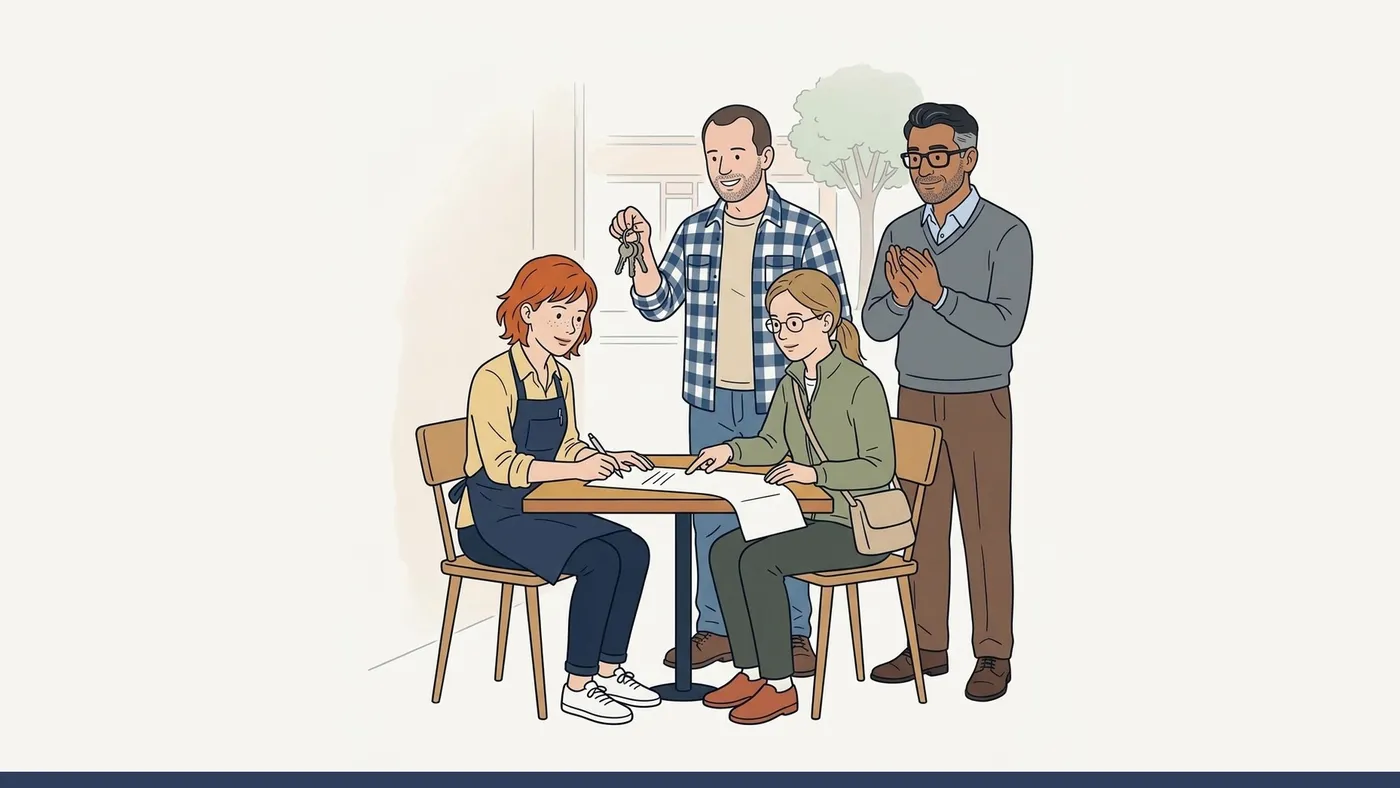
Four names on one lease
Relative clauses · passives