All mistakes / B2
I'm sorry, it seems to me: why English feelings need a subject
Polish puts the person who feels something in the dative and often leaves the sentence without a subject: „jest mi przykro”, „wydaje mi się”. English makes that person the subject, or brings them in with to: “I'm sorry”, “It seems to me”.
What it sounds like
What the mistake looks like
“Is sorry to me.” “It seems me that Tomek is right.” “It's a pity to me.” These come out when a Polish speaker talks about feelings, opinions and regrets: exactly the moments when you want to sound thoughtful. The listener usually understands, but the sentence sounds broken, and “Is sorry to me” can take a second to decode.
The mistake comes in a few shapes. Sometimes the subject is simply missing: “Is cold”, “Is sorry to me”. Sometimes an empty it appears, but the person is attached the Polish way, with to or with nothing: “It seems me”, “It is a pity to me”. And sometimes the whole sentence is built backwards, following a Polish verb where the person is only „mi”: „Brakuje mi rodziny” becomes “It's missing me my family” instead of “I miss my family”.
Why Polish causes it
Polish has a whole family of sentences with no grammatical subject, where the person who experiences something stands in the dative: „Jest mi przykro”, „Zimno mi”, „Szkoda mi go”, „Wydaje mi się, że…”, „Nie chce mi się”, „Wstyd mi”. Nobody is doing anything: the feeling simply happens to you. Translated word for word, „mi” becomes “to me” or “me”, „jest” becomes “is”, and the missing subject either stays missing or turns into an empty it.
A second group does have a subject, but it is the thing, not the person: „Podoba mi się ten film”, „Smakuje mi ta zupa”. English turns these round and makes the person the subject: “I like this film”, “I like this soup”. It does the same with subjectless „Brakuje mi domu” and „Chodzi mi o to, że…”: “I miss home”, “What I mean is…”.
An English sentence can't do without a subject, as the A1.1 guide on dropped subjects explains. The difference here is that adding it doesn't help: “It is sorry to me” is no better. The person has to move into the subject position.
The rule: the person who feels is the subject
Three patterns cover almost everything.
1. The person as subject + be + adjective: I'm sorry, I'm cold, I'm bored, I'm ashamed, I'm glad, I'm thirsty. „Jest mi przykro”, „zimno mi”, „nudzi mi się”, „wstyd mi” and „chce mi się pić” all fit this one shape. (Saying “I have cold” is a different mistake, covered in the guide for lesson B1.4.)
2. The person as subject + an ordinary verb: I like it („podoba mi się”), I miss you („brakuje mi ciebie”), I managed to („udało mi się”), I feel sorry for him („żal mi go”), I don't feel like it or I can't be bothered („nie chce mi się”), I care about it („zależy mi na tym”).
3. Empty it + verb + to me, where English keeps the thing as the subject: It seems to me, It occurs to me, It doesn't matter to me, It's all the same to me. Seem and matter need to before the person; “seem me” is never possible. “It seems to me” is also a careful, slightly formal way of giving an opinion; in conversation “I think” often sounds more natural.
Pity and shame don't take to me: “It's a shame (that) nobody came”, “What a pity”. If you want to say how you feel, switch to pattern 1: “I'm sorry nobody came.” Keep the meanings of sorry apart as well: “I'm sorry” apologises or sympathises, while “I feel sorry for him” is „żal mi go”.
How to practise and fix it
Learn the English sentence, not a translation of the Polish one. Make a short list of your own Polish favourites (wydaje mi się, szkoda, przykro mi, nie chce mi się, podoba mi się) and write a whole English sentence next to each: „wydaje mi się” → It seems to me, or I think.
Check the first word. If your sentence starts with Is, To me or Me, stop: English needs a subject in front of the verb, and for feelings it is usually I.
Practise reactions out loud, because in conversation they have to come fast: I'm sorry to hear that. What a shame. It seems to me that… I don't mind.
For teachers: board the English frames before a discussion about opinions or regrets starts, and leave them up. When a learner says “It is a pity to me”, say the sentence back correctly and move on; a side-by-side comparison in the middle of a turn stops the conversation.
How lesson B2.2 works on it
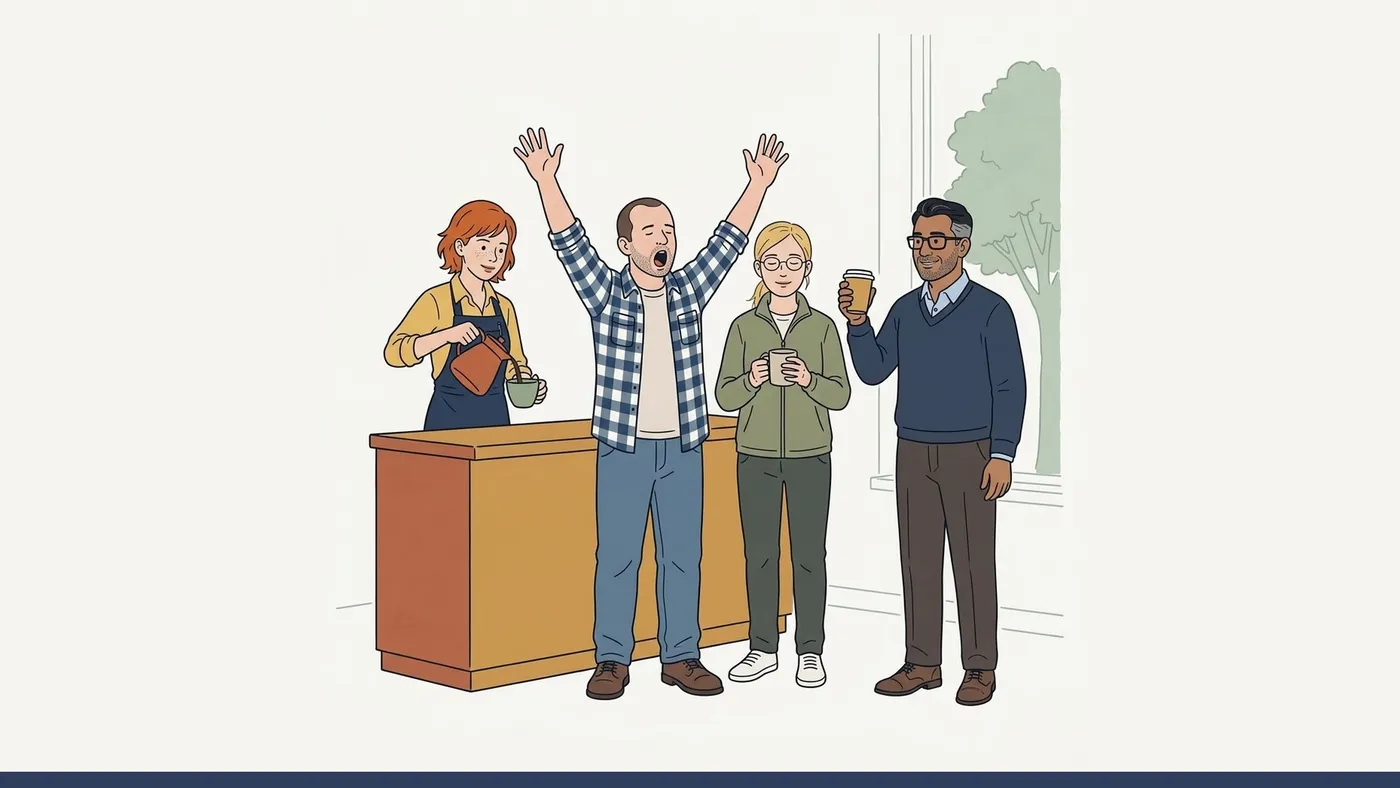
Lesson B2.2, “I wish we'd started sooner”, takes 50 minutes. It is the café's first week: on the first morning nobody came, because the leaflets that should have told the neighbours are still boxed by the door. The grammar is I wish, if only and mixed conditionals, and a lesson about regret gives these dative sentences plenty of openings, so it plans for them.
The teacher notes for the opening picture task expect „szkoda mi” to come out as “It is a pity to me that nobody came” and „wydaje mi się” as “It seems me”. They say to give the line back as “It's a shame nobody came” or “It seems to me that nobody knew”, without putting the two versions side by side. The reference sheet lists both among its four mistakes, with the fix: a pity never takes to me, and seem needs to before the person.
Before anyone voices a regret of their own, the notes say to board two frames, It's a shame we didn't and It seems to me, and leave them up. In the closing discussion the teacher adds “I'm sorry I didn't” to the board before the groups start, listens for „żal mi” and „szkoda mi” turning into “it is a pity to me” or “is sorry to me”, and doesn't stop anybody mid-turn. There is no separate exercise on these sentences: the lesson corrects them as they come.
Check yourself
Rewrite each sentence in correct English with the same meaning. One sentence is already correct: write “Correct”.
- Is sorry to me, I can't come on Friday.
Answer
I'm sorry, I can't come on Friday. (or: Sorry, I can't come on Friday.)
- It seems me that the café is too small.
Answer
It seems to me that the café is too small. (or: I think the café is too small.)
- It is a pity to me that you're leaving.
Answer
It's a shame you're leaving. (or: It's a pity you're leaving. / I'm sorry you're leaving.)
- Is cold to me in this room.
Answer
I'm cold in this room. (or: I feel cold in this room.)
- To me is all the same.
Answer
It's all the same to me. (or: I don't mind.)
- It's missing me my family.
Answer
I miss my family.
- Is boring to me at this party.
Answer
I'm bored at this party. (or: This party is boring.)
- It doesn't matter to me where we sit.
Answer
Correct.
I wish we'd started sooner
Wish · mixed conditionals