All mistakes / A1
There is a bed, not “There is bed”: articles with there is and there are
After there is, a singular countable noun needs a or an: “There is a bed”, never “There is bed”. After there are, a number, some or any usually follows, and there stays in the sentence even when you mention a place: “There are two boxes under the bed.”
What it sounds like
What the mistake looks like
A Polish speaker walks into an empty flat and reports what they see: “There is bed. There is kettle. In the kitchen is cupboard.” Every word is right, but each sentence is missing something small.
The mistake usually comes in three parts. The article disappears: “There is bed”, “Is there lamp?” The opening there disappears too, and the place moves to the front: “On the floor is kettle.” And sometimes the verb stops agreeing with the noun: “There is two boxes under the bed.”
This guide is about the pattern every beginner needs on the first day, so for the full rules of a, an and the, see the guide to articles and uncountable nouns (lesson A2.1).
Why Polish causes it
Polish has no articles, and it describes a room with the verb być alone: „Jest łóżko. Jest czajnik.” Nothing stands in front of the noun, so “There is bed” sounds complete.
Polish also likes to start with the place: „Na podłodze jest czajnik”, „W kuchni jest pusta szafka”. Translated word for word, that gives “On the floor is kettle”, with no there anywhere, because Polish has nothing that corresponds to it. In this pattern English there means nothing at all. It fills the subject position, so that English can keep its fixed order: subject, verb, the rest.
The negative and the question are built differently too. Polish says „Nie ma zasłon”, with nie ma and the genitive and no trace of jest. English keeps the same frame and makes it negative: “There aren't any curtains.” Polish can ask „Jest czajnik?” with rising intonation alone, while English turns the words round: “Is there a kettle?”
The rule in English
Singular countable noun: there is a or an. “There is a bed.” “There's an empty cupboard in the kitchen.” The short form there's is normal in speech and in most writing. A or an depends on the next sound: a cupboard, but an empty cupboard.
Plural: there are, usually followed by a number, some, any, no or many, though the plural noun alone is also fine: “There are boxes everywhere.” “There are two boxes under the bed.” “There are some cups in the cupboard.” Negative: “There aren't any curtains” or “There are no curtains.” Questions: “Are there any cups?”, “How many rooms are there?”
Uncountable noun: there is, often with some, any, much or no, and never a. “There's some water in the kettle.” “Is there any milk?” “There isn't much space.”
Order: there first, then the verb, then the thing, then the place. You can put the place at the front for emphasis, and “In the kitchen there's an empty cupboard” is good English, but there stays in the sentence. “In the kitchen is a cupboard” belongs to careful written description; in everyday speech it sounds odd.
Two nuances. First, there is introduces something new, so it goes with a, some or a number. For something the listener already knows about, use the and an ordinary sentence: “Where's the kettle?” “It's on the floor.” Second, in relaxed speech many native speakers say “There's two boxes”. You will hear it, but in writing and in exams use there are with a plural.
How to practise it
Learn there is a as one block, the way you learn a greeting: there's a kettle, there's a lamp, there's a window. Don't build it from parts every time. Once the block is automatic, the article comes with it.
Describe the room you are sitting in, out loud, in five sentences, and start every one with There: “There's a window. There are two chairs. There isn't a lamp.” Then ask three questions about it: “Is there a…?”, “Are there any…?”, “How many… are there?”
Learn new nouns with their article: not “kettle” but “a kettle”, not “cupboard” but “a cupboard”.
For teachers: at A1 there is no need to teach the article system to fix this. It helps to present every noun with its article and to recast rather than explain: when a learner says “On the floor is kettle”, say “There's a kettle on the floor” and let them repeat it. A sentence that starts with the place can stay, as long as there is in it.
How lesson A1.2 works on it
Lesson A1.2 of English for Polish Adults, “The empty flat”, takes 50 minutes. It is the first morning in flat 4B, above the shops on Mill Street in Blackwell: one bed, one kettle, an empty cupboard and no curtains.
The lesson deliberately does not teach the article rule; that comes in A2.1. Instead the article travels with the word. In the opening picture dictionary every item is written and said whole: a kettle, an empty cupboard, the stairs. In the substitution table the left column reads “There is a kettle”, “There isn't a lamp”, “Is there a cup”, “There are two boxes”, “Are there three bags” as single blocks, and the right column supplies the place, so there is always at the front. In the sentence unscramble learners put the opening at the front by hand, and the items include questions with any and how many and a negative with no.
The lesson ends with noughts and crosses in two teams: a square is won only with There are, the right number in words and a place. The article is not scored there. The teacher notes say that if a learner asks about the small word in front of the noun, the answer is that it comes with the word, and the class moves on.
Check yourself
Seven sentences are wrong and one is correct. Write the correct sentence, or write “Correct”.
- There is sofa in the living room.
Answer
There is a sofa in the living room.
- On the table is laptop.
Answer
There is a laptop on the table. (or: On the table there's a laptop.)
- Is there shop near here?
Answer
Is there a shop near here?
- There is two bags upstairs.
Answer
There are two bags upstairs.
- There isn't curtain in the bedroom.
Answer
There isn't a curtain in the bedroom. (or: There's no curtain in the bedroom.)
- There is a old lamp next to the bed.
Answer
There is an old lamp next to the bed.
- Are there any cups in the cupboard?
Answer
Correct.
- There is a milk in the fridge.
Answer
There is some milk in the fridge. (or: There is milk in the fridge.)
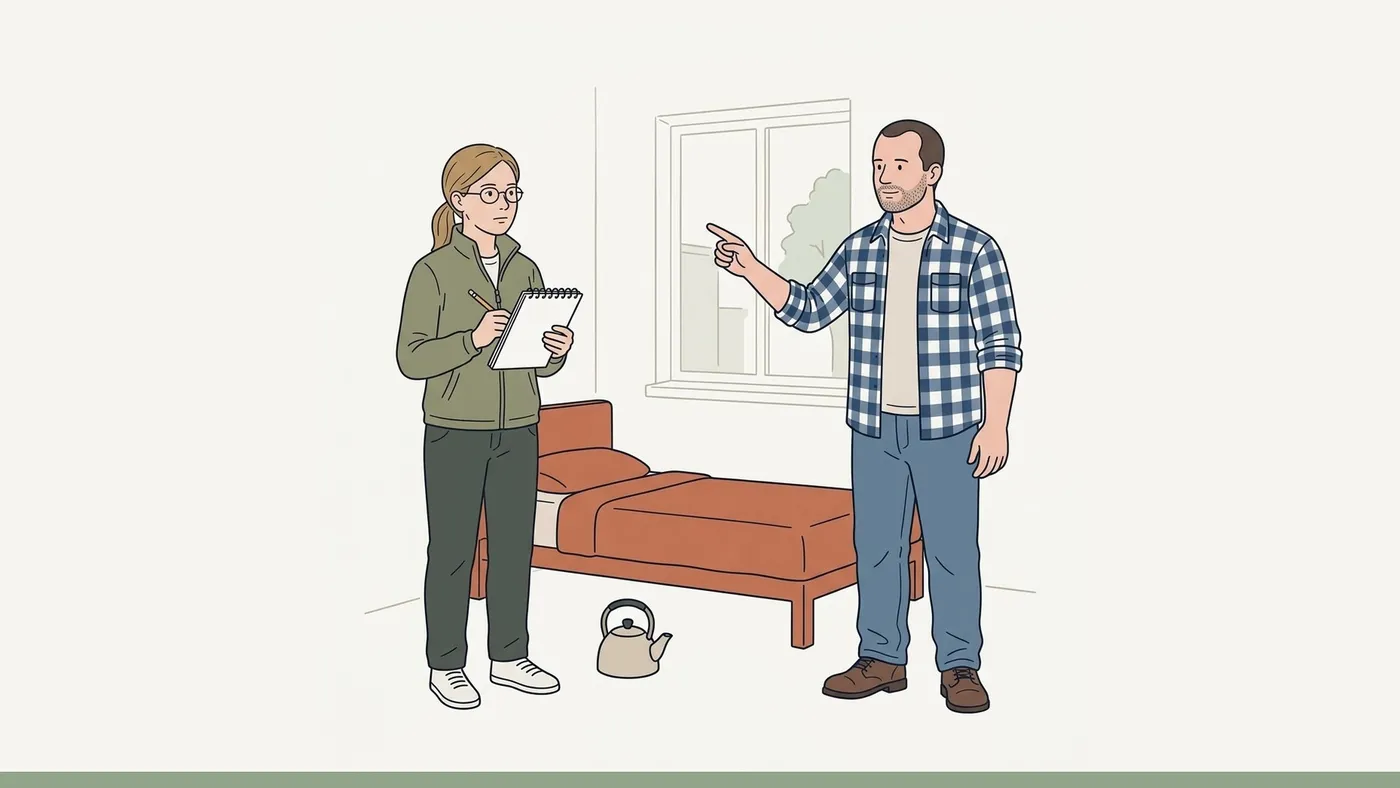
The empty flat
There is / there are